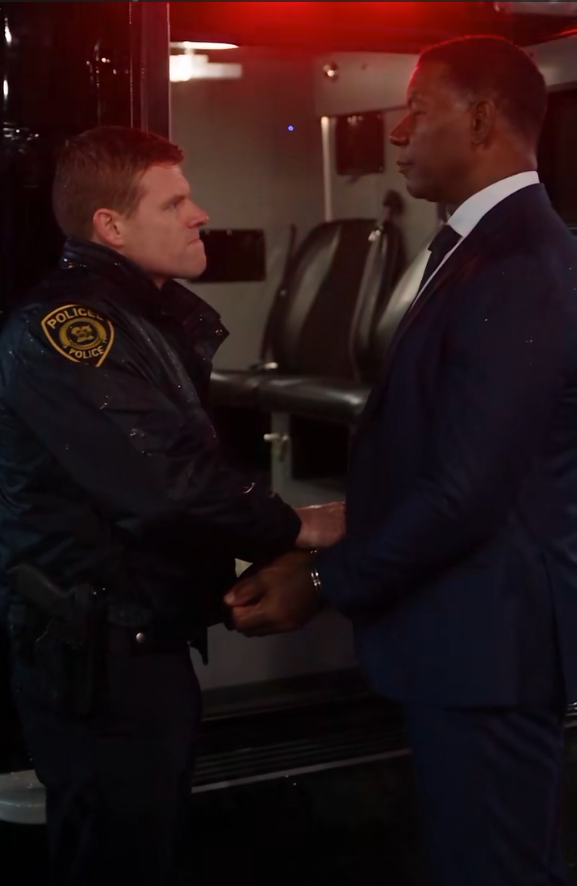
Lieutenant Ellis asked Jenkins for his account.
David was not present for the interview.
He did not need to be.
Higgins was.
And what Higgins said changed the investigation.
At 5:05 a.m., Ellis came into Miller’s office, where David was waiting for a ride.
“Do you have another ten minutes?”
“I’ve been awake for three days. Ten minutes has lost meaning.”
She sat.
“Higgins says Jenkins never attempted credential verification on scene.”
“I know.”
“He also says Jenkins told dispatch not to run the federal number because he believed the credential was fake.”
David frowned.
“That’s different.”
“Yes.”
“Different how?”
“He didn’t fail to verify it.”
Ellis folded her hands.
“He deliberately chose not to.”
David said nothing.
She continued.
“Higgins says he requested permission twice to call a supervisor.”
David’s eyes narrowed.
“And?”
“Jenkins told him not to.”
That changed the shape of the stop.
Until then, David had viewed Jenkins as a young officer who had allowed suspicion, ego, and poor judgment to compound.
Now there was intent in the chain.
Not necessarily intent to harm David.
But intent to prevent facts from interfering with a conclusion.
David leaned back.
“What reason does Jenkins give?”
“He says he believed verification could alert an accomplice if the credential belonged to someone involved in criminal activity.”
David stared at her.
“That makes no operational sense.”
“I know.”
“Did he articulate that on scene?”
“No.”
“Write it afterward?”
“Not before Higgins gave his statement.”
David looked toward the window.
Morning had not yet reached the sky.
“What did the body camera capture?”
Ellis hesitated.
David turned back.
“What?”
“Jenkins’s camera has a gap.”
“How long?”
“Fourteen minutes.”
David’s face went still.
“When?”
“Beginning shortly after he first looked at your federal identification.”
David said nothing.
“His camera resumes after you’re cuffed.”
“What about Higgins?”
“His was running.”
David watched her.
“Audio?”
“Yes.”
“Video?”
“Mostly passenger-side angle.”
“But it captured the stop.”
“Enough of it.”
David lowered his eyes.
There it was.
The first real reversal.
Not the credential verification.
Not the phone call.
Not the alert.
The rookie.
Higgins had been uncertain, frightened, and passive at the most important moment.
But his camera had remained on.
Ellis said, “There’s more.”
David waited.
“Higgins’s microphone recorded Jenkins asking him, before they reached your vehicle, ‘What do you think this guy does for a living?’”
David looked at her.
“And Higgins?”
“He said he didn’t know.”
Ellis paused.
“Jenkins said, ‘Driving this thing out here at two in the morning? We’ll find out.’”
The room seemed smaller.
David considered the sentence.
Not proof of racial motive.
Not proof of unlawful intent.
But a clue about the officer’s mindset before the first word was exchanged.
“What was the stated reason for the stop?”
“Failure to maintain lane.”
“And dash video?”
“We’re reviewing it.”
“Preliminary?”
Ellis breathed out.
“You appear to stay within your lane.”
David nodded once.
Ellis watched him.
“That’s the first time tonight you’ve looked angry.”
“I’m tired.”
“That wasn’t tired.”
David looked at her.
“No. It wasn’t.”
Silence sat between them.
Finally he said, “Don’t overstate what you have.”
Ellis seemed surprised.
“Excuse me?”
“The comment before the stop is suggestive. It is not conclusive. The body-camera gap is serious. It is not automatically intentional. The lane video needs technical review. Do not build your conclusion before you finish the evidence.”
Ellis stared at him.
“He arrested you.”
“I know.”
“You’re protecting him?”
“No.”
“Then what are you doing?”
David stood.
“My job.”
“You’re not on duty.”
“I’m always responsible for how I treat evidence.”
He picked up his coat.
“If Jenkins did exactly what this appears to show, you won’t need exaggeration.”
Ellis leaned against the desk.
“And if he didn’t?”
“Then you’ll be glad you didn’t exaggerate.”
She gave a tired, humorless laugh.
“You know what the worst part is?”
“What?”
“You’re making this harder.”
“Good investigations are harder.”
“I meant emotionally.”
David put on his coat.
“That part is your problem.”
Outside, dawn had turned the sky gray.
The rain had softened.
Hale waited beside a government sedan.
David climbed into the passenger seat.
For several minutes, neither man spoke.
Then Hale said, “You want home?”
“Yes.”
“Headquarters wants you downtown.”
“No.”
“Deputy director.”
“No.”
“Counsel.”
“No.”
“Professional responsibility.”
“No.”
Hale glanced at him.
“You planning to say no until I run out of departments?”
“Yes.”
“Home it is.”
They drove.
The world looked ordinary.
Traffic lights changed.
Delivery trucks moved through intersections.
People stood under umbrellas waiting for buses.
David watched them and thought about how close he had come to becoming a story other people would tell before he had even slept.
He hated that.
Not because he feared scrutiny.
Because narratives moved faster than facts.
Secret Service chief arrested.
Black federal official handcuffed.
Police misconduct.
National security incident.
Each phrase contained part of the truth.
None contained the whole.
His phone buzzed.
Hale glanced over.
“You going to answer?”
David looked at the screen.
Deputy Director Thomas Keane.
He answered.
“Harrison.”
“Tell me you’re not asleep in a car.”
“I’m awake in a car.”
“That’s not better.”
David closed his eyes.
“Good morning, Tom.”
“I’ve had a very bad morning.”
“I noticed.”
“Are you injured?”
“No.”
“Media doesn’t know yet.”
David opened his eyes.
“Yet?”
“The county has a leak problem.”
“Most institutions do.”
“Professional responsibility wants to coordinate.”
“Coordinate what?”
“Federal response.”
“There is no federal response.”
“David.”
“It’s a local police incident with a federal employee as the subject and some equipment-handling implications.”
“You’re the SAC of Presidential Protection.”
“I was still the SAC before he stopped me.”
“That is exactly the point.”
“No. That is exactly why we should be careful.”
Keane went quiet.
David continued.
“If our reaction becomes bigger because of my title, we undermine the very thing we’re going to criticize.”
Hale glanced at him.
Keane said, “You were handcuffed with valid credentials.”
“Yes.”
“A local officer handled your secure device and duty weapon.”
“Yes.”
“He searched an armored government vehicle.”
“Yes.”
“Do you hear yourself?”
“I hear every word.”
“What do you want me to do?”
“Secure our systems. Preserve records. Cooperate with their investigation. Do not make this a federal spectacle.”
Keane sighed.
“You’ve been awake how long?”
“Not relevant.”
“It is to me.”
“I’m going home.”
“Good.”
“I’m turning my phone off.”
“Better.”
“Call me only if the president is moving unexpectedly or someone has declared war.”
“Very funny.”
“I wasn’t joking.”
David hung up.
Hale drove another block.
Then said, “You know the press is going to get it.”
“Yes.”
“And when they do?”
David looked out the window.
“I’ll deal with that after I sleep.”
He slept for six hours.
When he woke, his story had a headline.
His wife was sitting at the edge of the bed holding a phone.
David opened one eye.
“How bad?”
She handed him the screen.
LOCAL OFFICER DETAINED SENIOR SECRET SERVICE OFFICIAL DURING LATE-NIGHT TRAFFIC STOP.