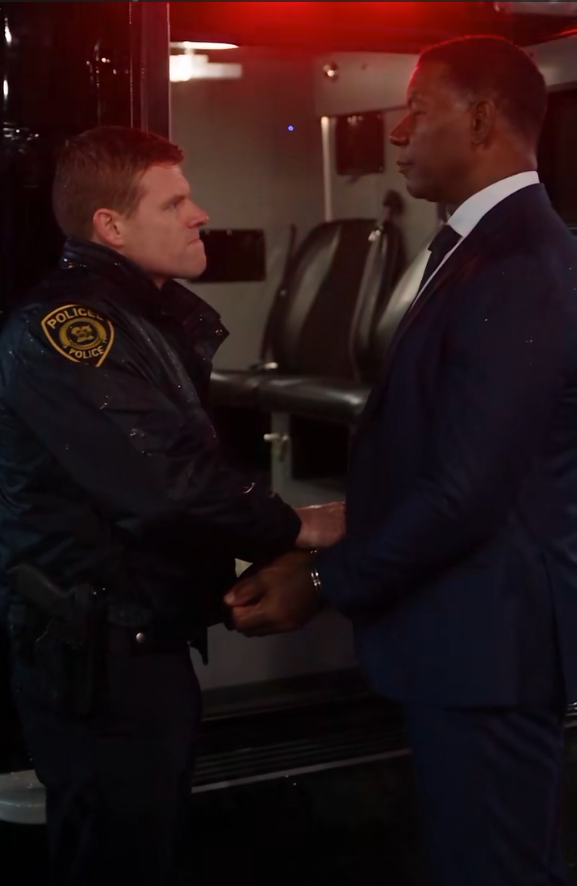
Below it was a blurred photograph of the precinct.
No body-camera footage.
No photograph of David in cuffs.
Yet.
He sat up.
“Who leaked it?”
“Does it matter?”
“Yes.”
“To you, apparently.”
David took the phone.
The article was cautious.
Unnamed law-enforcement sources.
No allegation of racial profiling.
No claim that David had resisted.
It reported an internal investigation and noted that federal officials had confirmed “an incident involving a senior Secret Service official.”
His wife crossed her arms.
“You look disappointed.”
“I’m relieved.”
“That’s your relieved face?”
“This is a restrained article.”
She looked at his wrists.
The marks had darkened.
“Your hands look worse.”
“They don’t feel worse.”
“That isn’t what I said.”
He set the phone down.
She studied him.
“You’re going back to work.”
“Eventually.”
“Today.”
“Yes.”
“You slept six hours after being awake for three days and arrested.”
“Temporarily detained.”
She stared at him.
He gave up.
“Arrested.”
“Thank you.”
He stood.
She remained seated.
“David.”
He turned.
“What are you going to do?”
“About what?”
“The officer.”
He leaned against the dresser.
“I don’t know.”
“You always know.”
“No. I usually know what decision has to be made. That’s different.”
She watched him carefully.
“Are you angry?”
“Yes.”
The answer surprised both of them.
She said, “At him?”
David looked at the fading line on his wrist.
“At the choices.”
“That sounds like you.”
“What does that mean?”
“You turn people into decisions when you don’t want to think about the people.”
He almost objected.
Then stopped.
She continued.
“You don’t have to forgive him because you’re senior to him. And you don’t have to destroy him because you can.”
David looked at her.
“I don’t have the authority to do either.”
“You know what I mean.”
He did.
She stood.
“Just don’t hide inside procedure.”
He smiled faintly.
“That is an attack on my entire personality.”
“I’ve been married to you too long to waste time.”
She kissed his cheek and left.
David remained by the dresser.
On the phone, the headline refreshed.
A second article appeared.
Then a third.
The story was moving.
He looked once more at his wrists.
And for the first time since the traffic stop, he wondered whether the most difficult decision would not be what happened to Jenkins.
It would be what David chose to say when everyone demanded that the incident mean more—or less—than the evidence could prove.
Part IV — Reckoning
Three days later, David watched the full body-camera footage.
He had delayed it deliberately.
Not because he feared what he would see.
Because he wanted his own memory written and preserved before another angle contaminated it.
The internal affairs conference room was windowless.
Lieutenant Ellis sat at one end of the table.
Sergeant Miller sat beside her.
An agency attorney sat near David but had been told not to interrupt unless necessary.
Higgins was not present.
Jenkins was not present.
A monitor filled the wall.
Ellis pressed play.
The roadside returned.
Rain.
Glare.
David’s Tahoe.
Higgins’s breathing audible near his microphone.
Jenkins’s voice, faint at first.
“What do you think this guy does for a living?”
Higgins: “No idea.”
“Driving this thing out here at two in the morning? We’ll find out.”
David did not move.
The video advanced.
License.
Credentials.
“Secret Service?”
David heard his own voice.
“Those are federal credentials. Run the number with your dispatch.”
“You don’t advise me.”
The room remained silent.
Higgins’s camera captured his own glance through the passenger window.
The reinforced frame.
The console.
Then his voice.
“Brad, maybe we should verify it.”
“Shut up.”
David watched himself get out.
Watched Jenkins pat him down.
Watched the discovery of the weapon.
“Gun!”
“I told you I’m a federal agent.”
The camera shook as Higgins moved around the hood.
“Brad, wait.”
Then the cuffs.
The angle did not show David’s hands clearly for the first second.
But it showed his shoulders.
Still.
It showed Jenkins pulling his arms upward.
Then:
“Stop resisting.”
David’s voice.
“I am not resisting.”
The conference room felt cold.
David had remembered the event with unusual clarity.
Still, seeing it from outside was different.
His own calm looked almost unnatural.
He understood now why Higgins had focused on it.
Ellis paused the footage.
“You okay?”
“Continue.”
She did.
Jenkins searched the Tahoe.
David warned him about classified-capable equipment.
Jenkins ignored him.
The footage showed Higgins looking away twice.
Once toward his cruiser.
Once toward the road.
A man searching for an exit he never took.
Then came the exchange David had not heard from inside the patrol car.
Jenkins and Higgins stood near the Tahoe.
Higgins said, “We should call Miller.”
Jenkins answered, “We’re not calling anybody until I know what this guy is.”
“He told you what he is.”
“He told me a story.”
“You have his ID.”
“Which could be fake.”
“So run it.”
Jenkins stared at Higgins.
“No.”
“Why?”
“Because I said no.”
The video ended several minutes later when they left the scene.
Ellis turned off the monitor.
David sat without speaking.
Miller rubbed his mouth.
The agency attorney wrote something on a pad.
Finally Ellis said, “There is dash camera too.”
“What does it show?”
“You did not cross the lane line.”
“Any movement that could reasonably support the stop?”
“You drifted within your lane once, approximately six inches toward center, then corrected.”
“In heavy rain.”
“Yes.”
“Speed?”
“Forty-four to forty-six.”
“Signal?”
“Proper.”
“Equipment?”
“Functional.”
David nodded.
Ellis opened a folder.
“There’s another piece.”
She slid a document across.
Jenkins’s initial arrest narrative.
David read.
The officer wrote that the vehicle had “weaved repeatedly,” that the driver had been “evasive regarding identity,” that David had “made movements toward the passenger compartment after being ordered to remain still,” and that during handcuffing he had “tensed and pulled away.”
David read it twice.
“Time filed?”
“Six seventeen that morning.”
“After Sergeant Miller verified my identity?”
“Yes.”
“After he knew Higgins’s body camera existed?”
“Yes.”
“He had not viewed it.”
“No.”
David set the document down.
This was worse than the stop.
Not emotionally.
Institutionally.
Bad judgment could be trained.
Fear could be corrected.
Inexperience could be supervised.
A false report after the facts were known was something else.
Miller said quietly, “That’s the piece I can’t get past.”
David looked at him.
Miller continued.
“You make a bad call on a wet road at two in the morning, I can at least understand how you get there. Doesn’t excuse it. But I can understand it.”
He tapped the report.
“This was written sitting at a desk.”
Ellis nodded.
“No rain. No darkness. No immediate threat.”
David said, “No urgency.”
“Exactly.”
The attorney beside him spoke for the first time.
“That report may create criminal exposure.”
David turned.
“Maybe.”
“It contains demonstrably false assertions.”
“That’s for the prosecutor.”
“David—”
“That’s for the prosecutor.”
The attorney stopped.
Ellis looked at David.
“You keep separating yourself from the outcome.”
“I’m trying to.”
“Why?”
David folded his hands.
“Because if I use my office to push for punishment, every decision afterward becomes suspect.”