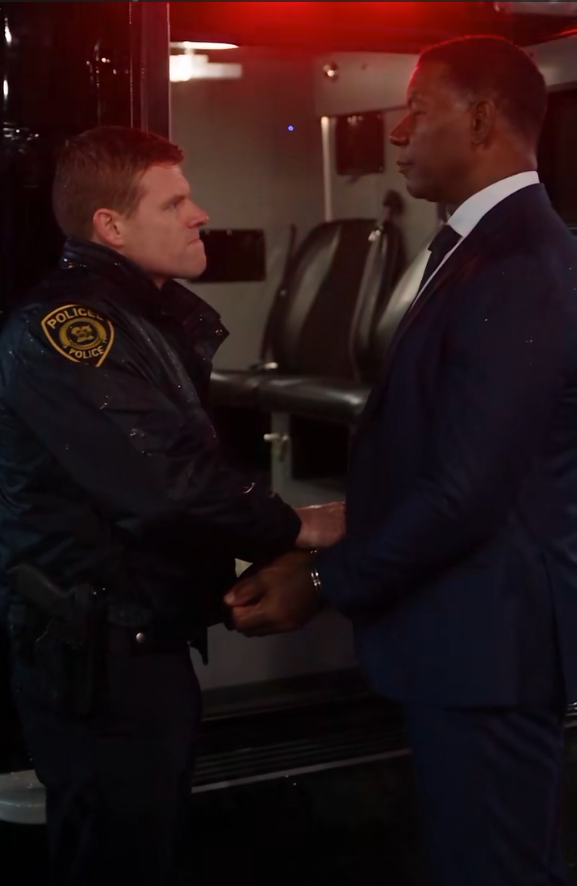
“You’re also the victim.”
“Yes.”
“You don’t lose your rights because you’re senior federal law enforcement.”
“No.”
“So why are you acting like your opinion is dangerous?”
David considered the question.
“Because it carries more weight than it should.”
Ellis sat back.
“That sounds noble.”
“It isn’t.”
“No?”
“No. It’s practical.”
He looked around the table.
“If I publicly demand his termination, everyone beneath your chief knows exactly what answer becomes easiest. If I publicly minimize what he did, same problem in the opposite direction.”
Miller said, “So you say nothing.”
“For now.”
Ellis studied him.
“Jenkins requested to speak with you.”
The room changed.
David’s expression hardened.
“No.”
“He asked through counsel.”
“No.”
“I told him I wouldn’t pass the request without asking.”
“You’ve asked.”
Ellis nodded.
“Fair enough.”
David stood.
Then stopped.
“Why?”
“Why does he want to speak with you?”
“Yes.”
Ellis glanced at Miller.
“He says he wants to apologize.”
David looked at the false report.
“Then he can start by correcting that.”
By the end of the week, Jenkins was placed on administrative leave.
His attorney issued a statement saying the officer had acted in good faith under difficult roadside conditions and that public judgment should wait for the investigation.
David agreed with the second half.
The public did not.
Once portions of Higgins’s body-camera footage became public through the department, the story spread nationally.
The clip was short.
Jenkins laughing at the Secret Service credential.
Higgins saying they should verify it.
Jenkins ordering David out.
The cuffs.
“Stop resisting.”
“I am not resisting.”
That was enough.
Television panels discussed the footage for hours.
Some focused on race.
Some focused on police training.
Some focused on David’s title.
Some argued that people should comply with police even when officers were wrong, apparently missing the fact that David had complied.
Others argued the incident proved the entire institution was corrupt, apparently uninterested in Higgins, Miller, or Ellis.
David watched none of it.
He read the reports.
He reviewed the timeline.
He went back to work.
At the White House complex, most people were smart enough not to mention it.
Those who did usually attempted humor.
One senior official glanced at David’s wrists and said, “You really know how to spend a night off.”
David answered, “I’m considering bowling.”
That ended the conversation.
But the incident followed him in subtler ways.
Agents looked at him differently.
Younger Black agents especially.
Not with pity.
With questions they had not yet asked.
One eventually did.
Her name was Special Agent Lena Brooks, six years into the job, assigned to a protective intelligence team.
She waited until a briefing ended.
“Sir?”
“Yes.”
“Can I ask something personal?”
“You can ask.”
“That’s not the same as answering.”
“No.”
She nodded.
“Did you tell the officer immediately that you were Secret Service?”
“Yes.”
“And he still cuffed you.”
“Yes.”
Brooks looked toward the empty conference room.
“What were you thinking?”
David almost gave the easy answer.
Training.
De-escalation.
Preserve safety.
Instead he said, “That I wanted to get home.”
She smiled faintly.
Then waited.
David continued.
“And that I knew exactly how quickly the situation could become worse.”
“Because you were armed?”
“Because he was.”
Brooks absorbed that.
David added, “And because he needed me to become what he had already decided I was.”
Her eyes moved back to him.
“What?”
“Uncooperative. Aggressive. Suspicious. Anything that made the next decision feel justified.”
Brooks was quiet.
“So you stayed calm.”
“Yes.”
“Were you scared?”
David looked at her.
There it was.
The question television panels could not answer.
The one rank did not erase.
“I was alert.”
“That’s not what I asked.”
He almost smiled.
“You’ve been around my wife?”
“No, sir.”
“You sound like her.”
Brooks waited.
David looked down at the table.
“Yes.”
She did not react visibly.
He continued.
“Not because I thought Jenkins intended to shoot me. I had no evidence of that. I was concerned because the stop had stopped responding to evidence.”
Brooks nodded slowly.
“That’s worse.”
“In some ways.”
She leaned against the chair.
“Does it bother you that people keep saying this happened to a Secret Service chief?”
“Yes.”
“Why?”
“Because it suggests the central mistake was that he chose the wrong person.”
Brooks watched him.
David said, “I don’t want a system where an officer pauses because the driver might be important.”
She completed the thought.
“You want him to pause because the driver might be telling the truth.”
“Exactly.”
Brooks gave a small nod.
“Thank you.”
“For what?”
“Answering the question I actually asked.”
She left.
David remained alone in the briefing room.
For several minutes, he looked at the empty chairs.
His wife had accused him of hiding inside procedure.
Brooks had just forced him out of it.
He did not like that.
Which probably meant he had needed it.
Part V — Final Confrontation
The investigation took nine weeks.
Long enough for public attention to move elsewhere.
Long enough for the bruising on David’s wrists to disappear.
Long enough for Jenkins’s face to stop appearing on television.
The department interviewed dispatchers, officers, supervisors, evidence personnel, and David twice more.
Technical experts examined the dash-camera video.
The stop lacked sufficient documented basis under department policy.
The body-camera interruption was traced to manual deactivation.
Jenkins claimed he had turned it off accidentally while adjusting his rain jacket.
The device logs showed the button had been pressed for the required duration.
Possible accident.
Not provable intent.
The false statements in the report were more difficult to explain.
Jenkins maintained that David had “tensed” during handcuffing and that his own recollection of lane movement differed from the camera perspective.
He eventually amended portions of the report.
Only after counsel became involved.
Then came the finding David had expected but not wanted to anticipate.
The department sustained multiple policy violations.
Improper stop justification.
Failure to verify identification.
Improper handling of federal equipment.
Unnecessary restraint.
Body-camera violation.
Inaccurate reporting.
The police chief scheduled a final administrative hearing before deciding discipline.
David was told he had the right to submit a victim impact statement.
He declined.
Then Higgins called him.
Not directly.
Through Miller.
“Agent Harrison,” Miller said, “I know you’re trying to stay out of this.”
“I am.”
“I need a favor.”
David leaned back at his desk.
“That sentence has never ended well.”
“Higgins is testifying at the disciplinary hearing.”
“That isn’t a favor.”
“He’s thinking of resigning.”
David was silent.
“Why?”
“Because he thinks he failed.”
“He did.”
Miller exhaled.
“I know.”
David rubbed his temple.
“What do you want from me?”
“Talk to him.”
“No.”
“David.”
“No.”
“He listens to you.”
“He spoke to me once.”
“Apparently that was enough.”
David looked through his office window.
Agents moved along the corridor beyond the glass.
“He has supervisors.”
“His supervisor that night put a federal agent in cuffs.”
“Jenkins was not his supervisor.”
“He was senior to him and acting like one.”
“That’s not the same thing.”
“You know what I mean.”
David closed his eyes.
“Why is he resigning now?”
“He says if he had done what he was supposed to do, none of it would’ve happened.”