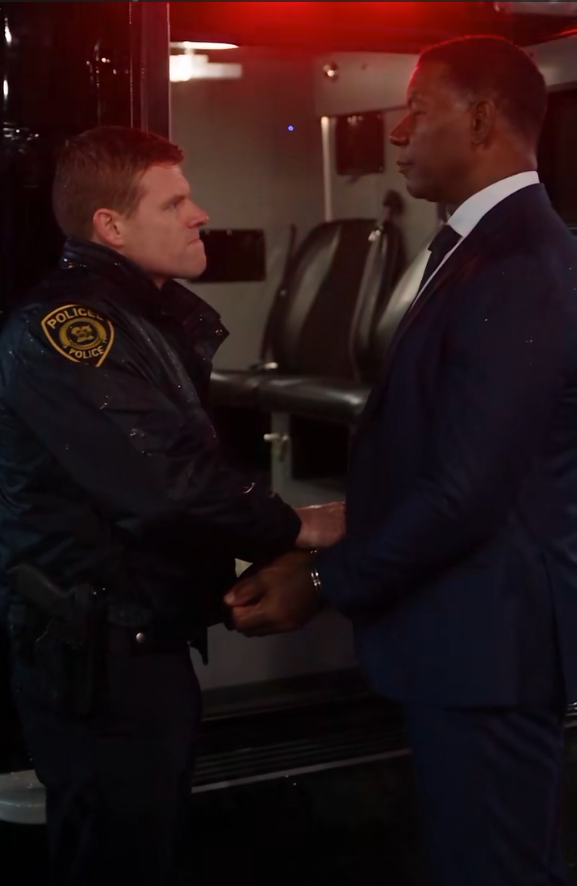
“That is partially true.”
“Exactly the kind of compassionate wisdom I hoped for.”
“You called the wrong man.”
Miller laughed despite himself.
Then his voice became serious.
“He’s a good kid.”
“That is not enough.”
“No.”
Miller paused.
“But maybe he can become a good officer.”
David looked at the clock.
“When is the hearing?”
“Tomorrow.”
“And you waited until now?”
“He told me today.”
David sighed.
“Give him my office number.”
“Thank you.”
“I did not say I’d change his mind.”
“I didn’t ask you to.”
“That is exactly what you asked.”
“Have a good night, David.”
Miller hung up.
David stared at the phone.
Ten minutes later, it rang.
“Harrison.”
“Sir. Officer Higgins.”
“Are you resigning?”
A pause.
“I was hoping to work up to that.”
“I’m tired.”
“Yes, sir.”
“So?”
Higgins breathed into the receiver.
“I don’t know.”
“That’s not an answer.”
“I think I should.”
“Why?”
“Because I froze.”
“You didn’t freeze.”
“I might as well have.”
“No. You objected three times.”
“And then I got in the cruiser.”
“Yes.”
“I watched him cuff you.”
“Yes.”
“I knew it was wrong.”
“You suspected it was wrong.”
“I knew.”
David let the distinction go.
Higgins continued.
“My camera is the reason everyone knows what happened.”
“Your camera was doing its job.”
“But I wasn’t.”
David sat forward.
“What do you think resignation fixes?”
Higgins said nothing.
“That wasn’t rhetorical.”
“I don’t know.”
“Does it make the stop unhappen?”
“No.”
“Does it make you more useful to the next person in that situation?”
“No.”
“Does it protect someone from a future bad decision?”
“No.”
“Then why resign?”
Higgins’s voice lowered.
“Because I’m not sure I deserve the badge.”
David looked at his desk.
That sentence mattered.
Not because it proved humility.
Because it could become another form of self-absorption if allowed to grow.
“Do you think the badge is a reward?”
“No.”
“Then whether you deserve it is not the right question.”
Higgins was silent.
David continued.
“The question is whether you can do the job better tomorrow than you did that night.”
“I don’t know.”
“Then find out.”
“How?”
“Training. Judgment. Speaking earlier. Knowing policy. Calling a supervisor before your partner makes the next mistake instead of after.”
Higgins took a breath.
“What if I freeze again?”
“You might.”
“That’s supposed to help?”
“It’s supposed to be true.”
David leaned back.
“No one can promise you that courage becomes automatic because you regret one failure.”
Higgins said nothing.
“But you already know what silence costs you,” David continued. “That gives you something you didn’t have before.”
“What?”
“A memory you won’t enjoy repeating.”
The line stayed between them.
Finally Higgins asked, “Would you want me to stay?”
There was the dangerous question.
A political question in miniature.
A moral burden disguised as permission.
David answered carefully.
“What I want is irrelevant.”
“It doesn’t feel irrelevant.”
“It needs to be.”
“Why?”
“Because if you stay to earn my approval, you’ll quit the first time you disappoint someone else.”
Higgins was quiet.
David said, “Make the decision based on whether you are willing to accept what happened without turning it into your identity.”
“I don’t know how.”
“You’re twenty-five.”
“Twenty-six.”
“Then you have time.”
Higgins laughed softly.
The first time David had heard him do it.
“Thank you, sir.”
“Don’t thank me yet.”
“For what?”
“You may decide to stay. Police work is hard.”
“I noticed.”
David almost smiled.
“Good night, Higgins.”
“Good night, sir.”
He hung up.
The next morning, David received another unexpected request.
This one from Jenkins.
Not through Ellis.
Through Jenkins’s attorney.
The disciplinary hearing had begun.
Jenkins wanted five minutes with David before final arguments.
No lawyers in the room.
No recording.
David’s first response was no.
His second was also no.
Then he read the attached note.
Not from the attorney.
From Jenkins.
Three sentences.
I wrote things in my report that weren’t true because I was scared of what would happen if I admitted I had been wrong. I kept making the stop worse because every correction felt like surrender. I am not asking you to help me keep my job.
David read it twice.
The final sentence made him reconsider.
Not forgive.
Not trust.
Reconsider.
He called Ellis.
“Is the hearing secure?”
“Yes.”
“Is Jenkins separated?”
“Yes.”
“Five minutes.”
“You sure?”
“No.”
“But you’re coming.”
“Yes.”
The conference room at police headquarters was larger than the Great Falls station office where David had first sat nine weeks earlier.
Jenkins was already inside.
No uniform.
Dark suit.
White shirt.
No tie.
He looked smaller without a duty belt.
Not physically.
Institutionally.
David entered alone.
The door closed behind him.
Jenkins stood.
David remained standing too.
For several seconds, neither spoke.
Finally Jenkins said, “Thank you for coming.”
“You have five minutes.”
Jenkins nodded.
He had rehearsed something.
David could see it.
Then he abandoned whatever it was.
“I was wrong.”
David waited.
Jenkins looked at the table.
“Not just about who you were.”
David’s eyes narrowed slightly.
Jenkins continued.
“I kept thinking that was the mistake. That I didn’t believe you were Secret Service.”
He looked up.
“That wasn’t the mistake.”
“No.”
“The mistake was deciding you were lying before I checked.”
David said nothing.
Jenkins swallowed.
“And then when Higgins pushed back, I got embarrassed.”
“You got angry.”
“Yes.”
“At him?”
“At both of you.”
“Why me?”
Jenkins looked away.
“Because you were calm.”
David almost laughed, but there was nothing funny in it.
“That made you angry?”
“It felt like you were looking down on me.”
“I was trying not to escalate the stop.”
“I know that now.”
“You knew enough then.”
Jenkins took that.
“Yes.”
David looked at him.
“Why did you turn off the body camera?”
Jenkins’s face changed.
There it was.
The unresolved fact.
The one finding the investigation had not established conclusively.
Jenkins looked at the closed door.
Then back at David.
“I turned it off on purpose.”
David felt nothing visible.
“Why?”
“I wanted to search the vehicle without Higgins’s camera catching me telling him to stay back.”
David’s voice went cold.
“You knew the search was questionable.”
“Yes.”
“And you did it anyway.”
“Yes.”
“Why?”
Jenkins’s eyes reddened, but he did not cry.
“Because by then I needed to find something.”
The sentence landed harder than an apology could.
David remained completely still.
Jenkins continued.
“If I found something, then I wasn’t wrong.”
David stared at him.
There was the entire incident reduced to its most dangerous truth.
Not racism proven.
Not corruption in the dramatic sense.
Not a conspiracy.
Something smaller.
More ordinary.
More frightening.
A man with authority trying to make reality justify his pride.
David asked, “Did you tell internal affairs?”
Jenkins hesitated.
“No.”
“Then why tell me?”
“Because they’re about to decide whether to fire me.”
“That is not an answer.”
Jenkins looked at him.
“Because if I walk out of that room with them believing it might’ve been an accident, then I’m doing the same thing again.”