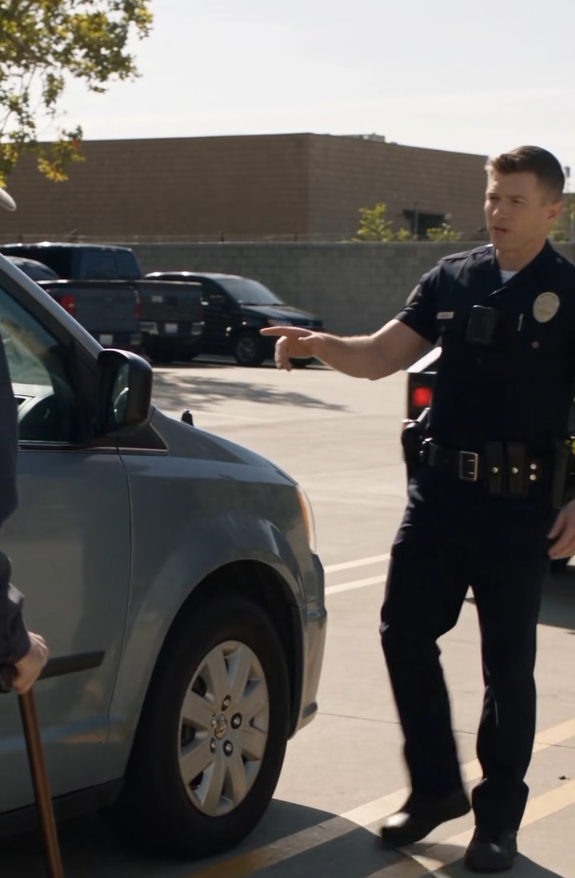
Griggs did not.
"Sir—"
"Canceled."
The driver turned toward his truck.
For one brief second, I thought that would be the end of it.
Wrong placard accusation.
Verification.
Embarrassed officer.
Canceled tow.
Everybody goes home with a story.
But pride hadn't finished with us.
Griggs pointed at me.
"He refused direction."
The supervisor stopped.
"What direction?"
"To move away from the vehicle."
"After the tow truck arrived?"
"Yes."
"Was he interfering?"
"He refused."
"That's not what I asked."
Griggs's face reddened.
"He was escalating the situation."
That was when several people actually murmured.
Not loudly.
Just enough.
I saw the supervisor notice.
He looked at me.
"Did you threaten Officer Griggs?"
"No."
"Touch him?"
"No."
"Raise your voice?"
"No."
"Anyone see otherwise?"
Nobody answered.
Then the man in the faded Marine cap said, "No."
A nurse near the sidewalk shook her head.
Another veteran said, "No, sir."
The tow driver had reached his cab.
He stopped with one hand on the door.
"No."
Griggs looked around.
His confidence didn't disappear.
It changed shape.
A cornered certainty is still certainty.
"You've got a crowd taking his side."
The supervisor said, "I've got witnesses."
That was the first time Griggs seemed to understand how far the morning had moved without him noticing.
He opened his mouth.
Before he could speak, two vehicles turned into the lot.
Not police cars.
Plain government sedans.
They parked near the curb.
Three people got out.
One wore an identification badge clipped to a jacket.
Another carried a tablet.
The third spoke briefly with the supervisor before looking in my direction.
Griggs frowned.
"Who are they?"
The supervisor didn't answer.
My phone vibrated.
Kincaid.
I answered.
"Yes?"
"You still there?"
"Apparently."
"Tow?"
"Canceled."
"Good."
He exhaled.
"Listen to me. Don't leave yet."
I looked toward the government vehicles.
"What did you do?"
"What you should've done fifteen minutes earlier."
"Which was?"
"Called somebody."
Despite myself, I smiled.
"Robert."
"Hank."
"I don't want a parade."
"You aren't getting one."
"I'm serious."
"So am I."
His voice softened.
"I called the facility administration office and asked for the veteran-patient liaison. Then I asked them to preserve any security footage covering that lot."
I stared at the nearest building.
That had not occurred to me.
Kincaid continued.
"I also told them an officer was attempting to tow a mobility vehicle belonging to a disabled patient after refusing verification."
"How many people did you call?"
"Enough."
"That's not an answer."
"You called me for help."
"I know."
"And I helped."
I looked at Griggs.
He was speaking quietly to the supervisor now.
The smirk was gone.
Kincaid said, "Are you safe?"
"Yes."
"Then stay calm."
"I am calm."
"You were calm when our transport caught fire."
"That was different."
"Not from where I was standing."
There was the old Kincaid.
Just enough dry humor to keep a bad moment from owning the room.
I looked down at my cane.
"I haven't talked to you in years."
"No."
"And the first thing I do is call you into some stupid parking dispute."
"It's not stupid if somebody can strand you."
I said nothing.
His next words came more quietly.
"You don't have to earn the right to ask for help, Hank."
That hit harder than anything Griggs had said.
I looked away from the crowd.
My wife used to tell me the same thing.
Different words.
Same accusation.
You're good at showing up for everybody else.
Terrible at letting anybody show up for you.
I cleared my throat.
"Don't get sentimental."
"Wouldn't dream of it."
A pause.
"The liaison may ask if you want to file a formal complaint."
"I haven't decided."
"Decide after you hear your options."
"You're giving orders again."
"Old habit."
"Bad one."
"Kept you alive."
"Debatable."
He laughed once.
It was a good sound.
Then his voice became serious.
"Hank."
"Yeah?"
"Don't make this about punishing him."
I looked at Griggs.
"Funny."
"What?"
"I was thinking the same thing."
"Good."
The call ended.
I slid the phone into my pocket.
The person with the clipped badge approached me.
"Mr. Delaney?"
"Yes."
"I'm with patient advocacy."
He introduced himself, but the name vanished from my memory almost immediately.
Not because he was unimportant.
Because my attention was fixed on Griggs.
The liaison explained that the facility wanted to document the incident, review the officer's contact, and ensure I could still attend my appointment.
"We can get you inside now."
I looked toward the medical center.
I had missed most of my scheduled slot.
"Will the van still be here?"
"Yes, sir."
"Then I'll go inside."
Griggs looked over.
Maybe he'd expected me to remain and demand his badge.
Maybe he wanted another confrontation.
I don't know.
I only knew I had not spent the morning fasting for blood work so I could miss it because one officer had made a bad decision.
I turned toward the entrance.
My first step sent pain up my hip.
The second was worse.
Stress does strange things to an old body.
The Marine in the faded cap moved toward me.
"Need an arm?"
Every reflex I had said no.
Then I remembered Kincaid.
You don't have to earn the right.
I nodded.
"Just to the curb."
The Marine offered his forearm.
I took it.
We walked.
Behind us, the tow truck started to pull away.
I didn't look back until I reached the automatic doors.
Griggs was still standing beside my van.
For the first time all morning, he wasn't smiling.
Part III — The Record
The blood draw took seven minutes.
The consequences took longer.
I sat afterward in a small examination room with a paper-covered table, two plastic chairs, a sink, and a poster explaining fall prevention to people who already knew far too much about falling.
My cane leaned against my knee.
The patient liaison sat across from me with a tablet.
"You don't have to do this today," he said.
"Do what?"
"Give a statement."
"I remember what happened today."
"That's not what I mean."
"I know."
He nodded.
I appreciated that he didn't pretend we were discussing forms.
Formal complaints have weight.
Especially when uniforms are involved.
They turn ugly moments into records.
Records create obligations.
Obligations create investigations.
Investigations change careers.
I had spent enough years around institutions to understand that the truth of an incident and the consequences of reporting it are separate things.
He placed the tablet on his lap.
"Would you like to proceed?"
I looked at the blank wall for a while.
"What happens if I don't?"
"The contact may still be reviewed because a supervisor responded."
"But no formal complaint from me."
"Correct."
"And if I do?"
"Your statement becomes part of the review."
I stared at my hands.
They had changed over the years.
Veins more visible.
Knuckles larger.
Old scars paler.
Hands that had once carried field equipment, rifles, stretchers, children, groceries, my wife's suitcase, the steering wheel on a thousand ordinary drives.
Now one of them sometimes shook when I was tired.
Griggs had seen that hand and made a decision about the man attached to it.
"What do you think I should do?" I asked.
The liaison didn't hesitate.