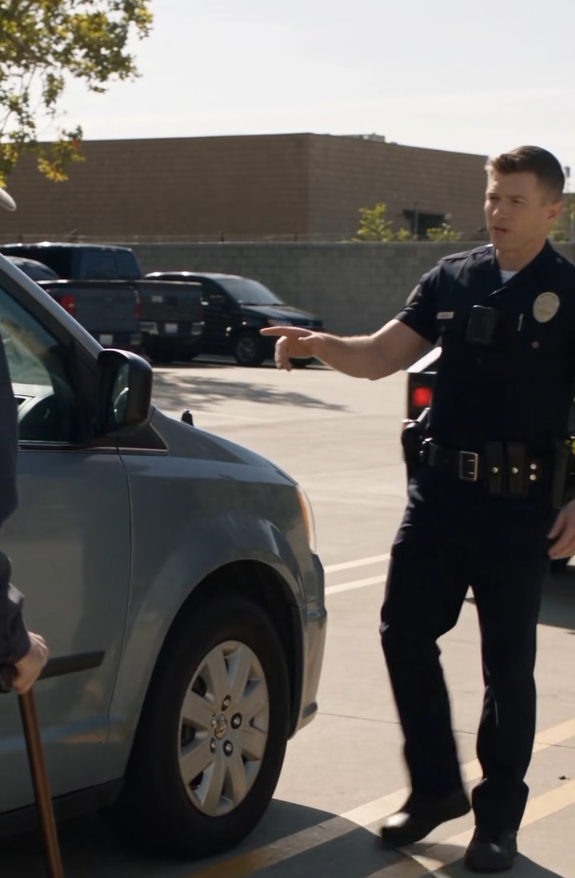
"I can't decide that for you."
Good answer.
I looked up.
"Was his camera running?"
The liaison's expression changed slightly.
"His body-worn camera?"
"Yes."
"I've been told there is footage."
"From the beginning?"
"I don't know yet."
"Parking cameras?"
"Also being preserved."
That was Kincaid's work.
I could picture him on the phone, refusing to be impressed by titles, repeating one phrase until somebody acted.
Preserve the footage.
Not punish the officer.
Not send a general.
Not make threats.
Preserve the facts.
Age had made him smarter too.
I leaned back.
"What happens if the camera proves exactly what I said?"
"Then the review has evidence."
"And if I file nothing?"
He took a second before answering.
"The department can still act on its own."
Can.
Not will.
I understood the difference.
"Give me the statement form."
He handed me the tablet.
I began.
I did not write that Griggs was cruel.
I wrote what he said.
I did not write that he was arrogant.
I described his refusal to run the plate.
I did not say he enjoyed humiliating me.
I recorded the smile, the crowd, the tow request, the words Photoshop exists.
Facts were enough.
That was something Griggs had never understood.
When I reached the line asking whether I believed I had been treated differently because of disability or veteran status, I stopped.
The liaison waited.
I read it again.
Believed.
That word asked for motive.
I couldn't see inside Griggs's head.
I knew what he'd said.
People like you.
Purple Heart plates don't make you special.
Wheelchair guy.
But I couldn't tell whether he resented veterans, disabled people, older men, people who challenged him, or simply anyone he thought he could dominate.
I selected: Unsure.
The liaison noticed.
"You can elaborate."
"I already did."
"You don't believe it was related?"
"I believe he judged me before checking anything."
"Based on what?"
"If I knew that, I wouldn't have marked unsure."
He nodded once.
Again, no argument.
I signed the statement.
There.
A decision.
It felt smaller than I expected.
He took the tablet.
"There's another issue."
"Of course there is."
"Officer Griggs alleged that you refused a lawful direction."
I looked at him.
"Am I being cited?"
"No."
"Detained?"
"No."
"Then what's the issue?"
"It's in his initial incident entry."
I let out a breath through my nose.
"Naturally."
"The supervisor did not substantiate it at the scene."
"But Griggs wrote it."
"Yes."
I looked toward the door.
"What exactly did he say I did?"
"Refused to step away from the vehicle during tow preparation and became verbally confrontational."
"Verbally confrontational."
"That's the phrase."
"Did the camera record me?"
"Likely."
"Then preserve that too."
"It already is."
I nodded.
"Good."
The liaison stood.
"Your physical therapy appointment has been moved. They can see you in forty minutes."
I almost laughed.
"After all this, you're still going to make me exercise?"
He smiled.
"Apparently."
"Government efficiency."
"I wouldn't go that far."
He left.
I sat alone.
The room became quiet again.
My phone showed two missed calls from Kincaid.
I called him back.
"Tell me you filed it," he said.
"Hello to you too."
"Did you?"
"Yes."
"Good."
"You sound pleased."
"I sound relieved."
"Why?"
"Because twenty years ago you would've decided it wasn't worth the trouble."
"Twenty years ago I could walk away faster."
He didn't laugh.
I knew what he was thinking.
My mobility had changed the mathematics.
A younger man can shrug off being ordered away from his car.
A younger man can call a cab, rent another vehicle, climb stairs, carry medication, adapt.
When independence becomes engineered around specific equipment, taking away that equipment doesn't inconvenience you.
It reorders your entire day.
Sometimes your week.
Sometimes your life.
Kincaid said, "They're reviewing the video."
"Already?"
"Apparently there are enough witnesses that people got interested."
"I hate that sentence."
"So do I."
"Robert."
"Yeah?"
"Don't interfere."
Silence.
"I'm serious."
"I haven't."
"You made calls."
"I made sure the process started."
"That's interference-adjacent."
A small sigh.
"What do you want from me?"
"If they call you, tell the truth."
"That's it?"
"That's it."
"No phone calls to anybody important?"
"No."
"No reminding people who I am?"
"I don't even know who you think you are."
That earned the laugh I wanted.
Then I said, "I mean it."
"I know."
"This needs to stand on what happened."
"It will."
I looked toward the closed door.
"Otherwise he'll learn the wrong lesson."
Kincaid understood immediately.
If Griggs believed he had been punished because I knew a colonel, then nothing essential would change.
He would not learn that the problem was what he'd done.
He would learn that he'd chosen the wrong target.
Those are very different lessons.
Kincaid's voice softened.
"That's why you're still you."
"Don't start."
"I'm hanging up."
"Good."
He did.
Physical therapy was miserable.
That helped.
There is something clarifying about being told to lift your leg while every muscle argues.
By the time I returned to the parking lot, the crowd was gone.
My van remained exactly where I'd left it.
Sunlight flashed from the windshield.
For a moment, the whole morning seemed impossible.
Then I noticed a business card tucked beneath the driver's-side wiper.
No message.
Just the tow company's number.
On the back, someone had written:
Didn't hook it. Hope you're okay.
I stood there reading those six words for a long time.
The driver hadn't made a speech.
Hadn't challenged Griggs dramatically.
Hadn't turned himself into a hero.
He had simply slowed the machinery down when something didn't feel right.
Sometimes that's enough to change what happens next.
I put the card in my wallet.
Then I climbed into the van and drove home.
I thought the worst part was over.
It wasn't.
Part IV — What the Camera Saw
Three days later, I received the call.
The review had become formal.
They wanted another interview.
This time I asked Kincaid to come with me.
Not as a colonel.
Not as an advocate.
As a friend.
He was waiting outside when I arrived.
I recognized him before he recognized me.
Age had narrowed him but not diminished him. White hair. Dark blazer. Straight posture. The old habit of scanning entrances before settling anywhere.
He looked toward my van.
Then he saw me.
For two men who had once trusted each other with things more important than comfort, we were remarkably awkward.
He opened his arms.
I stared at him.
"Absolutely not."
"Hank."
"We're grown men."
"So?"
"So act like one."
He hugged me anyway.
I tolerated it for approximately two seconds.
Then I pushed him away.
"You got sentimental."
"You got old."
"You're older."
"By eleven months."
"Ancient."
He looked at my cane.
His expression changed.
I saw the question.
I spared him from asking.
"Some days are better."
He nodded.
That was all.
A good friend learns which doors not to open for you.
We went inside.
The meeting room was plain and cold.
A supervisor from the department sat on one side of the table with an administrative representative and the patient liaison I'd met earlier.
Griggs was not there.
I noticed immediately.
The department supervisor began.
"Mr. Delaney, thank you for returning."