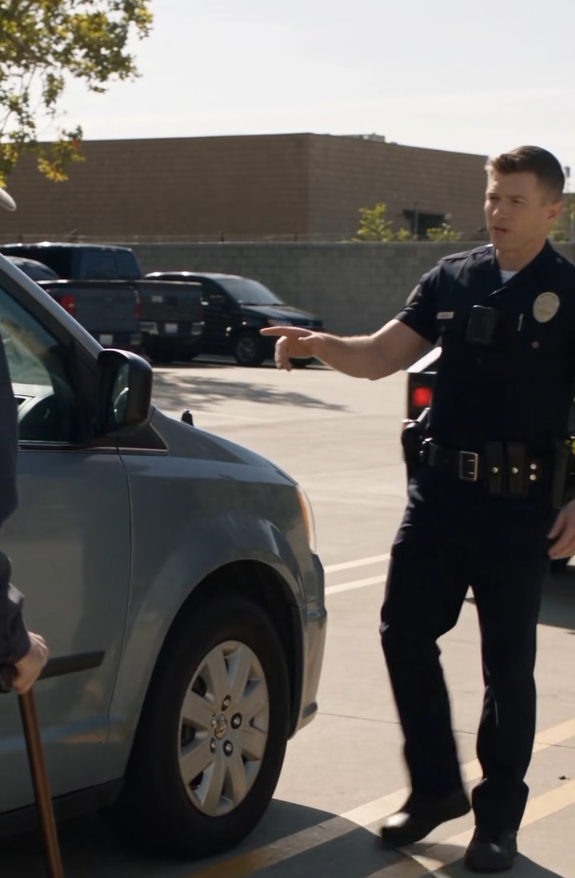
"Didn't think I had much choice."
"You did."
"Then I'm here voluntarily."
"Yes."
Kincaid sat beside me.
No uniform.
No medals.
No title displayed.
Just Robert.
The supervisor placed a folder on the table.
"We've reviewed the body-camera recording and fixed security footage."
I waited.
"The placard was visible before Officer Griggs approached you."
Kincaid didn't move.
Neither did I.
The supervisor continued.
"The video also confirms you offered documentation multiple times."
"Yes."
"He did not examine it fully."
"No."
"He did not run the plate before requesting the tow."
"No."
"The security footage supports your description of your behavior. You remained beside the vehicle, did not approach Officer Griggs aggressively, and did not interfere with the tow operator."
I glanced at Kincaid.
His expression was unreadable.
The supervisor said, "There is also audio."
I almost smiled.
"I assumed the camera wasn't making silent movies."
The administrative representative shifted.
The supervisor ignored my sarcasm.
"The audio includes several statements of concern."
That phrase bothered me.
"Concern?"
"We're not asking you to characterize them."
"Good."
He opened the folder.
He didn't need to read.
He knew the lines.
Wheelchair guy.
People like you abuse the system.
Purple Heart plates don't make you special.
Photoshop exists.
Not my problem.
When spoken one at a time in a hot parking lot, each phrase had seemed ugly but temporary.
Collected together in a quiet room, they became something else.
A pattern.
I understood then why records matter.
Memory softens edges.
Records put them back.
The supervisor continued.
"Officer Griggs was interviewed yesterday."
I looked at him.
"And?"
"He disputes the interpretation of several statements."
"Which interpretation?"
"That they reflected bias."
"I never claimed I knew what they reflected."
"We're aware."
"Then what does he say they reflected?"
"Frustration."
Kincaid moved for the first time.
Just a slight shift in his chair.
The supervisor noticed.
I said, "Frustration with what?"
The supervisor paused.
"With what he perceived as noncompliance."
"Before or after he called my placard fake?"
No answer.
"Before or after he refused to check it?"
Still nothing.
I leaned back.
"That's the problem, isn't it?"
The patient liaison looked at me.
"What problem?"
"He keeps explaining things that happened later as justification for things he did first."
Nobody interrupted.
I continued.
"He says he was frustrated because I didn't comply. But he accused me before I had anything to comply with."
Kincaid's eyes dropped toward the table.
The administrative representative made a note.
The supervisor said, "That's part of what we're reviewing."
I nodded.
"Good."
Then came the part I hadn't expected.
"There was a prior complaint."
The room changed.
Not dramatically.
No gasps.
No sudden music.
Just a subtle rearrangement of attention.
I looked at the supervisor.
"Against Griggs?"
"Yes."
"When?"
"I can't discuss another complainant's private information."
"Then why mention it?"
"Because your report triggered a broader review of similar contacts."
I felt something cold settle in my stomach.
Similar.
Kincaid looked at me.
This was the first true reversal.
Until then, the incident belonged to me.
My van.
My placard.
My humiliation.
My missed appointment.
Now it didn't.
The supervisor continued carefully.
"We are examining whether there is a pattern in disability-parking enforcement and interactions involving documentation."
"How many?"
"I'm not able to provide that."
"More than one?"
A pause.
"Yes."
I looked down at my cane.
Suddenly the complaint form felt heavier than it had three days earlier.
I thought of the question I'd marked unsure.
Did you believe you were treated differently?
I had wanted to be fair.
Still did.
But fairness did not require pretending patterns were accidents.
Kincaid spoke for the first time.
"What happens now?"
His voice was calm.
The supervisor answered him.
"Officer Griggs has been removed from field contact pending completion of the review."
Kincaid nodded.
No satisfaction.
No triumph.
That helped.
I asked, "Does he know about the other complaints?"
"He's been informed the review expanded."
"Does he think I caused that?"
"I can't speak for him."
"But you can tell me what he said."
The supervisor hesitated.
Then: "He believes this matter escalated because of Mr. Kincaid's intervention."
There it was.
Exactly what I'd feared.
Griggs had learned the wrong lesson.
I turned toward Robert.
He met my eyes.
Neither of us spoke.
The supervisor continued.
"For clarity, the decision to expand the review is based on internal records and video evidence, not Colonel Kincaid's status."
The title hung in the room.
I hated it.
Robert did too.
I said, "Can you put that in writing?"
The supervisor seemed surprised.
"Why?"
"Because if this ends with him believing he only got in trouble because I knew somebody important, then you've fixed nothing."
The administrative representative looked up.
"Mr. Delaney, disciplinary conclusions are based on policy."
"Policies don't teach lessons. Consequences do."
Kincaid glanced at me.
I knew the look.
Careful.
I continued more quietly.
"I'm not asking you to humiliate him. I'm asking you to be precise."
The supervisor closed the folder.
"We intend to be."
The meeting should have ended there.
Instead, the patient liaison slid a second document toward me.
"There's another decision you may need to make."
I looked at it.
"What is it?"
"A request from Officer Griggs."
"For what?"
"To speak with you."
Kincaid went still.
I looked at the liaison.
"Why?"
"He asked."
"That's not a reason."
"No."
"Is it required?"
"Absolutely not."
"What kind of meeting?"
"Mediated. No disciplinary negotiation. No request for you to withdraw anything."
I studied the paper.
"Did he apologize?"
The liaison chose his words carefully.
"He said he wants an opportunity to explain."
Kincaid's jaw tightened.
That interested me.
Robert had been the one warning me not to make this about punishment.
But explain can be a dangerous word when someone hasn't yet accepted what happened.
"What do you think?" I asked him.
Everyone looked at Kincaid.
He shook his head.
"No."
The supervisor raised an eyebrow.
Kincaid continued.
"You asked me as a friend. My answer is no."
"Why?"
"Because you don't owe him access to you."
That was true.
I looked at the request again.
Then I thought about the parking lot.
The smile.
The certainty.
The way Griggs had kept trying to force reality to match the decision he'd already made.
I signed the request.
Accepted.
Kincaid stared at me.
I handed it back.
"You told me not to make this about punishment."
"I didn't tell you to volunteer as target practice."
"I'm not."
"Then what are you doing?"
I picked up my cane.
"Checking whether he's learned the right lesson."
Part V — The Harder Choice
The meeting happened the following week.
Same building.
Different room.
Smaller.
No polished conference table this time.
Just four chairs arranged in a square.
The mediator sat near the door.
Kincaid had offered to wait outside.
I told him to go get coffee.
He told me exactly what he thought of that idea.
Then he went anyway.
Griggs entered two minutes late.
Without the full uniform, he looked younger.
That surprised me.
Dark slacks. Light shirt. No duty belt. No badge on his chest.
Authority changes the silhouette of a man.
Without it, he was simply Tyler Griggs.
He sat across from me.