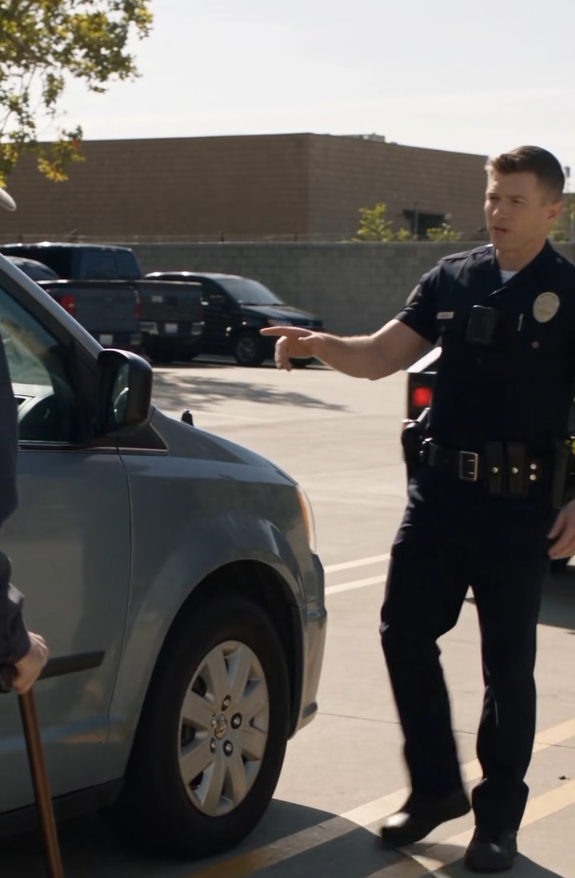
For several seconds, neither of us spoke.
The mediator began.
"This meeting is voluntary. Either of you may end it at any time. Mr. Delaney is not being asked to alter or withdraw his complaint. Officer Griggs—"
"Former field status," Griggs corrected.
The mediator looked at him.
"Officer Griggs remains employed during review."
Griggs's mouth tightened.
I noticed.
Still fighting language.
Still needing terms to land precisely in his favor.
The mediator continued.
"The purpose is communication, not resolution of the administrative case."
Griggs looked at me.
"Can I talk?"
The mediator nodded.
He leaned forward.
"I didn't know who you were."
There it was.
First sentence.
Wrong lesson.
I almost stood up.
Instead I stayed.
"Who did you think I was?"
Griggs frowned.
"That's not what I mean."
"It sounded like it."
"I mean I didn't know your background."
"You saw the plates."
"I saw plates."
"You called them irrelevant."
"They are irrelevant to parking enforcement."
"Then why does my background matter now?"
He sat back.
The mediator watched him.
Griggs looked toward the floor.
"I handled it badly."
"That's different from what you just said."
His eyes returned to mine.
"I said I handled it badly."
"Because you didn't know who I was?"
"No."
"Then say why."
His face tightened.
"I made an assumption."
"About what?"
"The placard."
"Why?"
"It didn't look right."
"The investigation says it did."
"I know what the investigation says."
There was still anger there.
Not explosive anger.
The quieter kind that makes a person defend each inch of retreat.
I waited.
He rubbed his hands together.
"I've dealt with fraudulent placards."
"I believe you."
He looked surprised.
"People use relatives' permits. They photocopy documents. They park in spaces they don't belong in. You deal with it enough, you start noticing things."
"Fine."
"So that morning, I saw something and thought—"
"You didn't see something."
His head lifted.
"You saw me."
Silence.
The mediator did not interfere.
I continued.
"You keep talking about the placard because it's safer."
Griggs's eyes narrowed.
"You don't know what I was thinking."
"You're right."
I leaned on the cane between my knees.
"I don't. That's why my complaint didn't accuse you of a motive."
He stared at me.
"I marked unsure."
That seemed to catch him off guard.
The mediator looked from him to me.
I said, "I didn't know whether you had a problem with disabled people, veterans, old men, patients, or anybody who questioned you. I still don't."
Griggs looked away.
"But I know when you made your decision."
He said nothing.
"It was before you checked anything."
Still nothing.
"Everything after that was you defending the decision."
His jaw moved.
"You refused an instruction."
"After you ordered a tow."
"You challenged me in front of a crowd."
"I asked you to verify documents."
"You made me look like an idiot."
The sentence escaped him.
Instantly, the room changed.
Griggs knew it.
The mediator knew it.
I knew it.
There it was.
Not a policy.
Not a placard.
Not a veteran.
Humiliation.
I looked at him.
"No."
He swallowed.
"No?"
"You made yourself look like an idiot."
His face hardened.
I almost regretted the wording.
Almost.
Then I softened my tone.
"But that's not what matters."
He laughed once without humor.
"Easy for you to say."
"Is it?"
"You walked out of there a hero."
I stared at him.
"A hero?"
"You had people gathering around you. A colonel making calls. Administration running outside. Everybody decided I was the villain before anybody reviewed anything."
"Your camera reviewed it."
His eyes flashed.
"I know."
"Did the camera lie?"
"No."
"Did the security footage?"
"No."
"Did the tow driver?"
"No."
"Did I?"
He looked at me.
A long silence.
"No."
The word barely carried.
That was the first honest thing he'd given me.
I sat back.
Griggs rubbed his palms together again.
"My father used to use my grandmother's placard."
The mediator shifted slightly.
I said nothing.
"He wasn't disabled. He'd park wherever he wanted. Used to joke about it. I hated it."
The information surprised me.
It did not excuse him.
Maybe that was why he told it.
"I started seeing it everywhere," he continued. "People cheating. People thinking rules were for somebody else."
I waited.
"And when I saw you..."
He stopped.
"What?"
He looked at my cane.
Then away.
"I thought you were putting it on."
The words were quieter than anything he'd said so far.
I felt them more than I expected.
Not because I was shocked.
Because something in me had known.
The way he looked at the cane.
The smirk.
Photoshop exists.
Purple Heart plates don't make you special.
The suspicion had never been just that my placard was fake.
He had suspected I was fake.
I asked, "Why?"
Griggs shook his head.
"I don't know."
"Yes, you do."
He looked at me.
I didn't rescue him.
Finally he said, "You got out of the driver's seat."
I stared at him.
"You stood up."
Understanding arrived slowly.
Not because the explanation was complicated.
Because it was so small.
So ordinary.
"I used the cane."
"I know."
"Now you know."
"I saw the wheelchair symbol and expected—"
"A wheelchair."
"Yes."
I looked down at my legs.
"So when I stood up, you decided I wasn't disabled."
He didn't answer.
The mediator's face remained neutral.
I thought about every time I'd pulled into an accessible space and felt someone watching.
Every time I'd climbed out slowly and seen confusion turn to suspicion because I could stand.
Disability, to some people, must perform itself correctly.
It must look the way they expect.
Wheelchair means never standing.
Cane means limping enough.
Pain must be visible.
Scars must explain themselves.
Anything less becomes fraud.
I looked at Griggs.
"Why didn't you say that in the parking lot?"
He stared at his hands.
"Because once I got close, I knew it sounded bad."
"And instead of checking—"
"I doubled down."
The phrase came from him.
Not me.
I said nothing.
He looked up.
"I doubled down."
Again.
Something in his posture had changed.
Not collapse.
Not redemption.
Just the exhausting loss of a defense he'd been carrying too long.
"I thought if I backed off in front of everybody, I'd lose control of the scene."
"There wasn't a scene until you made one."
"I know."
"Do you?"
"Yes."
I studied him.
He looked tired.
So was I.
The mediator asked, "Mr. Delaney, is there anything you want Officer Griggs to understand?"
I had expected that question.
I had rehearsed answers.
None of them felt useful anymore.
I looked at Griggs.
"When you first approached me, I was worried about my appointment."
He frowned.
"I had blood work."
He said nothing.
"I'd been fasting. My hip hurt. I was trying to get my cane positioned without falling."
I paused.
"You thought the most important thing happening in that moment was whether I respected your authority."
His eyes lowered.
"The most important thing happening to me was whether I could get through the day by myself."
The room stayed quiet.
"If you'd towed that van, I would've lost more than transportation. My chair was in there. My medication. The equipment I use to get in and out. You called it not your problem."