Brown evidence paper.
Tamper strip.
Her initials across the seal.
Date and time.
The copy was intended for a formal review panel at eight the next morning.
The original source documents had already been secured separately.
That was standard.
Copies could disappear.
Originals were harder.
Keller could not erase six months by taking the packet.
But he might think he could.
Claire set the package on the table.
She did not open it.
Instead she removed a thin working notebook from another compartment of the bag.
The notebook was not evidence.
It contained dates, cross-references, questions and patterns.
Most of it would be meaningless to anyone else.
To Claire, it was a map.
She turned pages.
Stop 14.
Camera failure.
Stop 21.
Late plate query.
Stop 23.
Search request immediately following removal from vehicle.
Stop 27.
Property discrepancy.
Stop 31.
Camera interrupted.
She found Keller’s name beside four events.
Not all the suspicious stops involved him.
That had been one of the reasons the investigation had taken so long.
Patterns crossed shifts and officers.
Some might have been innocent.
Some almost certainly were not.
Claire had resisted the temptation to choose a villain too early.
That was how investigations became stories instead of facts.
Keller appeared repeatedly, but never alone enough to make the case simple.
He had been present during two stops with missing camera footage.
He had signed one property sheet later corrected by another officer.
His unit number appeared near three incidents where dispatch notification was delayed.
Nothing, by itself, was enough.
That had frustrated people above Claire.
Six months and you still can’t tell us who did what?
She could tell them what the data suggested.
She could not tell them what she could prove.
Tonight had changed that.
Claire turned to a page marked with a boxed phrase.
You should think about your situation.
The line came from an interview with a driver whose complaint had been dismissed as unsubstantiated.
Claire remembered the man sitting across from her, embarrassed by how much the encounter still affected him.
He kept rubbing the edge of his paper coffee cup.
The officer stood close, the man had said.
Then he showed me something. Said it was from my car. I told him it wasn’t. He said I should think about my situation before making things worse.
Claire had written the sentence exactly.
The complaint identified the officer as tall, dark-haired, probably early forties.
The body camera from that stop was unavailable due to battery failure.
Claire closed her eyes briefly.
Battery failure.
Keller had used the same explanation tonight.
She opened them.
The clue had been sitting in front of her for three weeks.
Not proof.
But a pattern.
Her phone vibrated.
Unknown internal number.
Claire answered.
“Moreau.”
Silence.
Then Keller’s voice.
“You caused a hell of a problem.”
Claire stood completely still.
“Where are you?”
“You know this didn’t have to happen.”
His tone was controlled.
That disturbed her more than anger would have.
She glanced at the sealed dossier.
“Why did you stop me?”
“You were driving erratically.”
“Try again.”
A soft breath through the phone.
“You’ve been asking questions about people who know how things actually work.”
“Where are you?”
“You think those files tell you everything?”
“No.”
“That’s the difference between you and the people feeding you garbage. They think paperwork is reality.”
Claire pressed a button on the desk phone and waved through the small window toward the supervisor.
Record.
He saw her.
Moved.
Keller continued.
“You have complaints from people who hate cops. Missing video. Bad timestamps. That’s your big corruption case?”
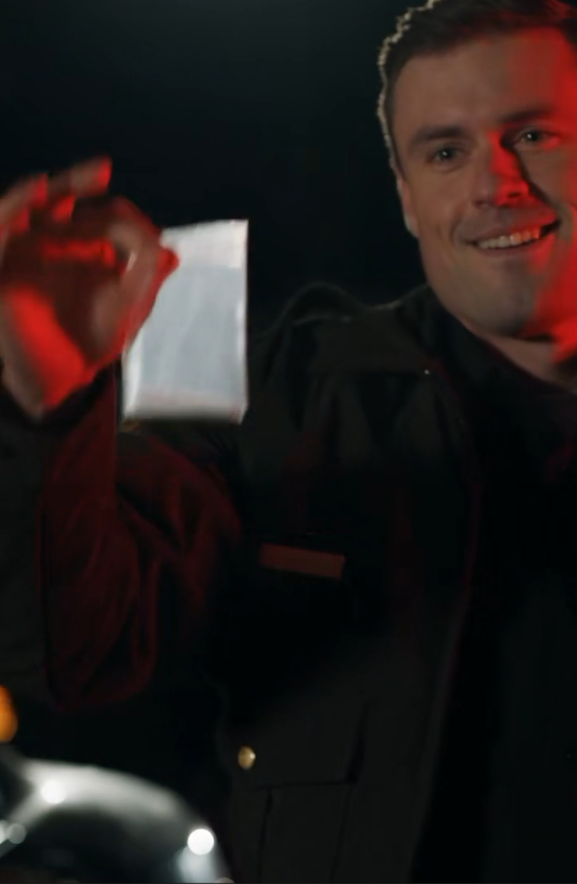
Claire said, “Then why were you carrying a bag of powder tonight?”
Silence.
Three seconds.
Four.
When Keller answered, his voice had changed.
“You don’t know what you saw.”
“I watched you take it from your cruiser.”
“No, you didn’t.”
Claire almost admired the simplicity.
Not the lie.
The confidence required to tell someone their own memory could be negotiated.
“You showed my photograph to your partner before shift.”
Another silence.
Longer.
Claire heard faint road noise on Keller’s end.
He was driving.
“I wanted to know who was crawling around our unit.”
“You knew my route.”
“No.”
“You knew I’d be out tonight.”
“No.”
“You knew enough to wait for me.”
“You’re making yourself important.”
Claire looked at the sealed dossier.
Then at her working notebook.
“Come back.”
Keller laughed once.
“Why?”
“Because leaving makes everything worse.”
“For me?”
“For anyone whose name is tied to yours.”
The line landed.
She heard it in his breathing.
“You don’t know whose names are in that file.”
Claire’s eyes narrowed.
She had not said there was a file.
Not on the roadside.
Dispatch had identified her occupation.
The supervisor knew about the sealed packet.
The second officer might have seen the handbag.
But Keller had just said that file.
Not your investigation.
Not your case.
That file.
Claire spoke slowly.
“How do you know I’m carrying one?”
Nothing.
The call ended.
Claire stared at the phone.
The supervisor entered.
“Did we get it?”
“Most.”
“Trace?”
“Department phone routing won’t help. He’s calling through something else.”
Claire looked down at the dossier.
The supervisor followed her gaze.
“He knew?”
“Yes.”
“How?”
“That’s the question.”
The supervisor said nothing.
Claire turned toward him.
“How many people knew I was delivering this copy tomorrow?”
“I don’t know.”
“Exactly.”
He frowned.
“You think this came from inside the review?”
“I think Keller had information he should not have had.”
“You think someone tipped him.”
“I think that’s now a fact.”
The supervisor walked to the far wall and back.
“What are you going to do?”
Claire resealed her handbag.
“The same thing I was going to do before he stopped me.”
“Deliver it.”
“At eight.”
“He may try to intercept you again.”
“Then I won’t transport it alone.”
“You’re taking a risk.”
Claire looked at the empty rectangle on the younger officer’s vest in her memory.
The green recording light.
Keller’s dark camera.
The five-minute dispatch delay.
His call.
His knowledge of the file.
“No,” she said. “I’m removing his options.”
At 2:15 in the morning, Claire watched a mirrored copy of the body-camera footage.
The second officer’s camera angle was imperfect.
But imperfect was not the same as useless.
The recording showed Claire’s black sedan ahead of them.
Keller’s voice instructed the second officer to remain near the cruiser.
It showed Keller walking toward Claire.
Returning.
Speaking beside the patrol car.
Then, several minutes later, the camera shifted as the second officer stepped sideways.
The passenger door opened.
Keller leaned inside.
His upper body blocked part of the view.
When he stepped backward, his right hand was closed.
He turned.
The plastic bag became visible.
There was no cut.
No obstruction long enough to hide a trip to Claire’s sedan.
No moment during which Keller could have lawfully recovered the bag from her vehicle.
He walked directly from his cruiser toward Claire with it.
Claire replayed the sequence.
Once.
Twice.
A third time.
The supervisor stood behind her.
“That’s bad.”