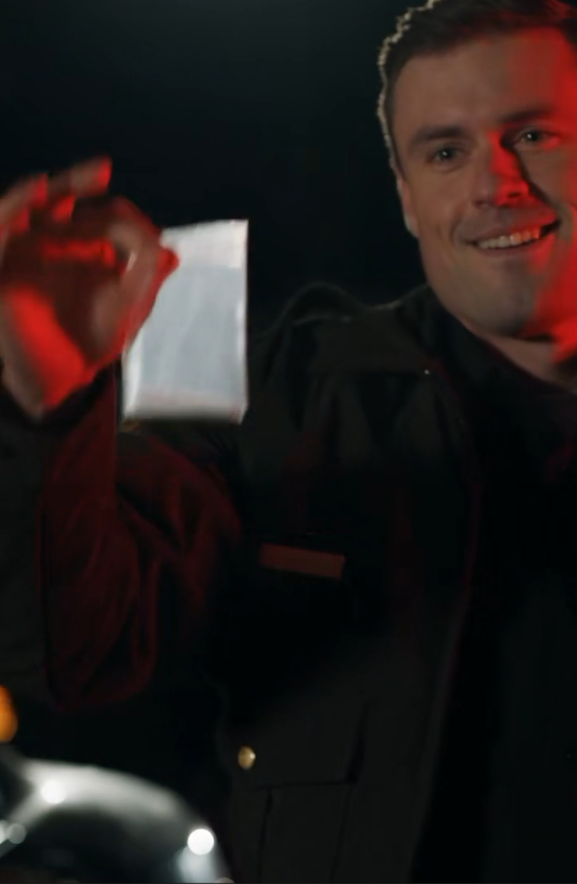
Claire paused the image.
Keller’s face was visible in profile.
The bag hung below his hand.
“No,” she said. “Bad is ambiguous.”
She advanced one frame.
“This is useful.”
“You still need chain.”
“We have chain.”
“For the video.”
“I mean behavior.”
The supervisor frowned.
Claire pointed at the screen.
“He keeps his own camera off. His partner’s stays on. He goes to the exact position described in prior complaints. Passenger side. Returns holding alleged evidence. Uses the same pressure language. Delays the dispatch query five minutes. Then asks to search.”
She looked up.
“He didn’t improvise tonight.”
The supervisor’s expression settled.
“This is a method.”
Claire nodded.
That was the reversal.
For six months, she had believed she was investigating scattered corruption.
Separate complaints.
Separate procedural failures.
Separate missing videos.
Perhaps a culture that encouraged shortcuts.
Perhaps several officers crossing lines independently.
But methods left repetition.
Repetition left patterns.
Patterns belonged to people.
Keller had given her the shape.
The dossier did not merely contain evidence against corrupt officers.
Keller had just shown her how some of that evidence had been manufactured.
Claire looked again at the body-camera frame.
The bag.
The cruiser.
The open passenger door.
She thought of every person whose complaint had died because the report looked cleaner than their memory.
Tomorrow morning, the sealed file would be opened.
But now it needed one more page.
Tonight.
Part IV — Reckoning
At 4:40 a.m., Keller’s vehicle was located in a parking area fifteen miles from the station.
Empty.
By six, an internal alert had been issued.
Claire had not slept.
She sat in a secure office with the sealed dossier on one side of the desk and a new supplemental statement on the other.
The statement contained only facts she could support.
No conclusions about Keller’s motive.
No speculation about who had leaked her schedule.
No accusation that every complaint in the dossier involved planted evidence.
Only the sequence.
Time of emergency-light activation.
Time of plate query.
Body-camera status.
Keller’s movement to the passenger side.
The bag appearing in his hand.
His statements.
His knowledge of the file.
His departure.
Precision felt almost calming.
At 6:12, the second officer entered.
He had changed out of uniform.
Without the vest and equipment, he looked tired.
Claire closed the statement.
“You should have counsel.”
“I’m getting one.”
“Good.”
He remained near the door.
“I wanted to tell you something before the formal interview.”
Claire did not invite him to sit.
Not because she was hostile.
Because the boundaries mattered now.
“What?”
“Keller asked me to turn my camera off.”
“When?”
“After dispatch identified you.”
Claire’s face stayed neutral.
“What did you do?”
“I said the battery latch was stuck.”
“Was it?”
“No.”
Claire looked at him for a long moment.
“Why?”
He rubbed the back of his neck.
“I didn’t know what was happening yet.”
“That isn’t an answer.”
“I knew enough.”
Claire waited.
He looked toward the window.
“I’ve seen things that didn’t make sense.”
“What things?”
He shook his head.
“Not without my lawyer.”
“Then don’t tell me.”
He looked relieved and ashamed at the same time.
Claire said, “You did the right thing by leaving the camera on.”
“I should’ve done something earlier.”
She did not rescue him from the statement.
Maybe he should have.
Maybe his silence had cost someone months or years of their life.
Claire had learned not to hand out absolution simply because a person finally became useful.
“You’ll have to answer for earlier,” she said.
He nodded.
“But last night matters too.”
Another nod.
He started to leave.
Claire said, “One question.”
He stopped.
“Did Keller know I had the dossier before the shift?”
The officer considered.
“He knew you were delivering something.”
“Those words?”
“He said, ‘She’s moving the package tonight.’”
Claire felt a cold clarity spread through her.
“Anything else?”
“He told me not to ask questions.”
“And you didn’t.”
“No.”
Claire held his gaze.
“No,” he repeated.
Then he left.
The door closed.
Claire stared at the sealed package.
She’s moving the package tonight.
Someone had not merely identified her.
Someone had described the transfer.
The leak was real.
And it was close enough to the investigation to know timing.
That meant the morning review could be compromised.
Claire picked up her phone and made one call.
Not to someone inside the local chain.
To the independent oversight office scheduled to receive the dossier.
When the duty attorney answered, Claire said, “The delivery protocol has changed.”
At 7:30, a conference room was prepared under independent custody.
The dossier would not be opened at the station.
The original plan had been abandoned.
Two outside investigators arrived to receive it directly.
Claire signed the transfer log.
The sealed package passed out of her hands for the first time since the previous afternoon.
She watched it cross the table.
There was something strangely intimate about surrendering six months of work.
Not pride.
Not ownership.
Responsibility.
Once evidence left your hands, you depended on procedure and other people to preserve what you had built.
Claire had never liked that part.
This morning she disliked it more.
One of the investigators checked the seal.
“Intact.”
Claire nodded.
The conference-room door opened.
The station supervisor stepped inside.
His expression told her something had happened.
“We found Keller.”
“Where?”
“He came in voluntarily.”
Claire blinked.
“When?”
“Ten minutes ago.”
“Lawyer?”
“On the way.”
“Did he say why he left?”
“No.”
The supervisor looked toward the dossier.
“He knows the review moved here.”
Claire’s eyes sharpened.
“How?”
“I didn’t tell him.”
Neither did Claire.
The outside investigators exchanged a glance.
The leak had followed them.
Claire said, “Nobody opens that until we identify who received the updated location.”
One investigator frowned.
“The review is scheduled.”
“Delay it.”
“We have enough security.”
“This isn’t about someone stealing paper.”
“Then what?”
Claire looked at the sealed dossier.
“If Keller knew the original route and now knows the changed site, someone with current access is feeding him information in real time.”
The room went quiet.
Not dramatically.
Administratively.
The kind of silence in which everyone began reconsidering their own phone calls, messages and assumptions.
The outside investigator said, “Who knew about the change?”
“Four people directly.”
“Names?”
Claire gave them.
The supervisor added two more who could have seen the updated access request.
The investigator wrote them down.
Then the conference-room door opened again.
A uniformed officer said, “Keller wants to speak to Moreau.”
The supervisor laughed without humor.
“Of course he does.”
Claire looked at the clock.
7:43.
Seventeen minutes before the review was supposed to begin.
“What does he want?”
“Wouldn’t say.”
“Lawyer there?”
“Not yet.”
The outside investigator shook his head.
“Don’t.”
Claire agreed.
“No.”
The officer left.
Three minutes later, Claire’s phone vibrated.
A text from an unknown number.
YOU’RE ABOUT TO BURN PEOPLE WHO NEVER TOUCHED YOU.
Claire read it once.
Then handed the phone to the outside investigator.
Another message appeared.
OPEN THE FILE AND LOOK AT PAGE 47 BEFORE YOU DO THIS.
Claire’s eyes remained on the screen.
The investigator asked, “Meaning anything to you?”