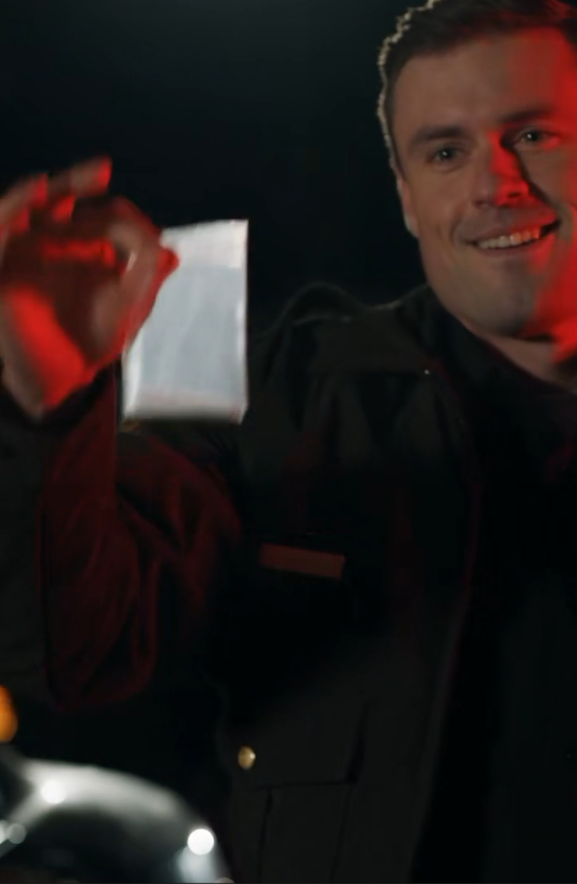
Yes.
Page 47 did.
Claire had numbered the dossier herself.
Page 47 was a dispatch-analysis table.
Rows of traffic stops.
Unit numbers.
Activation times.
Plate-query times.
Camera status.
Nothing emotional.
Nothing dramatic.
Just numbers.
Keller knew the page.
That meant someone had seen the dossier.
Not merely heard about it.
Claire reached for the packet, then stopped herself before touching it.
“Photograph the seal.”
The investigator did.
Claire leaned closer.
The seal looked intact.
Her initials crossed the adhesive exactly where she had placed them.
She felt a faint pressure behind her eyes.
“What?” the supervisor asked.
Claire pointed.
“Look at the lower corner.”
He bent closer.
A tiny wrinkle ran through the evidence tape.
So small it could have been created during handling.
Except Claire remembered smoothing that exact corner flat with her thumbnail before signing.
The packet had been opened.
Or someone had attempted to open it.
Then resealed it well enough to survive a casual inspection.
The room changed.
The dossier was no longer merely evidence.
It was evidence of access.
One of the investigators said, “Don’t open it.”
Claire nodded.
“Bag the whole package.”
“What about the review?”
“Use the secured original set.”
The investigator looked at her.
“I thought this was the review copy.”
“It is.”
Claire picked up her phone.
“The originals were never here.”
That was why the word copy had mattered.
Keller had built his plan around the wrong object.
He thought the packet in Claire’s handbag was the case.
It was not.
It was a certified duplicate prepared for presentation.
The underlying records, interviews, logs and digital media had already been stored under separate custody.
Destroying the copy would delay the review.
It would not erase the evidence.
But whoever accessed it had revealed something more valuable than paper.
Knowledge.
Claire looked toward the door.
Keller had not returned because he felt safe.
He had returned because he believed page 47 contained leverage.
Now Claire wanted to know why.
Part V — Final Confrontation
Keller sat in an interview room with his attorney by 8:25.
Claire did not question him.
She watched from an adjacent observation room while an independent investigator conducted the interview.
Keller looked composed.
Fresh shirt.
Hair combed.
No visible sign that he had abandoned his vehicle hours earlier and disappeared.
His attorney did most of the talking at first.
Keller denied planting evidence.
Denied targeting Claire.
Denied knowing details of the dossier before the traffic stop.
When asked why he showed Claire’s photograph to his partner, he said he had been advised to remain alert for investigators interfering with active operations.
When asked who advised him, he refused to answer.
When shown the body-camera footage, he leaned forward.
“That doesn’t show where the bag came from.”
The investigator said, “It shows you taking it out of your patrol car.”
“It shows me holding evidence.”
“Evidence you said you recovered from Moreau’s passenger floorboard.”
“I had already recovered it.”
“When?”
“Earlier.”
“Your own partner says you had not entered her vehicle.”
Keller looked toward his attorney.
The attorney said, “We’re not adopting another officer’s interpretation of an incomplete recording.”
Claire folded her arms.
There it was again.
Interpretation.
Incomplete.
The vocabulary of erosion.
Take a clear sequence and surround it with enough uncertainty until people became afraid to trust their own eyes.
The investigator asked, “Why was your body camera off?”
“Battery problem.”
“Maintenance report?”
“I hadn’t filed one yet.”
“You have nine prior stops with missing or incomplete body-camera records.”
Keller’s face changed by half a degree.
Claire saw it.
The investigator continued.
“Several involve allegations of improper searches.”
“No sustained findings.”
“That wasn’t the question.”
Keller leaned back.
“This is exactly what I’m talking about. You take complaints, half a video, bad equipment and people’s memories, then build whatever story you want.”
From behind the glass, Claire studied him.
He believed that.
At least partly.
That mattered.
People were rarely as simple as the files built against them.
Keller did not think of himself as a man planting evidence.
He thought of himself as someone correcting outcomes.
Making sure suspicious people could not hide behind procedure.
Making cases stronger.
Making the system work the way he believed it was supposed to.
And once someone accepted that logic, the distance from suspicion to fabrication became very short.
The investigator asked about Claire’s route.
Keller denied knowing it.
Then about the phrase “moving the package.”
Keller’s eyes flicked toward the mirror.
Claire felt him looking at her without being able to see her.
His attorney said, “We’re done with that line.”
The investigator placed a photograph on the table.
The sealed dossier.
Keller’s gaze dropped.
Claire watched closely.
No confusion.
Recognition.
The investigator asked, “Have you seen this before?”
“No.”
“Never?”
“No.”
“Then why did you tell Ms. Moreau to look at page forty-seven?”
For the first time, Keller stopped moving.
His attorney turned toward him.
Claire heard the ventilation fan above her.
Nothing else.
The investigator waited.
Keller said, “I didn’t.”
The investigator placed Claire’s phone in an evidence sleeve on the table.
“Message came from a prepaid device recovered when you surrendered.”
Keller’s attorney closed his eyes briefly.
Keller’s jaw tightened.
The investigator said, “Page forty-seven.”
No answer.
“What’s on it?”
Keller looked toward the mirror again.
Claire could almost feel the direction of his attention.
Finally he said, “Ask her.”
The investigator did not.
Keller leaned forward.
“Go ahead. Ask her what’s on page forty-seven.”
His attorney touched his arm.
Keller ignored him.
“Ask her why she doesn’t want to open the file.”
Claire straightened.
That was not fear in his voice.
It was confidence returning.
The investigator asked, “What do you think she’ll find?”
Keller smiled.
“The truth.”
Claire opened the secured original copy of page 47 in another room.
She had seen it dozens of times.
A table.
Dates.
Units.
Traffic stops.
The investigator stood beside her.
“Anything?”
“Not yet.”
She scanned each row.
Keller’s unit appeared five times.
Other units appeared more.
One column listed camera status.
Another plate-query delay.
Another property seizure.
Claire followed the dates.
Then she saw it.
Not something new.
Something she had interpreted incorrectly.
Four of Keller’s suspicious stops occurred on dates when another specific patrol unit was working the same sector.
Claire had assumed overlap meant coordination.
But page 47 showed something else.
On each of those nights, Keller’s plate queries were entered through a terminal assigned to that other unit.
Not his.
She checked the underlying logs.
Same result.
Someone else’s credentials had been used.
Claire’s stomach tightened.
The investigator asked, “What?”
She did not answer yet.
She went to the property records.
Three disputed seizures attributed to Keller had later been transferred through the same other officer’s electronic account.
Again, Claire had previously treated the overlap as evidence that several officers might be involved.
Now she saw the alternative.
Someone might have been using Keller.
Not innocently.
Keller had planted the bag tonight.
The video showed enough.
His partner’s statement supported it.
His messages supported prior knowledge.
There was no path back to innocence for him.