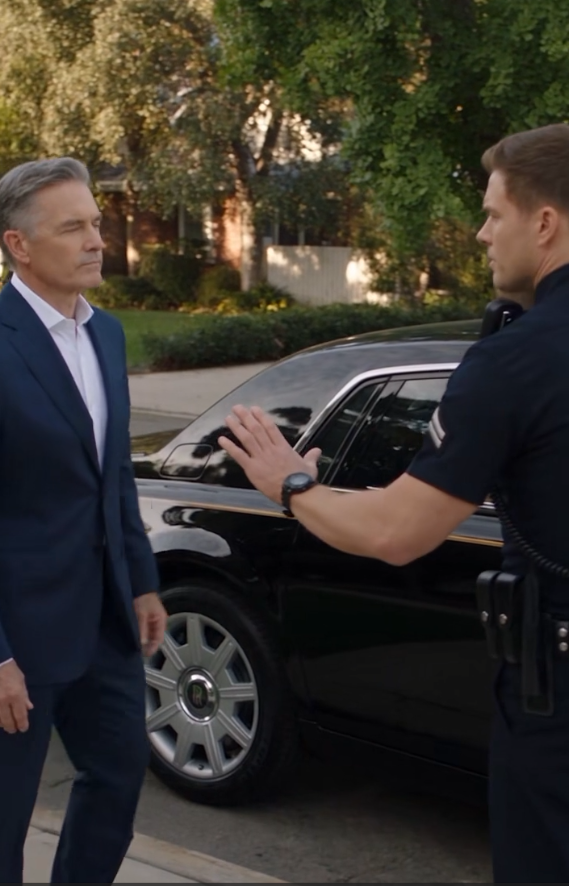
Terrence entered alone.
Monica had offered to attend.
He asked her not to.
Not because he did not want her there.
Because this part belonged to him.
He took the oath.
Then sat.
The questions began with simple facts.
Why were you in the neighborhood?
“To visit a family friend.”
Did you commit any traffic violation?
“No.”
Did the officer tell you why he approached?
“No.”
Did you provide identification?
“I attempted to. He physically interrupted the attempt, then later removed my wallet during the search.”
Did you resist?
“No.”
Did you threaten Officer Callaway?
“No.”
What did you mean when you said he would understand what he had done before sunset?
Terrence paused.
“I meant that the encounter was recorded and would be reviewed.”
Callaway’s representative stood.
“Judge Hayes, isn’t it true that you identified yourself as a federal judge in the middle of the encounter?”
“Yes.”
“Why?”
“Because the officer had already searched me, found my identification, and continued escalating the situation.”
“Were you trying to influence him?”
“I was trying to make him stop and reconsider.”
“So you invoked your office.”
“I stated my occupation.”
“An occupation carrying considerable authority.”
“Yes.”
“Could Officer Callaway reasonably have interpreted that as intimidation?”
Terrence considered the question.
“He could have interpreted it many ways.”
“That isn’t an answer.”
Terrence looked at the representative.
“It is the precise answer. What he interpreted is his testimony. What I intended is mine.”
The representative shifted.
“Were you angry?”
“Yes.”
It was the first answer that seemed to surprise the room.
Terrence continued before another question came.
“I was angry when he grabbed me. I was angrier when he searched me without explaining a lawful basis. I was angrier still when he dismissed my questions as defiance.”
“Yet you remained calm?”
“Outwardly.”
“Why?”
“Because anger does not improve judgment.”
Callaway looked down.
The representative asked, “Judge Hayes, you understand officers sometimes must make fast decisions.”
“Of course.”
“You understand they may be concerned for their safety.”
“Yes.”
“You understand reaching inside a jacket can reasonably cause concern.”
“Yes.”
“Then why not simply comply?”
Terrence’s gaze moved briefly toward Callaway.
“I did comply.”
“You questioned him.”
“Compliance and silence are not the same thing.”
The representative paused.
Terrence continued.
“An officer may ask questions. A citizen may ask questions. Authority does not become unlawful because it is questioned, and lawful authority does not need irritation to defend it.”
The room stayed still.
The representative tried again.
“Are you asking this panel to terminate Officer Callaway?”
“No.”
That surprised everyone more.
Even Callaway looked up.
The panel chair leaned forward.
“Judge Hayes, what outcome are you asking for?”
Terrence said, “I am asking you not to make your decision based on who I am.”
The chair frowned slightly.
Terrence continued.
“If the conduct shown on that recording violates policy or demonstrates unfitness for duty, then act on that. If it does not, then do not invent a harsher standard because the person he arrested happened to be a federal judge.”
Callaway stared at him.
Terrence met his eyes.
“But do not minimize it either. Do not say no one was harmed, therefore nothing serious occurred. Do not say the encounter ended safely, therefore the decisions were acceptable. And do not reduce this to a misunderstanding. The recording shows choices.”
Callaway’s representative sat slowly.
Terrence turned toward the panel.
“That is all I have to say.”
The panel chair nodded.
“Thank you, Judge Hayes.”
Terrence stepped down.
As he passed Callaway’s table, the officer said quietly, “Why?”
Terrence stopped.
The chair looked up.
Callaway’s representative touched his arm, but Callaway pulled away slightly.
“Why aren’t you asking them to fire me?”
Terrence turned.
Callaway’s expression had changed since the afternoon beside the sedan.
The arrogance was gone.
In its place was something less comfortable.
Uncertainty without defense.
Terrence answered quietly.
“Because I don’t get to decide your consequence.”
Callaway stared at him.
Terrence added, “You didn’t get to decide mine either.”
Then he walked out.
Part VII — Reversal
The investigation lasted another three weeks.
During that time, Terrence returned to work.
He heard cases.
Ruled on motions.
Listened to lawyers argue about evidence, authority, intent, credibility.
But the stop followed him in subtle ways.
One morning, a defense attorney challenged the legality of a vehicle search.
The facts were different.
The officer had articulated a specific reason.
The defendant had made movements described by two witnesses.
The body camera supported much of the testimony.
Still, as the prosecutor argued that “reasonable people who have done nothing wrong generally cooperate,” Terrence felt the room tighten.
He interrupted.
“Counsel.”
The prosecutor stopped.
“Yes, Your Honor?”
“Be careful.”
The attorney blinked.
“With what?”
“With turning a person’s willingness to question authority into evidence of guilt.”
The prosecutor nodded.
“Understood.”
Terrence continued hearing the case.
He ruled based on the record.
No more.
No less.
That evening, Monica met him outside the courthouse.
“You were different today.”
He looked at her.
“You were there?”
“Last row.”
“Spying on me?”
“Observing.”
“Much more respectable.”
They walked toward the car.
Monica said, “You let the defense attorney talk longer than usual.”
“He had a point.”
“He usually has a point.”
“Not always a good one.”
She smiled.
Then her expression changed.
“The department called.”
Terrence stopped.
“When?”
“Twenty minutes ago.”
“What happened?”
“They completed the review.”
Terrence waited.
Monica watched him.
“Callaway is being terminated.”
Terrence looked toward the courthouse steps.
People moved past them.
Clerks.
Attorneys.
Visitors.
Ordinary motion.
“On what finding?”
“Multiple sustained violations. Unjustified detention. Improper search. Failure to articulate lawful grounds. Escalation. Inaccurate report language.”
Terrence absorbed each phrase.
Monica continued.
“And dishonesty.”
His eyes returned to hers.
“What dishonesty?”
“The report said you repeatedly refused to identify yourself.”
Terrence said nothing.
Monica’s voice lowered.
“The body camera shows you agreed to provide identification almost immediately.”
“That was already known.”
“Yes. But there’s more.”
She took out her phone.
“Miller apparently pushed them to review earlier complaints.”
Terrence thought of their conversation.
“What did they find?”
“Another body-camera file.”
“From the convenience-store stop?”
“No. Another one.”
Terrence frowned.
“A stop eight months ago. Similar pattern. Unverified suspicious-person call. Officer approaches. Person questions why. Callaway escalates. Report characterizes questions as refusal.”
Terrence looked away.
Monica said, “The person never filed a formal complaint.”
“Why not?”
“No idea.”
Terrence thought of Miller’s words.
Some complaints closed.
Some never pursued.
Some incidents never became complaints at all.
Monica put the phone away.
“The department said your case triggered a broader audit.”
Terrence exhaled.
“There it is.”
“What?”
“The part I was afraid of.”
She studied him.
“That they’re overcorrecting?”
“No.”
He looked at her.
“That I wasn’t the first.”
Part VIII — Reckoning
Sergeant Miller asked to see Terrence again.
This time, Terrence invited him to chambers.
Miller stood near the door until Terrence gestured toward a chair.
“You heard about Callaway.”
“Yes.”
Miller sat.
“He’s appealing the termination.”
“He has that right.”
Miller nodded.
For a moment, neither spoke.
Then Miller said, “I reviewed every stop he made in the last year that began with a vague suspicious-person call.”