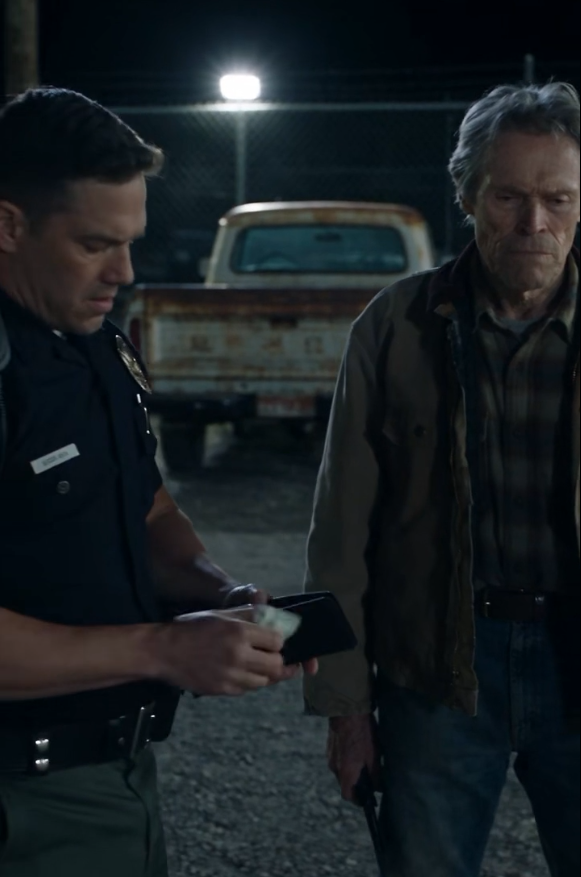
"I almost did that."
I glanced toward Mercer.
"I nearly ignored the phone number on the receipt. I was tired. It was cold. I wanted to go home."
My eyes moved to the hearing officer.
"Then I thought about what five hundred dollars meant in my house."
I let a moment pass.
"It meant heat."
No one wrote for a second.
Then pens started again.
"I don't know what every other payment meant to every other person. Rent. Groceries. Medicine. Maybe nothing. Maybe everything. That's not my part to invent."
Ryder finally looked down.
"The part I know is this: the money was not his to decide I could spare."
I heard a chair shift behind me.
"And there's another part."
I thought of Miller.
"For a long time, I wanted this to be simple. One officer did something wrong. Another officer eventually helped expose him."
Mercer's eyes narrowed slightly.
"But that isn't what happened."
Ryder's attorney did not object.
Maybe he liked where it was going.
"Miller saw things before he acted. Sometimes he looked away. At least once, he helped make something sound legitimate when he knew it might not be."
The hearing officer listened.
"I'm not saying that because I hate him."
I took a breath.
"I don't."
That surprised me as I said it.
It was true.
"I'm saying it because if you clean his part up just because he later helped, you teach everyone in the next uniform that waiting has no cost as long as you eventually pick the right side."
Mercer's gaze dropped briefly.
"And if you let Ryder leave with nothing but the word resigned, you teach the next person standing at an impound gate that the record belongs to whoever has the badge."
Ryder looked at me again.
His expression was no longer angry.
It was harder to read than that.
Maybe calculation.
Maybe exhaustion.
Maybe the first experience of being unable to control which version of an event survived.
"I don't need an apology," I said. "I don't need somebody to call me brave. I need the record to say what happened."
I turned toward the enlarged image of the yellow release slip still displayed among the exhibits.
"That paper said paid in full before he threw it in the gravel."
I looked at the hearing officer.
"Please don't throw it away again."
Then I sat down.
The room stayed quiet for a few seconds.
The hearing officer recessed.
Ryder walked out with his attorney.
He did not look at me.
Mercer remained seated.
"You planned that line?" she asked.
"No."
"Good."
"Why?"
"If you'd planned it, I'd be annoyed."
I almost smiled.
Twenty minutes later, we were called back.
The hearing officer accepted Ryder's resignation.
But he did not dismiss the record.
Instead, he ordered the admitted exhibits, testimony, findings to date, and unresolved allegations preserved as part of the official disciplinary file and referred to the appropriate certification and prosecutorial authorities.
Ryder's lawyer objected.
The objection was noted.
The file stayed.
That was all.
No handcuffs.
No dramatic confession.
No one applauded.
Ryder signed a document.
His department credentials were surrendered.
He left through a side door.
I thought that would be the climax.
I was wrong.
Mercer found me in the lobby ten minutes later.
"Don't leave."
"What now?"
"There's someone here."
I followed her into a small interview room.
Miller was sitting inside.
No lawyer.
No uniform.
He stood when I entered.
"Sit," I said.
He did.
Mercer remained by the door.
Miller looked worse than he had at the hearing.
"I was terminated this morning."
I nodded.
"Effective immediately."
"I heard it was likely."
He rubbed his palms together.
"They offered me the option to resign."
"Why didn't you?"
He looked at me.
"Because then the paper would say resigned."
I did not answer.
That was mine.
Not the words exactly.
The lesson.
He had heard it.
"I gave another statement," he said.
Mercer watched him carefully.
"About August?"
"About everything."
"What does everything mean?"
He took a breath.
"Twelve incidents where I was present or knew immediately afterward that Ryder had taken cash."
My chest tightened.
"Twelve."
"Yes."
"You told investigators nineteen were suspicious."
"I suspected nineteen."
"But knew twelve."
"Yes."
"Why didn't you say that before?"
"Because in four of them, I told myself I hadn't seen enough. In three, I was nearby but not at the transaction. In two, Ryder told me afterward and I acted like I thought he was joking."
"And the others?"
Miller stared at the table.
"Three times I directly reassured people."
The room seemed smaller.
"Like the man with the four hundred."
"Yes."
"You told them the charges were real."
"Yes."
"Why?"
His answer came slowly.
"Because the first time, I was confused. The second time, I was protecting my partner. The third time, I knew what I was doing."
Mercer did not move.
Miller continued.
"After that, I filed the complaint."
I sat across from him.
"What do you want from me?"
"Nothing."
"People usually want something when they confess in small rooms."
"I want you to hear it from me before it becomes another document."
"Why?"
"Because I came to your house and told you I was late."
"You were."
"I made it sound like I was only late."
I looked at him.
"You were involved."
"Yes."
"Did you take money?"
"No."
"Did Ryder give you any?"
"No."
"Did you help him keep taking it?"
Miller closed his eyes briefly.
"Yes."
There are moments when anger arrives hot.
This was not one of them.
Mine arrived cold and clear.
"You stood in my kitchen."
"I know."
"You told me you weren't brave from the beginning."
"Yes."
"You let me think cowardice was your worst part."
"Yes."
"Why?"
"Because I was still trying to save a version of myself."
That answer stopped me.
Not because it excused anything.
Because I recognized it.
Everybody did it.
We edited ourselves while events were still happening.
Cut the ugliest angle.
Keep the line that sounded better.
Call silence uncertainty.
Call fear caution.
Call complicity loyalty.
Then hope nobody had the raw recording.
Miller looked at me.
"Ryder wasn't the only one who needed the record corrected."
Mercer stepped forward.
"We'll need to continue this separately."
Miller nodded.
I stood.
He said, "Mr. Hale."
I turned.
"I'm sorry."
I studied him.
"For the money?"
"For making you stand there alone while I pretended I wasn't part of what was happening."
That was better than a general apology.
Still not enough.
Maybe apologies were not supposed to be enough.
"I believe you," I said.
His face changed.
Then I added, "That doesn't clear anything."
"I know."
This time, I thought he did.
Three months later, the prosecutor filed charges against Ryder related to multiple unauthorized cash collections, including mine.
The criminal case took longer.
Much longer.
Lawyers argued over recordings, intent, records, witnesses, and what could be admitted.
I testified again.
So did the impound clerk.
So did several vehicle owners.
Miller testified under an agreement requiring complete cooperation while leaving his own administrative and potential legal exposure unresolved.
He did not get to become the hero.
That mattered.
Ryder eventually entered a plea to charges tied to several of the transactions rather than take every allegation to trial.