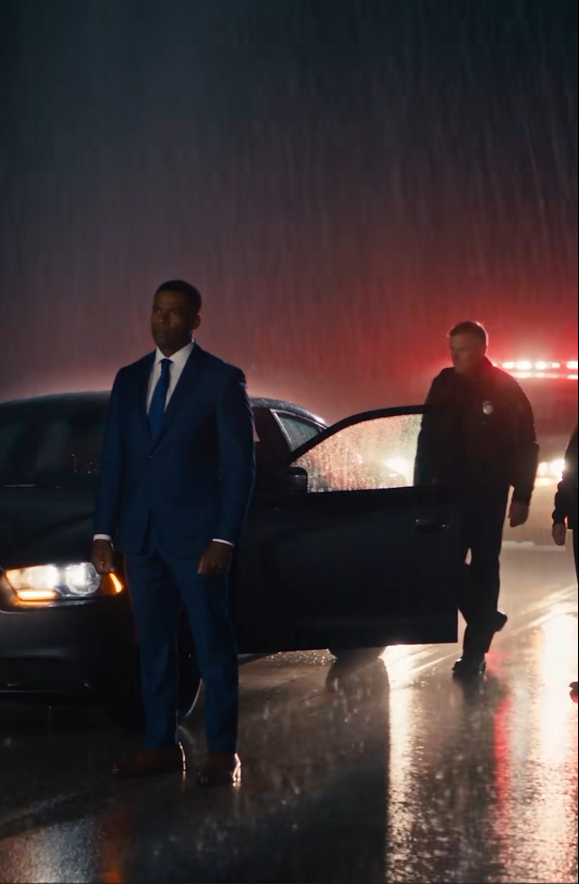
The video progressed.
Ryker’s face on the witness stand remained still.
On screen, he bent into the car.
Sarah slowed the footage.
“Your Honor, timestamp 00:43:14.”
She paused.
The image showed Ryker’s hand near his vest.
“Advance three frames.”
The technician did.
A corner of clear plastic appeared.
Another frame.
More of the bag.
Another.
Ryker’s fingers around it.
The gallery made a sound.
Not a gasp.
Something lower.
A collective shift as dozens of people understood the same thing at once.
The judge leaned forward.
Sarah continued.
“Play.”
On screen, Ryker’s hand disappeared beneath the seat.
Then emerged.
The bag now fully visible.
Looks like cocaine.
The video stopped.
Nobody moved.
David looked at Ryker.
For the first time since the stop, the man’s control slipped.
His mouth opened slightly.
Closed.
Sarah returned toward the witness stand.
“Officer Ryker.”
His lawyer stood.
“Your Honor, I need to confer with my client.”
The judge’s eyes remained on Ryker.
“You may have five minutes.”
Court recessed.
The room exploded into whispers.
Ryker’s lawyer gripped his arm.
They left through the side door.
David remained seated.
Sarah leaned toward him.
“Do not look at the gallery.”
“I wasn’t.”
“You were about to.”
He looked down.
His hands were steady.
That surprised him.
He had imagined this moment while sitting in county holding.
Imagined Ryker exposed.
Imagined the room recognizing what happened.
In those fantasies, victory felt clean.
This did not.
Because Chloe Bennett was sitting in the back row, staring at the floor.
Because Brenda Hayes sat two seats away, arms folded tightly.
Because somewhere in the building, every case Ryker had touched had just changed.
Because one clear piece of evidence did not erase the night David spent wondering whether clarity would matter.
Court resumed eleven minutes later.
Ryker returned without his dress jacket.
His attorney addressed the judge.
“My client invokes his Fifth Amendment privilege against further testimony.”
The judge’s expression hardened.
“You understand he has already provided substantive testimony.”
“Yes, Your Honor.”
Sarah rose.
“The defense moves for immediate dismissal.”
The special prosecutor was already standing.
“The state joins.”
Silence.
The judge looked at David.
Then at the prosecution.
“On what basis?”
The special prosecutor spoke carefully.
“Newly presented evidence materially contradicts the sworn testimony supporting the arrest and the factual basis for probable cause. The state cannot ethically proceed.”
The judge nodded once.
“Charges are dismissed with prejudice.”
David heard camera shutters outside the courtroom doors.
The judge wasn’t finished.
“And I am ordering the transcript, exhibits, and all preserved recordings forwarded immediately to the appropriate investigative authorities. No original media associated with this matter is to be altered, deleted, overwritten, or removed without further order.”
Ryker stared ahead.
The judge turned toward him.
“Officer Ryker, you are not to leave this jurisdiction pending notification from investigators.”
His lawyer rose.
“Your Honor—”
“That is not an arrest order. It is notice. Sit down.”
He did.
David remained still.
Sarah touched his sleeve.
“It’s over.”
David looked at Ryker.
“No.”
She followed his gaze.
He was right.
Ryker was placed on administrative suspension before sunset.
His badge and service weapon were collected at the precinct.
The police union withdrew its earlier statement and issued a new one saying it supported “a thorough and fair investigation.”
News stations replayed the second-camera footage until nearly everyone in Monroe County knew the exact motion of Ryker’s hand.
Vest.
Seat.
Bag.
David’s mug shot disappeared from some homepages.
It remained on others.
His arrest could be corrected.
Not erased.
At nine that evening, he sat alone in his apartment and watched no television.
Sarah called.
He let it ring twice before answering.
“You eating?”
“Is that legal advice?”
“Yes.”
“I had something.”
“What?”
“Coffee.”
“That is not food.”
“Then no.”
She sighed.
“Tomorrow is going to be worse in a different way.”
“I know.”
“Reporters. Civil-rights groups. Police organizations. Every defense lawyer with a Ryker case.”
“I know.”
“You are not returning calls tonight.”
“I know.”
“You are also not going to the office.”
He hesitated.
“David.”
“I was put on leave because of charges that no longer exist.”
“And your boss will call when your leave ends.”
“He should have called already.”
Sarah was quiet.
That landed harder than he wanted it to.
“Get some sleep,” she said.
After they disconnected, David stood by the window.
The city below looked ordinary.
Traffic signals.
Apartment lights.
An ambulance moving without sirens.
His phone buzzed again.
Unknown number.
He almost ignored it.
Then answered.
“Caldwell.”
Silence.
Then a woman’s voice.
“Mr. Caldwell?”
“Yes.”
“This is Officer Chloe Bennett.”
David straightened.
“You shouldn’t be calling me.”
“I know.”
“Do you have counsel?”
“No.”
“You may need it.”
“I know.”
A pause.
“I wanted to say something.”
David looked out the window.
“You should say it to investigators.”
“I did.”
“Then don’t compromise that.”
“I’m not calling about the evidence.”
He waited.
Her voice was quieter.
“When he told you to turn around, I almost said something.”
David said nothing.
“I knew something felt wrong. I didn’t know exactly what I’d seen. But I knew.”
“Officer Bennett—”
“I let him put you in the car.”
The sentence hung between them.
David closed his eyes briefly.
When he answered, his voice was controlled.
“You were a rookie standing next to a twenty-year veteran.”
“That doesn’t change it.”
“No.”
She went quiet.
He continued.
“But you preserved something too.”
“What?”
“You didn’t change your report after he spoke to you.”
“I wrote enough to help him.”
“You also didn’t write that you saw drugs beneath the seat.”
Silence.
David said, “That mattered.”
“I was scared.”
“I know.”
“You don’t know me.”
“No.”
He looked at his reflection in the glass.
“But I know what pressure looks like in a report.”
She exhaled.
“I’m sorry.”
David had cross-examined witnesses who apologized only after being caught.
This sounded different.
That didn’t make it easy.
“Tell the truth,” he said. “Every time they ask. Even when the person asking is wearing the same uniform.”
“I will.”
“That’s more useful than apologizing to me.”
She didn’t answer for several seconds.
Then she said, “Good night, Mr. Caldwell.”
“Good night.”
The call ended.
David put the phone down.
A minute later it rang again.
This time it was his boss.
Part V — What One Lie Uncovered
David returned to the District Attorney’s office forty-eight hours later.
No cameras were allowed inside, but reporters filled the sidewalk.
The District Attorney met him in the same office where he had been suspended.
“You’re reinstated.”
David remained standing.
“Effective?”
“Immediately.”
“Am I returning to the Seventh Precinct cases?”
His boss leaned back.
“That’s complicated.”
“Why?”
“You’re now a witness.”
“I was already connected to the investigation.”
“Not like this.”
David sat.
The District Attorney folded his hands.
“The state attorney general is taking over the Ryker investigation.”
“Good.”
“They’ll also review cases involving the narcotics unit.”
“Also good.”
“You will not participate.”
David looked at him.
“Because I’m a witness.”
“And because any prosecution you bring now will be attacked as retaliation.”