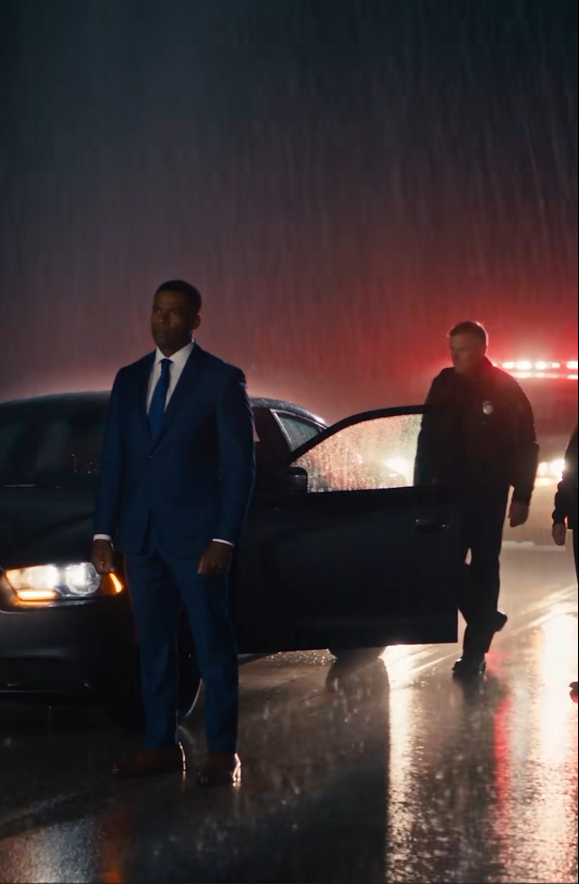
David hated that his boss was right.
“So what do you want me doing?”
“For now? Anything else.”
“Murder calendar.”
“If you want.”
“Appeals.”
“Yes.”
David looked toward the shelves.
Fourteen months of his work sat in boxes in another room.
Three officers removed.
Dozens of cases reviewed.
Patterns identified.
And now the largest break in the investigation had come from someone trying to destroy him.
He stood.
His boss spoke.
“David.”
He turned.
“I should have called sooner.”
David waited.
“After the hearing.”
“Yes.”
“Why didn’t you?”
The District Attorney considered lying.
David could see the moment.
Then he didn’t.
“Because I was embarrassed.”
“About what?”
“I put you on leave before asking whether there might be another explanation.”
“You had an employee arrested on a felony charge.”
“I know.”
“You did what you were supposed to do.”
“I also watched your mug shot on television and wondered whether maybe I’d missed something about you.”
David’s face remained unreadable.
His boss continued.
“That’s the part I’m embarrassed by.”
The room stayed quiet.
David finally said, “You believed evidence.”
“I believed an officer.”
“No. You believed a bag.”
His boss frowned.
David went on.
“The problem wasn’t that you considered the possibility I was guilty. You should have. The problem is everybody considered the bag evidence before considering how it got there.”
His boss nodded slowly.
David opened the door.
“That distinction is going to matter.”
It mattered sooner than either of them expected.
The attorney general’s office began with Ryker’s recent arrests.
Then expanded.
Seven years.
Twelve.
Twenty.
Defense lawyers filed motions in waves.
Some claims were weak.
Some opportunistic.
Some devastating.
David stayed out of the formal review, but he could not avoid hearing what surfaced.
A search five years earlier in which Ryker claimed narcotics were found in a bathroom vent, though photographs taken before the search showed the vent screws undisturbed.
A weapons arrest where property records listed a firearm booked twenty-two minutes before officers said the search began.
Three affidavits using identical language to describe three unrelated suspects supposedly making spontaneous admissions.
Then came the case that changed the investigation.
A man convicted nine years earlier had always claimed Ryker planted heroin in his truck.
At trial, the jury believed the officer.
Why wouldn’t they?
No body-camera footage existed from that year.
No rookie had been standing at the right angle.
No dispatcher had watched live.
The man served six years.
After release, he moved away.
Investigators reopened the property file.
The evidence envelope contained an old internal tracking sticker.
The heroin had entered narcotics-unit inventory two days before Ryker claimed to discover it.
David learned this from Sarah.
They were having lunch three blocks from the courthouse.
He stopped eating.
“You’re sure?”
“Public filing this morning.”
“How does controlled inventory end up as street evidence?”
“That is currently the question.”
“Who signed it out?”
Sarah slid a photocopy across the table.
David read the name.
Thomas Ryker.
Purpose: training demonstration.
Returned: blank.
David looked up.
Sarah said, “Nine years.”
“He’s been doing this for nine years.”
“At least.”
David stared at the page.
A detail returned to him from the stop.
The movement.
How smooth it had been.
Not improvisation.
Practice.
David pushed his plate away.
Sarah studied him.
“This is what you wanted.”
“No.”
“You wanted his prior cases reviewed.”
“I wanted them reviewed because there might be misconduct.”
“And now there is.”
“That isn’t the same as wanting to find it.”
She nodded.
Fair.
David looked down again.
“One bag.”
“What?”
“One bag in my car opens a nine-year-old conviction.”
“It may open more.”
“That man served six years.”
“I know.”
David’s voice lowered.
“For something Ryker may have planted.”
“Yes.”
He leaned back.
“I got four hours.”
Sarah understood.
David rarely compared his experience to defendants he had prosecuted. He had been careful not to turn his arrest into borrowed suffering.
But numbers were numbers.
Four hours.
Six years.
He looked toward the restaurant window.
“Do you know what bothers me?”
“A list or one item?”
“One.”
“Go ahead.”
“If Bennett’s camera hadn’t been streaming, I’d be preparing for trial.”
Sarah said nothing.
“The DA might have fired me. My license could have been suspended. Every conviction I ever touched would be challenged. People would say I prosecuted cops because I was hiding my own crimes.”
“Yes.”
“And the bag would still be evidence.”
She nodded.
David tapped the photocopy.
“Which means every case I’ve ever tried where the jury chose an officer’s word over a defendant’s just became harder for me to remember.”
Sarah’s voice stayed measured.
“Don’t overcorrect.”
He looked at her.
“One corrupt officer doesn’t make every officer corrupt.”
“I know.”
“One false search doesn’t make every search false.”
“I know.”
“Good prosecutors do not replace blind trust with blind distrust.”
David folded the photocopy.
“No.”
He put it into his pocket.
“They verify.”
Thomas Ryker was indicted six weeks later.
Evidence tampering.
Perjury.
Official misconduct.
Obstruction.
Civil-rights violations.
The indictment later expanded as reopened cases produced new evidence.
He pleaded not guilty.
His lawyer argued that the footage from David’s stop was misleading, that errors in old property records were administrative, and that investigators were reconstructing innocent events through the lens of public outrage.
Ryker did not resign.
He did not apologize.
And through pretrial motions, one fact became clear.
He intended to fight everything.
Then prosecutors discovered why.
The Seventh Precinct evidence room had suffered an unexplained digital access event two hours after David’s arrest.
Someone using a supervisory credential opened records connected to the narcotics unit.
Several files were marked for archival deletion.
The deletion never completed because the server received a litigation hold from county communications at 1:08 a.m.
Brenda Hayes’s preservation action.
The same action designed to protect Bennett’s video had frozen related evidence-system changes across the arrest.
Including Ryker’s access.
Investigators traced the credential use.
Ryker.
The timeline was brutal.
12:43 a.m. — cocaine produced from David’s vehicle.
1:08 a.m. — Brenda’s retention hold applied.
2:51 a.m. — Ryker accessed evidence-control records.
2:56 a.m. — attempted deletions blocked.
3:02 a.m. — Ryker called evidence control to ask about camera uploads.
Sarah showed David the filing in her office.
He read it standing up.
“He knew.”
“Yes.”
“He knew there might be another recording.”
“Apparently.”
“So he tried to clean something.”
“Investigators think he was trying to remove records showing prior access to controlled narcotics.”
David’s eyes moved down the page.
“Did he know Brenda had preserved the feed?”
“Probably not specifically.”
“But he knew enough to worry.”
Sarah nodded.
David sat.
“Why plant cocaine from department inventory?”
“Availability.”
“That’s reckless.”
“People become careless when previous methods work.”
He looked at the filing again.
“No.”
Sarah waited.
David pointed to the timeline.
“This wasn’t reckless.”
“What do you mean?”
“He expected the arrest itself to protect him.”
Sarah’s expression sharpened.
David stood and started pacing.
“If I’m accused of possessing cocaine, what happens to my investigation?”
“You’re removed.”
“My credibility?”
“Damaged.”