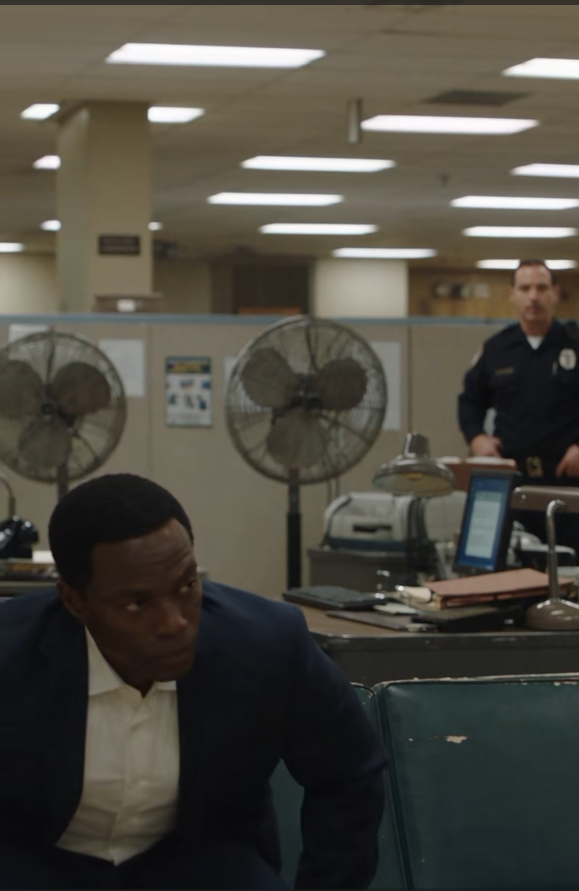
One officer intimidated a business owner.
Another altered a log.
A supervisor dismissed a complaint.
Someone in records removed a video.
Someone in command signed off.
Someone who knew better stayed quiet.
Each step small enough to defend by itself.
Together, they built machinery.
Kendrick lowered the ice pack.
“Where’s O’Malley?”
“Conference room two.”
“Talking?”
“Not yet.”
“Phone?”
“Seized.”
“Computer?”
“Being imaged.”
“Records room?”
The lead agent hesitated.
“What?”
“We found active shredding.”
Kendrick looked at him.
“When?”
“Looks recent.”
“How recent?”
“Machine’s warm.”
Kendrick stood.
The lead agent said, “Sit down.”
“I’m fine.”
“You’ve got a swelling eye and blood on your shirt.”
“I’ve had worse meetings.”
“This wasn’t the meeting.”
Kendrick looked toward conference room two.
“No. The meeting’s starting now.”
The records room was colder than the bullpen because portable cooling units had been set up to protect the server racks.
The temperature difference hit Kendrick’s skin immediately.
Inside, technicians photographed everything before touching it.
Cabinets stood open.
Boxes were marked.
A heavy industrial shredder sat near a rear wall.
Its collection bin was half full.
An evidence technician held up a gloved hand.
“Don’t cross the tape.”
Kendrick stopped.
“What was shredded?”
“Too early.”
“Paper type?”
“Mixed.”
“Can you reconstruct?”
“Some.”
“How much?”
“Depends whether they cross-cut everything twice.”
Kendrick looked at the bin.
Thin strips of white paper.
Manila stock.
Blue carbon copies.
One piece of red lettering.
He recognized the color format used on internal complaint routing sheets.
His expression did not change.
“Photograph the contents before removal.”
“Already done.”
“Prioritize complaint numbers.”
The technician nodded.
From the hallway came raised voices.
Kendrick stepped out.
Rourke was arguing with an agent.
“I’m telling you, I need to call my union rep.”
“You can make legal calls when processing permits.”
“I’m not being processed.”
“Then stop acting like you are.”
Rourke saw Kendrick.
“You.”
Kendrick stopped.
The supervising agent shifted position.
Rourke pointed at him.
“This whole thing was a setup.”
Kendrick said, “The warrant was signed before you hit me.”
“You came in here looking for trouble.”
“I came in here for a meeting.”
“You were sitting there watching people.”
“That tends to happen when you have eyes.”
Rourke’s mouth tightened.
“You think you’re funny?”
“No.”
Kendrick stepped closer, not aggressively, just enough to make Rourke stop pointing.
“I think you made a decision in about four seconds based on what you thought I was.”
Rourke stared at him.
“You reached into your coat.”
“I explained the movement before I made it.”
“You expect me to gamble my life on your explanation?”
“No.”
Kendrick’s voice stayed level.
“I expected you to wait one second longer.”
That hit harder than shouting would have.
Rourke looked past him.
“I’ve been doing this fifteen years.”
Kendrick nodded.
“That’s what concerns me.”
The supervising agent stepped between them before Rourke could answer.
“That’s enough.”
Kendrick walked away.
Behind him, Rourke said, “You people already decided what this place is.”
Kendrick stopped but did not turn.
“No,” he said. “Your records did.”
Captain O’Malley did not ask for a lawyer immediately.
That surprised Kendrick.
Not because innocent people always spoke.
They did not.
And guilty people did not always stay silent.
What mattered was strategy.
O’Malley sat at one end of conference room two with a bottle of water untouched in front of him.
His glasses rested folded beside it.
Kendrick sat across from him.
Another federal agent occupied the corner.
The room’s blinds were closed.
O’Malley looked at Kendrick’s cheek.
“That looks painful.”
Kendrick said, “You should see the wall.”
O’Malley almost smiled.
Almost.
“Rourke shouldn’t have hit you.”
Kendrick waited.
“That what you wanted me to say?”
“No.”
“You think I told him to?”
“No.”
“Then why am I here?”
Kendrick folded his hands.
“Fourteen months.”
O’Malley’s expression barely shifted.
“That’s how long we’ve been looking at your department.”
“Looking at what?”
“Missing dash-camera files.”
“No system is perfect.”
“Evidence discrepancies.”
“Human error.”
“Cash payments from businesses.”
O’Malley leaned back.
“That’s an accusation.”
“Yes.”
“Protected narcotics dealers.”
“Another accusation.”
“Excessive-force complaints disappearing after command review.”
O’Malley’s face hardened.
“Be careful.”
Kendrick held his gaze.
“I’ve been careful for fourteen months.”
Silence.
The air-conditioning in the conference room worked only weakly. A ceiling vent clicked.
Kendrick continued.
“Your name appears often.”
“Because I run the building.”
“Your signature appears on complaint closures.”
“That’s my job.”
“Your phone records overlap with officers we’re investigating.”
“I supervise officers.”
“Your financial records show deposits that don’t match salary.”
O’Malley did not move.
Kendrick leaned back slightly.
There.
First real reaction.
Not visible to most people.
Just a pause in breathing.
O’Malley looked at the water bottle.
“I want counsel.”
“Of course.”
Kendrick rose.
O’Malley said, “You think Rourke helped you.”
Kendrick stopped.
O’Malley’s eyes remained on the bottle.
“Excuse me?”
“The punch.”
Now he looked up.
“You think it proves your theory about this place.”
Kendrick said nothing.
O’Malley continued.
“One hotheaded officer makes a stupid decision and suddenly that becomes evidence of institutional corruption.”
“No.”
Kendrick walked toward the door.
“The institutional part was everybody watching.”
O’Malley’s face stayed still.
Kendrick opened the door.
“And nobody looking surprised.”
By early evening, the headquarters search had expanded.
The public entrance remained closed.
Outside, news vehicles had gathered beyond the parking-lot boundary despite efforts to keep the operation quiet.
No agency had released details.
That did not matter.
A federal search of a police headquarters generated its own weather.
Inside, evidence technicians recovered deleted administrative emails.
A secondary accounting ledger appeared on a command office computer.
Several complaint files listed as archived could not be physically located.
Kendrick moved between teams, answering questions and identifying priority material.
At 6:20, he finally sat down again.
His eye had darkened.
The cut was small.
His headache was not.
The lead agent handed him coffee.
“You look terrible.”
“Thank you.”
“You should go get checked.”
“After we finish the initial inventory.”
“We’ll still be here at midnight.”
“Then I’ll look worse at midnight.”
The agent sat beside him.
For a minute they watched technicians carry sealed boxes through the lobby.
Rourke was no longer visible.
“Where is he?”
“Interview room.”
“Voluntary?”
“For now.”
“Talking?”
“Too much.”
Kendrick took a sip.
“That sounds like him.”
“He says you provoked him.”
“With my face?”
The agent glanced over.
Kendrick stared into the coffee.
The joke had come out flatter than he intended.
The agent said nothing.
Kendrick appreciated that.
After a moment, he asked, “What are the two witnesses saying?”
“One says he saw Rourke strike you after you announced you were reaching for ID.”
“And the other?”
“Doesn’t remember the exact sequence.”
Kendrick nodded.
“Of course.”
“He’s nervous.”
“He’s trained to testify in felony cases.”
“That doesn’t make him brave inside his own department.”
Kendrick looked across the bullpen.
“That’s the case.”
“What is?”
“The second officer.”
The agent frowned.
Kendrick pointed subtly.
“One says what he saw. The other forgets because remembering has a cost.”