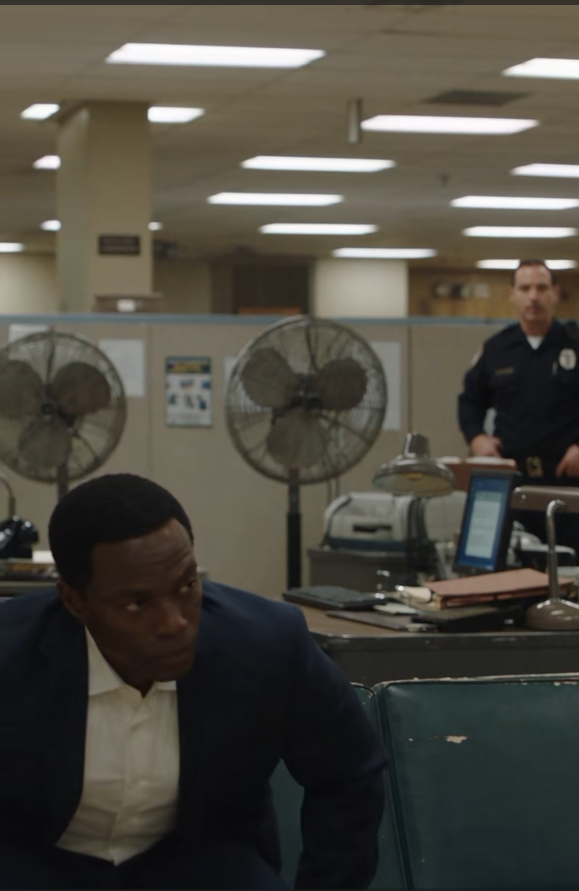
The agent leaned back.
“You think he’s dirty?”
“I think corruption survives on more people than the ones taking money.”
That stayed between them for a while.
At 6:43, an evidence technician approached.
“We found something.”
Kendrick stood.
“What?”
“Video archive.”
“Deleted files?”
“Some.”
“From where?”
“Local server mirror.”
Kendrick followed him.
The file directory contained old dash-camera recordings.
Many were routine.
Traffic stops.
Domestic calls.
Business checks.
But several deleted videos corresponded to complaint numbers already in the federal case file.
The technician opened one.
The timestamp was nearly a year old.
A patrol car sat outside a convenience store at night.
Audio began.
A business owner’s voice.
Then an officer’s.
The image angle was imperfect.
But the exchange was clear enough.
Money changed hands.
Not a misunderstanding.
Not a gratuity.
Not an ambiguous gesture.
Cash.
Kendrick watched without speaking.
Then another clip.
An officer removing a sealed narcotics envelope from a bag and returning it minutes later.
Another.
A detainee against a wall.
An officer using force after the man was already restrained.
Then a supervisor walking into frame.
Not O’Malley.
The video ended.
Kendrick said, “Why was this mirrored?”
“Automatic backup. Somebody deleted the user-facing copy but missed an old maintenance partition.”
There it was.
The kind of mistake cases depended on.
Not luck.
Human overconfidence.
Kendrick looked at the technician.
“Preserve everything twice.”
“Already doing it.”
“Hash values.”
“Running.”
Kendrick stared at the paused image.
One missing file had started the case.
Now the missing files were talking.
Part III — Reversal
By 9:00 p.m., Travis Rourke had changed his story three times.
First, he said Kendrick had moved suddenly.
Then he said Kendrick had ignored commands.
Then he said Kendrick’s jacket had opened enough for him to believe there might be a weapon.
The lobby security camera showed something else.
Kendrick standing.
Hands visible.
Speaking.
A slow reach.
Rourke closing distance.
The strike.
No audio.
But there were witnesses for that.
The first officer repeated his account.
The second still claimed uncertainty.
Kendrick watched both interviews from an adjacent room through a video monitor.
The first officer sat rigidly, hands together.
“I heard Agent Hayes tell Officer Rourke his credentials were inside his jacket.”
“Exact words?”
“Something close to that.”
“Did Agent Hayes make any sudden movement?”
“No.”
“Did you see a weapon?”
“No.”
“Did you believe Officer Rourke was in immediate danger?”
A pause.
“No.”
The second officer was different.
“I was doing paperwork.”
“You looked toward them before the strike.”
“I heard voices.”
“What did you hear?”
“I’m not sure.”
“Did you hear Agent Hayes explain he was reaching for identification?”
“I don’t remember.”
“Did you see his hands?”
“Not clearly.”
Kendrick paused the recording.
The lead agent beside him said, “You know him?”
“No.”
“Then why do you look like that?”
“Because he keeps answering questions that weren’t asked.”
The agent waited.
Kendrick rewound.
The interviewer had asked whether the officer saw Kendrick’s hands.
The officer had answered not clearly.
But earlier, he had volunteered that Kendrick “might have been reaching inside the jacket.”
To see that movement, he would have had to see the hand.
Kendrick played it again.
The lead agent nodded slowly.
“He’s protecting Rourke.”
“Or protecting himself.”
“From what?”
“That’s the question.”
Kendrick stood.
His headache had settled behind his left eye.
He ignored it.
“Pull his complaint-review history.”
“You think he’s involved?”
“I think he’s afraid of saying what he saw.”
“That could just be culture.”
Kendrick opened the door.
“Culture leaves paperwork.”
At 10:18 p.m., technicians found a second ledger.
Not financial.
Personnel.
A spreadsheet buried inside a password-protected folder on a command workstation.
The column labels looked harmless.
A.
B.
C.
Each officer’s name had one.
No explanation.
But when investigators cross-referenced the categories with known complaint histories, a pattern emerged.
A officers received favorable assignments and overtime.
B officers were ordinary.
C officers were transferred, denied specialty slots, or placed on unpopular shifts.
The first officer who had corroborated Kendrick’s account was listed B.
The second was A.
Rourke was A.
Kendrick stared at the screen.
O’Malley was more systematic than they had known.
Not merely corrupt.
He was managing loyalty.
One of the technicians opened metadata.
The file had been modified repeatedly over eighteen months.
User credentials traced back to O’Malley’s office account.
Kendrick sat down.
“Print nothing.”
The technician looked at him.
“Digital preservation only until counsel reviews chain.”
“Got it.”
Kendrick called the prosecutor assigned to the case.
He summarized the discovery.
There was silence on the line.
Then: “That changes the theory.”
“It confirms it.”
“It shows favoritism.”
“It shows control.”
“Potentially.”
Kendrick looked through the glass at the bullpen.
Rourke sat alone at a desk under supervision.
The second witness officer was back in a chair near dispatch, staring at the floor.
Kendrick said, “People here weren’t just covering misconduct. They were being trained which side of the building they wanted to live on.”
The prosecutor said, “Don’t outrun the evidence.”
“I’m not.”
“You’re angry.”
Kendrick’s voice cooled.
“Am I wrong?”
A pause.
“No.”
“Then don’t confuse the bruise with the case.”
The prosecutor exhaled.
“All right. We’ll draft supplemental seizure authority for personnel systems if needed.”
“We already have administrative records within scope.”
“Good. Preserve first. Interpret later.”
“That’s what I’m doing.”
After the call, Kendrick stayed seated.
Anger was not useful unless you could separate it from judgment.
He had spent years learning that.
Civil-rights cases made anger easy.
The facts often came with images that were hard to watch and witnesses who had already been ignored by systems designed to receive complaints.
But outrage did not authenticate evidence.
It did not establish intent.
It did not survive cross-examination.
Facts did.
So Kendrick forced himself back to facts.
Rourke had hit him.
That mattered.
But Rourke was not the whole case.
The greater danger was letting the punch make him see every document through the bruise.
He wrote three words on a legal pad.
Prove. Don’t assume.
Then he underlined them once.
Near midnight, O’Malley’s attorney arrived.
The captain refused further questioning.
That was expected.
What was not expected was the attorney’s first request.
“My client wants to know whether Officer Rourke has been arrested.”
Kendrick looked across the table.
“Why?”
“I’m asking.”
“And I’m asking why your client cares.”
The lawyer gave him a thin smile.
“He runs the department.”
“Not tonight.”
The smile disappeared.
Kendrick leaned back.
“Rourke hasn’t been arrested.”
“Will he be?”
“That depends on evidence and charging decisions.”
O’Malley sat beside his attorney, silent.
Kendrick watched him.
“You worried about him?”
The lawyer said, “Agent Hayes.”
Kendrick kept his eyes on O’Malley.
“Captain?”
O’Malley finally said, “He’s one of my officers.”
“So are fifty other people in this building.”
No answer.
Kendrick let the silence stretch.
O’Malley looked at his lawyer.
The lawyer stood.
“We’re done.”
They left.
The lead agent, seated against the wall, waited until the door closed.
“What was that?”
Kendrick looked at the empty chair.