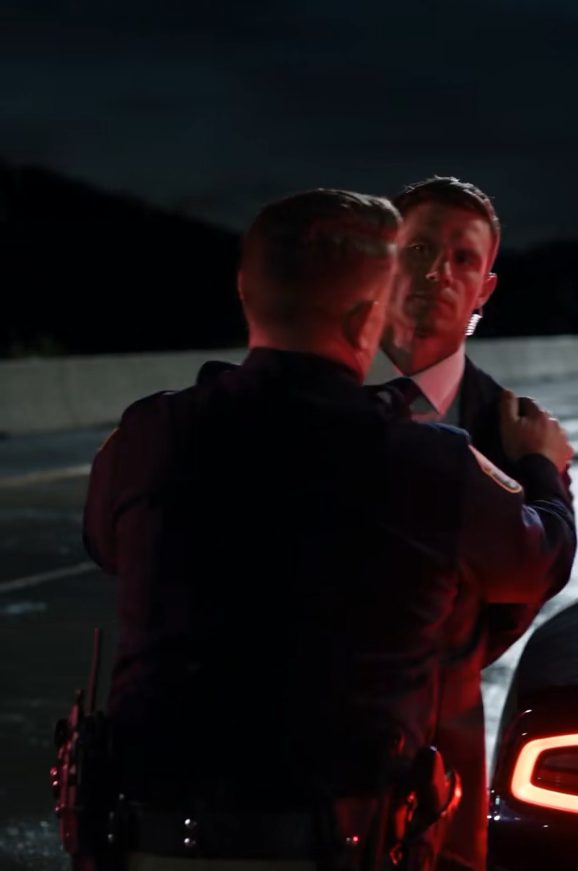
Local units were assigned to outer traffic control.
Mitchell’s unit number was not at Delta.
It was not anywhere near Delta.
Harris enlarged the county map.
Mitchell had been assigned north of the route.
Seventeen miles away.
“Maybe he drifted,” Harris said.
“Seventeen miles?”
“Cops freelance.”
“Not through two roadblocks.”
That was the issue.
To reach the maintenance entrance where I first saw him, Mitchell had to cross into a corridor that local agencies had already been told was restricted.
Harris opened another file.
“County AVL.”
Automatic vehicle location.
The system that tracked patrol cars.
A blue line appeared.
Mitchell’s cruiser had traveled south from his assigned sector forty-three minutes before the motorcade.
It stopped for seven minutes near a service station.
Then continued toward the secured highway.
At 10:41 p.m., its location feed froze.
According to the county system, the cruiser remained parked beside a frontage road.
But eighteen minutes later, it appeared behind me.
“GPS failure?” I asked.
“Possible.”
“Along with the radio?”
“That’s becoming a lot of possible.”
A knock came at the door.
A county supervisor entered carrying a sealed evidence bag containing Mitchell’s body camera.
He looked like a man who had spent the night discovering new definitions of bad.
“Camera was powered down,” he said.
Harris did not react.
“When?”
“Twenty-two minutes before the stop.”
“Manually?”
“Yes.”
I leaned back.
Radio.
Body camera.
Location feed.
All unavailable.
Harris asked, “What does Mitchell say?”
The supervisor’s mouth tightened.
“He says he was investigating a suspicious vehicle.”
“My vehicle.”
“Yes.”
“Why?”
“He claims he believed your federal plates might be counterfeit.”
Harris looked at me.
I said, “Based on what?”
“He hasn’t explained that.”
“Has he explained why he left his assigned sector?”
“No.”
“Radio?”
“Says he was experiencing intermittent system problems.”
“Camera?”
“He says he shut it down because it was malfunctioning.”
“Location?”
“No explanation.”
Harris rubbed one thumb over the edge of the table.
The gesture meant he was thinking.
“What does his disciplinary record look like?”
“Not my department.”
“That wasn’t what I asked.”
The supervisor hesitated.
“Mostly clean.”
“Mostly.”
“One prior complaint about an off-book vehicle stop.”
That got my attention.
“How long ago?”
“Eight months.”
“What happened?”
“He stopped a sedan displaying federal government plates. Driver turned out to be a contractor carrying expired credentials.”
“Counterfeit?”
“No.”
“Criminal?”
“No.”
“Then why the complaint?”
“Mitchell detained him after dispatch told him the vehicle was authorized.”
Harris’s expression did not change.
“How long?”
“Forty-one minutes.”
There it was.
Not a conspiracy.
Not yet.
A pattern.
“What was the disposition?” I asked.
“Counseling. Additional training.”
“And Mitchell’s position?”
“He believed supervisors were too quick to accept government credentials.”
Harris stared at the route map again.
“Bring me the complete file.”
The county supervisor left.
For several minutes, Harris said nothing.
I knew what he was considering because I was considering the same thing.
One explanation was sinister.
Mitchell had deliberately penetrated a protected route and disabled multiple accountability systems because he intended to disrupt the motorcade.
The other was simpler.
He believed he was the smartest cop in every room.
Simple did not mean harmless.
Ego mixed with authority can create the same operational effect as malice.
Harris closed the map.
“You think he targeted you.”
“Yes.”
“Because of the plates.”
“Maybe.”
“Not the protectee.”
“I don’t know.”
“You think he knew Eagle route?”
“If he did, he knew enough to enter at the worst possible moment.”
Harris looked at the clock.
“County investigators interview him at nine.”
“I want to be there.”
“No.”
“He cuffed me.”
“Exactly.”
“I’m also the advance agent whose route he compromised.”
“You’re a witness.”
“I can sit behind the glass.”
Harris considered it.
Then he shook his head.
“You’re going to medical.”
“Harris.”
“That wasn’t a negotiation.”
I held up my wrist.
“I can still move my hand.”
“Excellent. You can use it to sign the medical release.”
I started to answer.
He cut me off.
“Then you sleep for four hours.”
“I’m fine.”
“You’ve said that enough times that I’m beginning to doubt it.”
He picked up his jacket.
At the door, he stopped.
“There is one more thing.”
“What?”
“The alternate hold worked.”
I knew what he meant.
The primary package had stopped before entering the compromised checkpoint.
“Because my unit went silent.”
“Because you followed procedure before you went silent. You set Delta as unconfirmed until visual verification. Command honored it.”
“That’s the system.”
“Yes.”
He looked back at the glowing route map.
“And systems are what we’re going to be talking about for a while.”
Part III — The Officer Who Didn’t Trust the Screen
I slept for ninety-three minutes.
At noon, I was back.
Harris didn’t bother pretending to be surprised.
He handed me a sandwich without comment.
“Interview is done.”
“And?”
“He admits turning off the body camera.”
“Reason?”
“He didn’t want the encounter prejudged.”
I stopped opening the sandwich.
“What does that mean?”
“He believes recordings make supervisors focus on procedure instead of intuition.”
“That’s convenient.”
“Yes.”
“The radio?”
“Also deliberate.”
I looked at him.
“He admitted it?”
“Eventually.”
Harris sat across from me.
“He says he didn’t trust dispatch to let him complete the stop.”
There was a strange moment when the entire incident became easier to understand and harder to accept.
I had expected something more complicated.
A payoff.
A plot.
An outside instruction.
Instead, the man had disconnected himself because he expected his own chain of command to tell him no.
“Why me?”
“He saw the plates.”
“That’s it?”
“Not exactly.”
Harris slid a printed photo across the table.
It showed the rear of my sedan.
Federal government plate.
Dark paint.
Temporary route transponder mounted inside the rear glass.
Nothing unusual unless you knew what to look for.
Then I saw it.
The registration verification sticker in the lower corner was wrong.
Not fake.
Wrong.
The fleet sedan had been swapped into our package less than six hours before the movement because the original advance car developed a transmission warning.
The replacement vehicle had federal registration, but the county interoperability database had not yet updated the verification token attached to the plate.
To us, it was irrelevant. We verified vehicles internally.
To a local officer using the county mobile system, the plate returned a delayed validation code.
Not stolen.
Not counterfeit.
Delayed.
“What did his terminal show?” I asked.
Harris handed me another page.
FEDERAL REGISTRATION — RECORD PENDING SYNCHRONIZATION.
“That’s not a stolen hit.”
“No.”
“It doesn’t say fraudulent.”
“No.”
“It says pending synchronization.”
“Correct.”
I put the page down.
“And he decided that meant counterfeit.”
“He says it reminded him of the contractor stop.”
“Where the vehicle was also legitimate.”
“Correct.”
I leaned back.
Harris took a drink of water.
“There’s more.”
“There usually is.”
“When Mitchell ran your plate, county dispatch called him.”
“Before he stopped me?”
“Yes.”
“How long before?”
“Three minutes.”
My jaw tightened.
“What did they tell him?”
“They told him the road was under federal closure and instructed him to hold his position until the vehicle could be verified.”