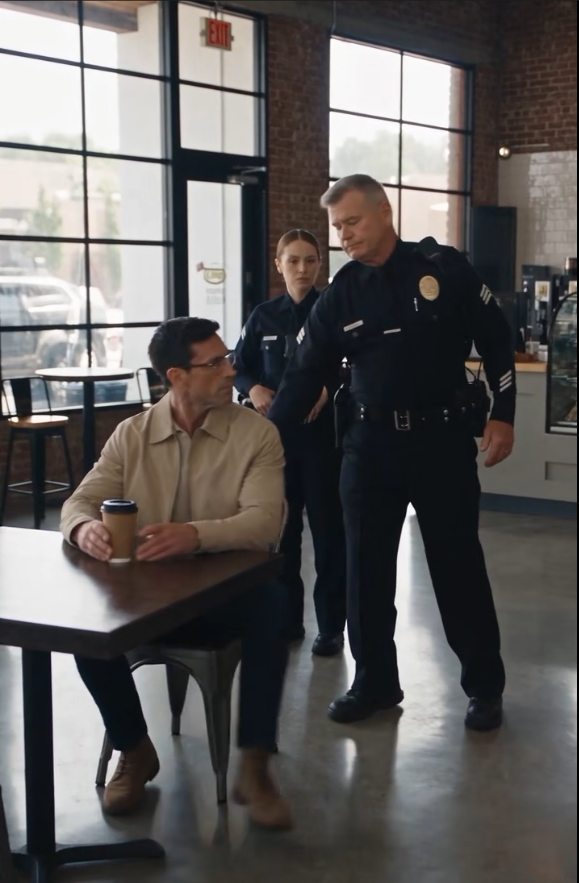
He leaned forward.
“Let me explain something to you. Downtown business owners call us when people make customers uncomfortable.”
“Did Nora call you?”
He ignored the question.
“People have complained.”
“Who?”
“That’s not your concern.”
“What did they complain about?”
He placed both palms on the table.
“You asking questions now?”
“You arrested me. I’d like to know why.”
“I told you why.”
“No. You gave me charges.”
The muscles around his mouth tightened.
I kept my tone level.
“What did I do?”
“You refused a lawful order.”
“An order to leave private property?”
“Yes.”
“Given by you?”
“Yes.”
“On whose authority?”
He sat back.
“There it is.”
“What?”
“The attitude.”
I almost smiled.
I had read that word in fourteen complaint files.
Attitude.
Not conduct.
Not threat.
Not interference.
Attitude.
“What attitude?”
“You think because you can speak in complete sentences, you’re smarter than everybody wearing a badge.”
“I haven’t said anything about your badge.”
“You don’t have to.”
I looked at him.
For the first time, I understood something the complaint files had not fully captured.
Thornton did not simply react to defiance.
He interpreted calmness as defiance.
If a person argued, he saw resistance.
If a person remained composed, he saw contempt.
The only acceptable response was submission.
He stood.
“You’re staying here until you understand how things work.”
I said nothing.
He walked to the door.
Before opening it, he turned back.
“You had your chance to walk out.”
Then he left.
I sat alone for eleven minutes.
I counted them by the wall clock.
At minute twelve, voices rose outside.
Thornton’s first.
Then Nora’s.
I straightened.
The door was closed, but old buildings carried sound.
“I never said that.”
Nora.
Thornton answered too quietly for me to catch.
Then Nora again.
“No. I told you I didn’t ask him to leave.”
Silence.
Thornton said something.
Nora’s voice sharpened.
“I’m not signing that.”
My cuffed hand went still.
There it was.
Not the arrest.
The correction.
The moment after the event when reality became inconvenient.
Footsteps approached.
The door opened.
Thornton stood there.
Behind him, I could see Nora near the hallway entrance.
Her arms were folded.
Ray was not with her.
Good.
Thornton entered and closed the door.
He did not sit.
“You know Nora?”
“I buy coffee from her.”
“She says you’re there every morning.”
“That sounds right.”
“She says you’ve never caused trouble.”
“I haven’t.”
His stare hardened.
“You two friends?”
“No.”
“You paying her?”
“No.”
His eyes narrowed.
“Why would I be paying her?”
“You tell me.”
I let the silence sit.
Thornton hated silence.
I had already learned that.
Finally he said, “You know what happens when people start interfering with police investigations?”
I looked at him.
“Is that what Nora is doing?”
“I’m asking the questions.”
“Then ask one.”
For the first time that morning, Thornton’s control slipped.
Only a fraction.
He leaned across the table.
“Who are you?”
The question was different from everything before it.
Not What are you doing?
Not Why are you here?
Who are you?
Something in my behavior had begun bothering him.
Maybe it was the way I watched.
Maybe it was the fact that I was not asking to call a lawyer.
Maybe Nora’s refusal had made him realize the scene was not forming into the story he expected.
I gave him the same answer my cover file would.
“Aaron Cole.”
“That’s not what I asked.”
“It’s my name.”
He stared at me another second.
Then left.
The door slammed hard enough to rattle the metal frame.
I exhaled slowly.
The harder choice had arrived sooner than I wanted.
I could end my cover now.
Or I could let Thornton keep writing.
Part III — The Report
An hour after my arrest, Officer Sullivan entered the interview room carrying a paper cup of water.
She set it in front of me.
“Your cuff okay?”
“It’s fine.”
She glanced at my wrist.
Thornton had tightened the restraints more than necessary at the coffee shop. There was a red line around the skin, but nothing serious.
Sullivan sat.
“This isn’t an interview.”
“Okay.”
“I’m checking on you.”
“Okay.”
She looked irritated by my answers.
“Do you always talk like that?”
“Like what?”
“Like every word is going into a transcript.”
I met her eyes.
“Isn’t it?”
She glanced instinctively toward the camera.
That told me more than her answer would have.
She leaned back.
“You’re not a retired principal.”
“Administrator.”
“Whatever.”
“What makes you think that?”
“You’re too calm.”
I smiled slightly.
“I’ve met calm school administrators.”
“Not while handcuffed to police furniture.”
“That depends on the school district.”
For half a second, her mouth almost moved.
Then the moment vanished.
She folded her arms.
“Thornton is writing the report.”
“I assumed.”
“He says you refused repeated orders to leave after the business requested assistance.”
I watched her.
“What does your body camera show?”
Her expression closed.
“I didn’t say I agreed with him.”
“No. You didn’t.”
“He says you pulled away.”
“I stood when he pulled me out of the chair.”
“I know.”
That answer mattered.
I waited.
Sullivan looked toward the closed door.
“I saw what happened.”
“Then write what happened.”
“You think it’s that easy?”
“No.”
That surprised her.
Most people telling officers to do the right thing imagine the choice exists in isolation.
It does not.
A person may have a mortgage.
Children.
A partner.
A pension.
A supervisor who decides schedules, assignments, promotions.
Doing the right thing can still have a cost.
Understanding that cost does not erase responsibility.
But ignoring it makes courage sound cheap.
I said, “If it were easy, it wouldn’t matter what you chose.”
She looked away.
I let the silence do its work.
Finally she said, “He’s been chief nine years.”
“I know.”
Her head snapped back.
A beat too late, I realized the mistake.
“How do you know?”
I corrected without rushing.
“People talk. He’s a public official.”
She studied me.
“People talk about you too?”
“Not much.”
“I’m starting to think that’s intentional.”
The door opened before I could answer.
Thornton stood there.
“Sullivan.”
She rose.
“Chief.”
“Report done?”
“Working on it.”
“Finish it.”
She left.
Thornton remained in the doorway.
For a moment I thought he would come in.
Instead he said, “You get one phone call.”
“Now?”
“Unless you’d rather wait.”
“I’ll make it.”
He led me to a phone in a small side room.
My cuff was secured in front this time.
There was no privacy.
That was fine.
The number I dialed belonged to a line established for the operation.
A woman at our office answered.
“Hello?”
“It’s Aaron.”
A pause.
Not too long.
“You all right?”
“I spilled my coffee.”
Another pause.
“Anything else?”
“My morning may run longer than expected.”
“Understood.”
“I’ll call when I’m done.”
Thornton watched me.
“That your wife?”
“No.”
“Girlfriend?”
“No.”
“Who?”
“Friend.”
He took the phone from me.
“Conversation’s over.”
Back in the hallway, Sullivan was standing at a terminal.