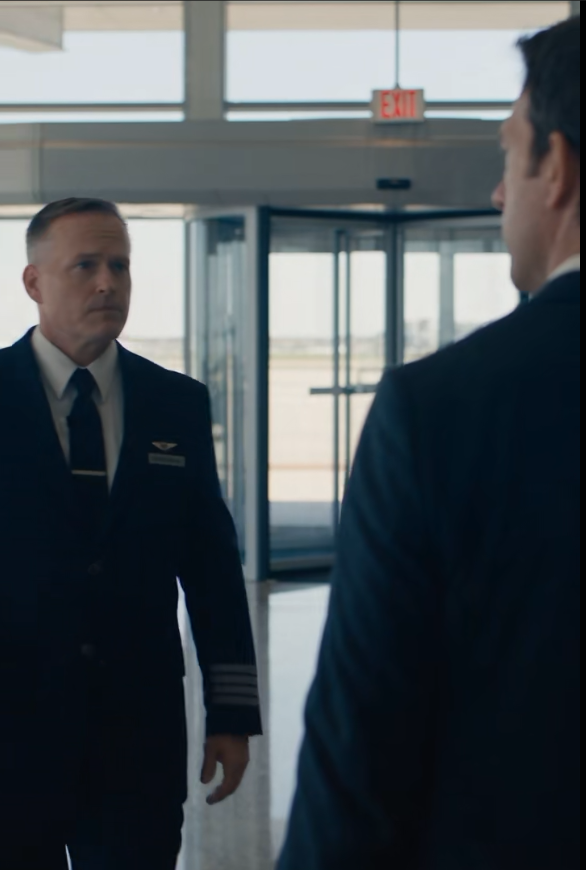
Sarah entered through the side door with Reed and took a seat against the wall.
No uniform.
No entourage.
No visible rank.
Just a dark suit.
Boyd saw her immediately.
His expression changed.
He leaned toward his attorney.
The hearing began.
County counsel summarized the basis for suspension: discrepancies between Boyd’s report and video evidence, coercive treatment of a subordinate, and attempted unauthorized access to preserved records.
Boyd’s attorney attacked each point.
The traffic stop, he argued, required split-second judgment.
The supplemental report had merely been a draft.
The server access had concerned personal administrative files.
Then Boyd asked to speak.
His attorney hesitated.
Boyd insisted.
He approached the microphone.
For several minutes he described himself as a career lawman being punished for refusing to bow to federal intimidation.
Then he looked directly at Sarah.
“This entire thing happened because one woman couldn’t stand being told what to do.”
Reed shifted beside her.
Sarah remained still.
Boyd continued.
“She had one goal from the beginning. Make me look like some kind of monster because I didn’t recognize her title.”
County counsel stood.
“That characterization is unsupported.”
Boyd ignored him.
“She knew who she was. She knew one phone call would bring the United States military down on this county. She wanted a spectacle.”
Sarah watched him.
There it was.
The argument he needed.
If the case could become about helicopters, rank, Washington, or federal arrogance, then it did not have to remain about a traffic stop.
Boyd pointed toward her.
“She could have identified herself at any moment. She chose not to. Ask yourselves why.”
The room turned toward Sarah.
Reed leaned closer.
“You don’t have to answer.”
Sarah looked at Toby.
He sat rigidly, eyes lowered.
She understood then why he had wanted her present.
Not to rescue him.
To refuse Boyd’s version in person.
Sarah stood.
County counsel approached.
“General Hayes, you are not required to testify at this hearing.”
“I understand.”
Boyd’s attorney rose.
“We object to unscheduled testimony.”
The commission chair conferred with counsel.
After several minutes, Sarah was permitted to make a limited statement concerning Boyd’s claims about her conduct.
She walked to the microphone.
The room became quiet.
No rotor blades.
No secure phones.
No uniforms.
Just a woman standing beneath fluorescent lights.
The chair asked, “Please state your name for the record.”
“Sarah Hayes.”
“Occupation?”
Sarah paused.
Then said, “United States Army officer.”
Boyd looked irritated by the understatement.
“Rank?”
“Brigadier general.”
The chair nodded.
“Sheriff Cleary has asserted that you intentionally concealed your status in order to provoke or manufacture an incident. Is that accurate?”
“No.”
“Why did you not identify yourself by rank?”
Sarah looked toward the commissioners.
“Because he did not pull over Brigadier General Sarah Hayes.”
She paused.
“He pulled over a driver.”
No one moved.
Sarah continued.
“I gave him my lawful driver’s license. I told him where my documents were. I kept my hands visible. I complied when he ordered me out of the vehicle. I complied when he ordered me to face the car.”
Boyd shifted in his seat.
Sarah’s voice remained level.
“He did not need my military rank to decide whether I crossed a yellow line. The camera answers that question.”
She looked at Boyd now.
“He did not need my title to decide whether I was speeding. The radar answers that question.”
Her gaze returned to the commission.
“He did not need Pentagon authorization to decide whether asking, ‘Am I receiving a citation or being detained?’ constituted disorderly conduct.”
Boyd’s attorney stood.
“Argumentative.”
Sarah stopped.
The chair said, “General Hayes, remain factual.”
“Yes, ma’am.”
She adjusted the microphone slightly.
“I did not reveal my military status because it was not relevant to the traffic stop.”
The chair asked, “Did you understand revealing it might have changed Sheriff Cleary’s behavior?”
“Yes.”
“And you chose not to?”
“Yes.”
“Why?”
Sarah looked around the hearing room.
She saw reporters.
Local residents.
Toby.
Boyd.
Reed.
Then she answered.
“Because lawful treatment that depends on knowing someone’s rank is not lawful treatment. It is favoritism.”
The sentence landed without force.
That made it stronger.
Sarah continued.
“I did not ask the military to intervene in the charges. I requested protection of a classified communications device and notification through my chain of command. I remained in custody. I completed booking. I appeared under the county’s release procedure. I have cooperated with state investigators.”
Boyd scoffed audibly.
Sarah looked at him.
The chair said, “Sheriff Cleary, do not interrupt.”
Sarah could have stopped there.
Her statement had answered the question.
Instead, she made the choice that would define the rest of the hearing.
It would have been easy to make Boyd the center of everything.
Easy to describe the humiliation.
Easy to use her position.
Easy to ask the commission to remove him.
She did none of those things.
“I do want to correct one other point.”
The chair nodded.
Sarah turned slightly.
“Deputy Toby Miller preserved the evidence before anyone knew what that evidence would show.”
Toby looked up.
Boyd’s expression darkened.
Sarah continued.
“He did not know whether the footage supported me or Sheriff Cleary. He preserved it anyway.”
She looked toward the commissioners.
“That matters.”
Toby swallowed.
Sarah said, “He was later asked to sign a statement about events he did not witness. He refused. That also matters.”
Boyd surged to his feet.
“He violated chain of command.”
His attorney grabbed his arm.
The commission chair struck the gavel.
“Sheriff, sit down.”
Boyd did not.
“He’s a deputy. He works for me.”
Toby rose slowly from his chair.
Boyd pointed at him.
“You think she’s going to save your career?”
Toby stared at the sheriff.
His voice shook at first.
“No.”
Boyd laughed.
“Then what are you doing?”
Toby looked around the room.
Then back at Boyd.
“My job.”
The words were quiet.
Boyd’s face reddened.
“Your job is to follow your sheriff.”
Toby answered, “My job is to follow the law.”
The room erupted in overlapping voices.
The chair struck the gavel repeatedly.
Reed remained seated.
Sarah stepped away from the microphone.
Boyd pulled free of his attorney’s hand.
“You self-righteous little—”
Two county deputies moved toward him.
He stopped.
Not because Sarah was a general.
Not because Reed was there.
Not because Washington had sent helicopters.
He stopped because his own deputies were standing between him and the witness table.
For the first time, Boyd Cleary seemed to understand the real nature of authority.
It existed only as long as others agreed to carry it for you.
The chair restored order.
Boyd sat.
Toby remained standing for another second, then returned to his chair.
Sarah watched him.
His hands were shaking.
He placed them flat on his knees.
The hearing continued.
The commission voted to maintain Boyd’s suspension pending state proceedings and the outcome of the broader civil-rights review.
There was no applause.
The chair prohibited it.
Outside, reporters crowded the steps.
Sarah intended to leave through the side entrance.
Toby found her in the hallway first.
For a moment neither knew what to say.