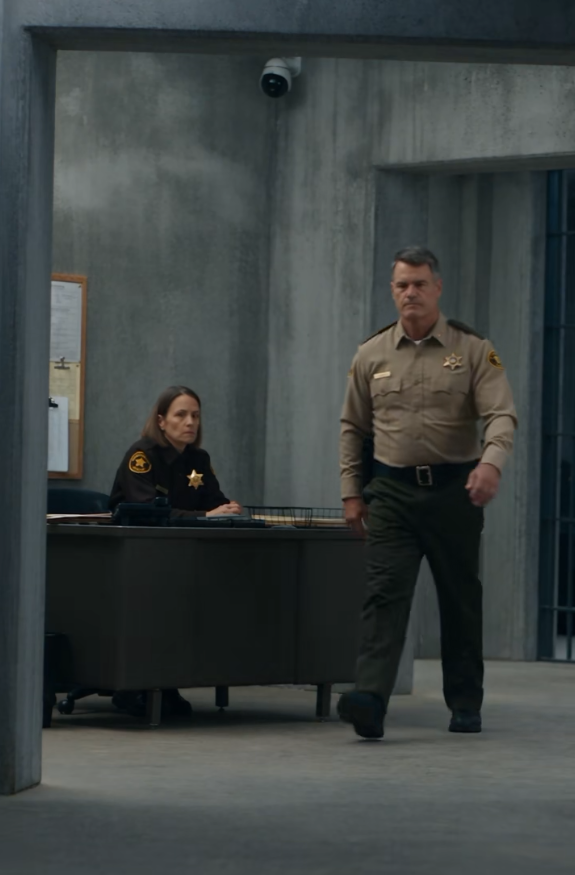
Hart said, “Do you want the interview clip?”
“No.”
“He also says Pentagon pressure caused the charges to be dropped.”
“Did the Pentagon direct the solicitor?”
“No.”
“Then we don’t answer nonsense with noise.”
Hart hesitated.
“Ma’am, with respect, this may be past the point where silence protects the process.”
Sarah leaned back.
“Who am I protecting by speaking?”
“The institution. Maybe yourself.”
“That’s not enough.”
Hart frowned.
“What would be enough?”
Sarah looked at him.
“The truth being clearer because I spoke, not simply louder.”
That evening, Lieutenant Colonel Shaw sent Sarah three documents.
The first was the transcript of the bodycam.
The second was Ryker’s written incident report.
The third was a newly obtained audit from the sheriff’s records system.
Sarah read the audit twice.
Then she called Shaw.
“What am I looking at?”
“Ryker’s report was edited Saturday morning.”
“I know that.”
“Look at the earlier autosave.”
Sarah opened it.
The first draft had been preserved automatically.
One line differed.
Current report:
Subject physically resisted by turning away and pulling arms forward during handcuffing.
Autosave:
Subject continued verbally challenging instructions during handcuffing.
Sarah sat still.
“No physical resistance in the first draft.”
“No.”
“When did he add it?”
“Saturday, 10:31 a.m.”
“And the Pentagon knew I’d been arrested by Friday at 4:04.”
“Yes.”
Sarah looked at the screen.
“So after the call, after release, and after he knew my identity, the account grew physical resistance.”
“Yes.”
Sarah rubbed her thumb once over her wrist.
The bruise was fading.
Shaw said, “That is significant.”
“It is.”
“There’s more.”
Sarah waited.
“The reckless-driving language was also added Saturday.”
“What did the first version list?”
“Disorderly conduct and resisting.”
Sarah closed the file.
“What exactly did Ryker say today about Pentagon interference?”
“He said he stood by the arrest but released you out of professional courtesy once your identity was confirmed.”
Sarah’s voice remained level.
“He’s still making rank the story.”
“Yes.”
“Then maybe I speak.”
Shaw said nothing.
Sarah continued.
“One interview.”
“With whom?”
“Local first.”
Shaw sounded surprised.
“Not national?”
“No.”
“Why?”
“Because Oak Haven is where the conduct occurred. The people there deserve the record without the town being turned into a backdrop for television.”
The interview took place Friday afternoon in a plain conference room at the county courthouse.
Sarah wore civilian clothes again.
Dark slacks.
Blue blouse.
No uniform.
No rank insignia.
The reporter was Lena Brooks, thirty-seven, born in the county, now working for a regional newspaper.
She placed a recorder on the table.
“General Reynolds, why agree to speak now?”
“Because the criminal case is over.”
“You could have spoken earlier.”
“Yes.”
“Why didn’t you?”
“I did not want public pressure substituting for review of the evidence.”
Brooks watched her.
“Sheriff Ryker says you withheld your rank.”
“I provided my driver’s license. It has my name.”
“That’s not what he means.”
“I know.”
“Why didn’t you tell him you were a major general?”
Sarah paused.
Because this was the question everyone wanted.
She answered it simply.
“Because I should not need to be a major general to ask why my car is being searched.”
Brooks did not interrupt.
Sarah continued.
“If I had said, ‘Sheriff, I’m a three-star general,’ and he had immediately changed his behavior, what would that have proven?”
“That status matters.”
“Yes.”
“And you wanted to know whether he would treat you the same without it?”
Sarah shook her head.
“No. I wasn’t conducting an experiment. I was tired. I was driving to see my aunt. I expected a traffic stop to be a traffic stop.”
Brooks leaned closer.
“Did you believe race played a role?”
Sarah was quiet for several seconds.
“I heard the sheriff say, ‘You people always have a speech ready.’”
“That’s on video?”
“Yes.”
“What did you think he meant?”
“I know how I received it.”
“That’s not an answer.”
“It’s the accurate answer. I cannot prove what was in his mind. I can tell you what he said, when he said it, and what he did afterward.”
Brooks studied her.
“People may find that cautious.”
“I am responsible for being accurate.”
“Were you angry?”
Sarah looked at the recorder.
“Yes.”
It was the first time she had said it aloud.
Brooks waited for more.
Sarah gave none.
Finally Brooks asked, “Did the Pentagon get you released?”
“No.”
“The call came five minutes after you were put in a cell.”
“Yes.”
“And you were released twenty-three minutes later.”
“Yes.”
“That looks connected.”
“It may have affected Sheriff Ryker’s decisions. You would have to ask him.”
“But did anyone from the Pentagon order your release?”
“No.”
“Did anyone threaten the sheriff?”
“Not to my knowledge.”
“Did your rank help you?”
Sarah’s eyes lifted.
“Yes.”
Brooks seemed surprised.
Sarah continued.
“My absence was noticed quickly because of my position. A missed secure briefing triggered calls that would not happen for most people. That is precisely why I do not think the lesson here should be that the system worked.”
Brooks sat very still.
Sarah said, “The system noticed me because I was a general. The law was supposed to protect me before anyone knew that.”
The quote ran the next morning.
It changed the story.
Not completely.
Stories rarely change completely.
But the focus shifted.
The bodycam became public through a records request.
People watched the stop instead of only arguing about summaries of it.
Miller’s words were heard.
Ryker’s were heard.
Sarah’s refusal to consent was heard.
So was Ryker’s response.
Whatever explains the attitude.
By Monday, the county commission called an emergency session.
Ryker refused to resign.
He sat at the long table in the public meeting room beneath fluorescent lights while residents filled the seats behind him.
Sarah did not attend.
She watched a recorded stream that evening from her aunt’s kitchen.
The meeting lasted four hours.
Some residents defended Ryker.
They called him tough.
They said outsiders were trying to destroy a man over one stop.
Others described experiences of their own.
Searches after traffic violations.
Threats of arrest for asking questions.
Charges reduced after defendants agreed not to complain.
Not all stories were documented.
Not all were comparable.
Sarah resisted the urge to treat them as proof.
Then Brenda Lawson stood.
The room quieted.
She wore a navy cardigan and carried no notes.
“My name is Brenda Lawson. I’ve worked dispatch twenty-three years.”
Ryker looked at her.
Brenda did not look back.
“I’m not here to tell you what happened on Route 119. The video does that.”
She paused.
“I’m here to tell you what happened afterward.”
Sarah leaned closer to the laptop.
Brenda described the Pentagon call.
Ryker’s conversation with Miller.
The body-camera upload.
The corruption claim.
The retention record.
She described Ryker ordering federal requests routed through him.
Then she said something Sarah had not expected.
“Friday evening, before I went home, I checked the holding log.”
Brenda looked toward the commissioners.
“There are supposed to be automated timestamps for detainee rights notifications. The notification entry for Ms. Reynolds showed 4:19 p.m.”
Sarah frowned.