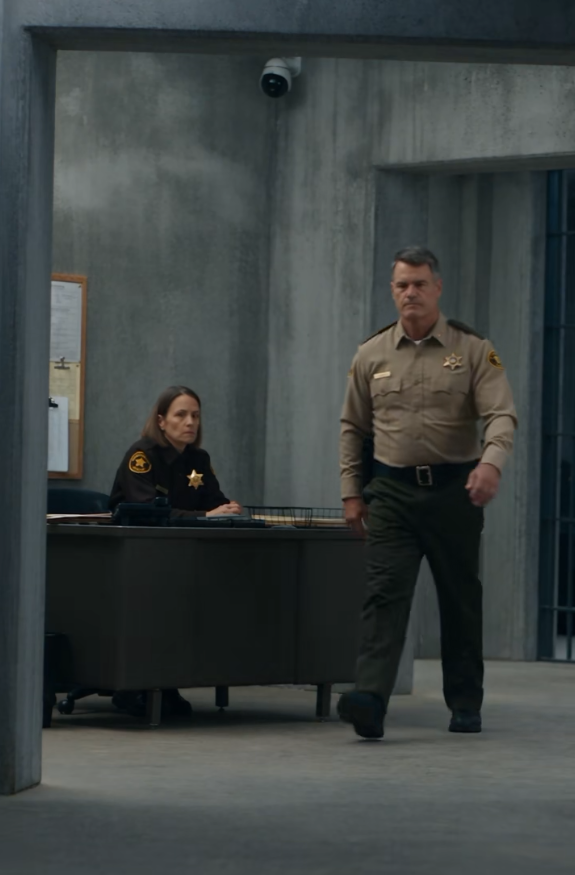
Ryker answered:
“Whatever explains the attitude.”
Bell stopped the footage again.
No one spoke.
Sarah stared at the frozen image.
The words were worse than she remembered.
Not louder.
Not more dramatic.
Just cleaner.
There was no emergency in them.
No fear.
No public-safety concern.
Only entitlement.
Bell said, “That sentence is going to matter.”
“Yes.”
The footage resumed.
Ryker opened the center console.
Miller said:
“She denied consent.”
Ryker replied:
“We’re inventorying.”
“The car’s not towed yet.”
“It will be.”
Sarah leaned closer to the screen.
There it was.
The sequence.
Search first.
Tow justification second.
The footage ended when Miller finally deactivated the camera after the sheriff drove away.
Bell stopped sharing.
Sarah sat silent.
Then she asked, “What is Miller’s current report?”
Bell read the key sections.
It matched the footage closely.
Not perfectly.
But closely enough.
“Sheriff’s report?” Sarah asked.
Bell summarized.
It did not.
Ryker claimed Sarah repeatedly refused orders.
Video showed compliance.
He claimed she pulled away.
Video showed no such movement.
He claimed reckless driving was the reason for arrest.
Video showed the arrest preceded discussion of any reckless-driving charge.
He claimed the vehicle search occurred incident to towing.
Video showed the decision to tow was made during the search itself.
Sarah looked down at the table.
Bell said, “The solicitor will likely dismiss the charges.”
“Likely?”
“He wants to interview Miller first.”
“Good.”
“And the county administrator wants the sheriff to issue a statement.”
Sarah’s head lifted.
“Do we control that?”
“No.”
“Then let them.”
Bell hesitated.
“There’s pressure for you to issue one too.”
“No.”
“Public affairs will want at least a confirmation.”
“Then confirm the basic fact if necessary. No accusation. No speech.”
Bell sounded almost amused.
“You know reporters are going to ask why you didn’t identify yourself.”
“I’ll answer that if and when I speak.”
“And what will you say?”
Sarah looked toward the conference-room window.
Soldiers moved across the courtyard outside, uniforms bright in the afternoon sun.
“I told the sheriff who I was legally required to tell him I was. My name.”
By Wednesday evening, the footage had not yet become public.
But the sheriff knew it existed.
County counsel called him at 4:50.
Ryker listened without interrupting.
Then he said, “That footage doesn’t show the whole context.”
“It shows most of the stop.”
“You weren’t there.”
“No.”
“She was provocative.”
“She was calm.”
“You’re taking her side.”
“I’m taking the county’s side.”
Ryker stood behind his desk.
“They’re coming after us.”
“No, Thomas. Right now the solicitor is reviewing possible charges against her.”
“Possible?”
“Yes.”
“And after?”
County counsel was silent.
Ryker understood.
“You think I’m exposed.”
“I think your written report conflicts materially with video evidence.”
“I wrote what happened.”
“Then explain the differences.”
“She kept turning.”
“Video shows one head movement.”
“She interfered.”
“By speaking?”
“She challenged every command.”
“She complied with the commands visible on video.”
Ryker’s voice hardened.
“You sound like her lawyer.”
“I am the county’s lawyer.”
“Exactly.”
The line went quiet.
County counsel said, “Do not alter any records.”
Ryker laughed once.
“You think I’m stupid?”
“I think you are angry. I’m telling you not to make an angry problem worse.”
The call ended.
Ryker remained standing.
Through the glass wall of his office, he saw Miller at a terminal.
Brenda at dispatch.
The booking officer carrying a file.
People he had known for years.
For the first time, the building felt hostile.
Not because anyone had openly turned against him.
Because he could no longer assume they would follow.
At 5:07, Ryker walked out.
“Miller. Office.”
Jared froze.
Then stood.
Brenda looked up.
Ryker noticed.
“You too, Brenda.”
She removed her headset.
Inside the office, Ryker shut the door.
He stayed standing.
“So apparently county legal found Jared’s video.”
Miller said nothing.
Brenda folded her hands.
Ryker looked at her.
“You knew that file existed.”
“I knew it uploaded.”
“You tell county?”
“No.”
“Pentagon?”
“No.”
“Then who put the retention hold on it?”
“County counsel.”
“How’d county counsel know the file number?”
Brenda held his gaze.
“Every bodycam file is tied to the CAD incident.”
Ryker stared at her.
“So anybody could find it.”
“If they knew how our system works.”
“And apparently everybody does now.”
Miller shifted.
Ryker turned on him.
“You happy?”
“No.”
“You got what you wanted.”
“I wanted the report to be accurate.”
“You think this makes you some hero?”
“No.”
“Because you’re in that video too.”
“I know.”
“You called her argumentative.”
“I know.”
“You extended the stop.”
“I know.”
“You stood there while I cuffed her.”
Miller’s face tightened.
“I know.”
That answer stopped Ryker.
Miller continued, voice low.
“That’s why I wrote what happened.”
Ryker stared.
Miller looked directly at him.
“I should’ve said something sooner.”
Brenda turned her face slightly toward him.
Ryker laughed without humor.
“So now we’ve got confession hour.”
“No, sir.”
“Get out.”
Miller remained still.
“Get out!”
He left.
Ryker looked at Brenda.
She stood.
He said, “You too.”
At the door, Brenda paused.
“I did tell you one thing.”
Ryker’s eyes narrowed.
“What?”
“Friday. After the call.”
He waited.
“You said outsiders didn’t care what happened to this department.”
She looked at him steadily.
“Neither did you.”
Then she left.
Part VI — Reckoning
The charges against Sarah Reynolds were dismissed Thursday morning before they were formally filed.
The county solicitor issued a short statement:
After review of available video, audio, reports, and witness accounts, the office found insufficient legal basis to pursue criminal charges arising from the traffic stop.
Sheriff Ryker issued his own statement forty-three minutes later.
It was longer.
It described the stop as “a rapidly evolving roadside encounter.”
It stated that deputies had acted “in good faith under circumstances requiring split-second judgment.”
It accused “outside institutions” of judging local law enforcement without understanding “the realities officers face.”
It did not mention the video.
By noon, local reporters had the booking record.
By two, a national outlet had confirmed Sarah’s rank.
By four, the story was everywhere.
Three-star Army general arrested in rural Georgia.
Pentagon calls sheriff.
Traffic stop raises questions.
Sarah declined every interview request.
At Fort Stewart, Colonel Hart found her in a planning room studying cargo throughput numbers.
He closed the door.
“Ma’am.”
“What?”
“You’re on every network.”
“I know.”
“Public affairs says they can’t hold the line much longer.”
“The line being?”
“No comment beyond confirming the arrest and dismissal.”
Sarah looked back at the screen.
“Then they know what to say.”
Hart did not leave.
Sarah finally looked at him.
“What?”
He chose his words carefully.
“People are filling in the silence.”
“They always do.”
“Some are saying you didn’t identify your rank because you wanted to trap the sheriff.”
Sarah’s expression barely changed.
“Some?”
“Ryker said in an interview that he believes you withheld your status strategically.”
Sarah looked away.
There it was.
The inversion.
The problem was no longer that he had arrested her without lawful basis.
The problem, according to Ryker, was that she had failed to prevent him from doing it.