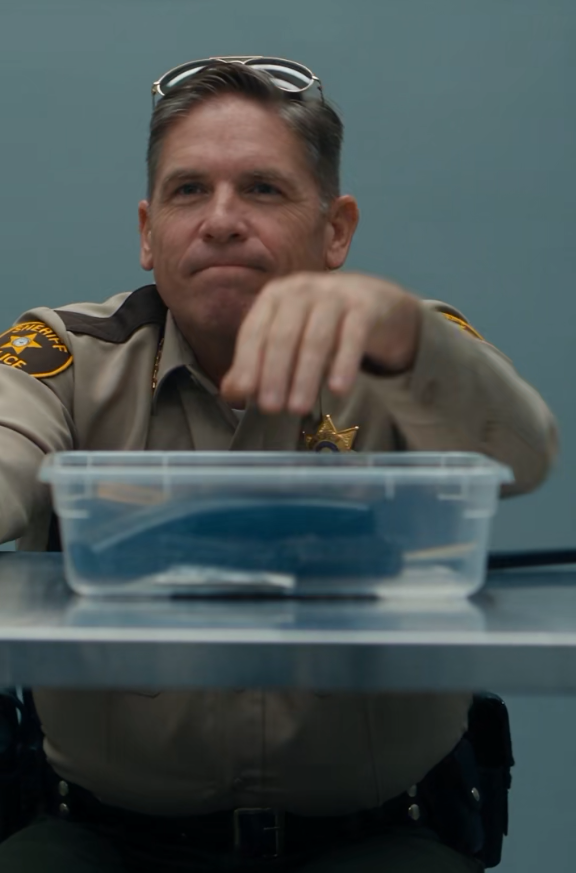
“What happens now?”
Sarah looked into the cameras.
“Now evidence should be preserved.”
Then she walked away.
Boyd watched from behind the blinds.
He heard every word through a television in the dispatch room.
Evidence should be preserved.
He turned it off.
Toby was standing behind him.
Boyd looked over his shoulder.
“You got something to say?”
“No.”
“Then quit staring.”
Toby returned to the booking desk.
He opened the administrative log again.
BCLEARY.
3:52 p.m.
He printed the page.
Then he printed the system metadata.
He placed both sheets inside the normal end-of-shift records packet.
Not hidden.
Not stolen.
Not sent anywhere.
Preserved.
Exactly where policy said they belonged.
Sarah sat in the rear of a black SUV rather than taking the helicopter.
Reed climbed in beside her.
The aircraft would transport the secure device after technicians completed the required custody process.
For several minutes, neither officer spoke.
Oak Haven’s main street passed outside.
A diner.
Hardware store.
Brick courthouse.
A row of houses shaded by old trees.
Small town.
Ordinary town.
That bothered Sarah more than she expected.
Reed looked at her wrists.
“You should have identified yourself.”
“I did. Eventually.”
“At the roadside.”
“He had my license.”
“You know what I mean.”
Sarah turned toward the window.
Reed waited.
“I didn’t want rank to be the reason he treated me correctly.”
Reed exhaled.
“That answer sounds noble and infuriating at the same time.”
“It can be both.”
“He could have hurt you.”
“Yes.”
“Sarah.”
She looked at him.
He had known her for fourteen years.
Long enough to criticize her without ceremony.
“You don’t get to become a test case because you think you can control the variables.”
“I know.”
“Do you?”
“Yes.”
He watched her.
She leaned back.
“I thought it would end with a citation.”
“And then?”
“When he arrested me, I thought it would end at booking.”
“And then?”
“I saw the device in the evidence tray.”
Reed nodded.
That was the actual turning point.
She continued.
“If I identified the stakes too early, everything after that could be explained away as deference to rank. I wanted him to follow his own process.”
Reed looked out the opposite window.
“He did.”
“That’s what concerns me.”
Reed's phone vibrated.
He read a message.
“What?”
He turned the screen toward her.
County systems had issued an automated preservation notice for body-camera, dash-camera, booking video, jail video, property logs, access logs, dispatch records, and communications related to Sarah’s detention.
Sarah read it.
“Who requested it?”
“Your lawyer. Mine. County counsel. Possibly half the federal government.”
“Good.”
Reed put the phone away.
“You’re still planning to attend tomorrow’s briefing?”
“Yes.”
“You were arrested three hours ago.”
“I noticed.”
“You missed your flight.”
“There are other aircraft.”
Reed gave her a look.
Sarah finally allowed herself a small, tired smile.
“What?”
“You know most people would take one evening.”
“Most people don’t have tomorrow’s briefing.”
“Most people don’t have helicopters either.”
The smile disappeared.
“I didn’t want those.”
“I know.”
Outside, Oak Haven receded.
Sarah looked back once.
She had spent decades learning how systems failed.
Usually the failure was complicated—bad incentives, weak oversight, ambiguous authority, institutional fear.
Boyd Cleary was simpler.
He believed authority meant the ability to make reality conform to his report.
Sarah suspected the next twenty-four hours would teach him otherwise.
She underestimated how far he was willing to go.
Part IV — Pressure
At 7:12 the following morning, Toby Miller discovered that the printed administrative log was missing.
He had arrived early.
The records packet sat where he had left it.
Every sheet remained inside except two.
The system access log.
The metadata page.
Toby checked the wastebasket.
Nothing.
He checked the printer tray, his desk, the file cabinet.
Nothing.
Boyd entered through the side door carrying coffee.
“You lose something?”
Toby straightened.
“Some paperwork.”
“What paperwork?”
“Routine.”
Boyd sipped.
“You ought to be more careful.”
Toby stared at him.
Boyd smiled slightly.
Then walked into his office.
Toby returned to the computer.
The digital system still contained the log.
He opened it.
BCLEARY.
3:52 p.m.
Still there.
He clicked print.
ACCESS DENIED.
Toby tried again.
ACCESS DENIED.
He checked his account permissions.
His records-export privileges had been removed.
He sat very still.
Then he pulled out his phone.
Not to photograph the screen.
Not to text Sarah Hayes.
He opened the department policy manual.
He read the section on preservation of evidence.
Then the section on reporting possible records interference.
For nine years, Toby had survived Boyd Cleary by learning the difference between discomfort and danger.
Discomfort was being yelled at.
Danger was being asked, without words, to share responsibility for someone else’s lie.
At 7:18, Toby called county counsel.
Sarah spent the morning in a secure conference room two states away.
She had changed clothes.
The marks on her wrists remained faintly visible.
Nobody mentioned them.
That was one of the qualities she valued in professional rooms: important things did not require immediate conversation.
She completed the briefing.
Answered questions.
Signed two documents.
Rejected a recommendation to delay an unrelated inspection.
At 11:34, Reed met her in the corridor.
“We have a problem.”
Sarah stopped.
“What kind?”
“The dash recording ended before the arrest.”
“Expected.”
“Administrative logs show Cleary accessed the system afterward.”
She looked at him.
“Still expected.”
“Printed copies disappeared overnight.”
That was not expected.
Sarah’s face became still.
“Digital originals?”
“Restricted. County counsel locked down the system after a deputy reported concerns.”
“Toby?”
Reed did not answer.
He did not need to.
Sarah resumed walking.
Reed kept pace.
“He’s cooperating.”
“He shouldn’t be described that way yet.”
“He called counsel.”
“That means he followed procedure.”
“Which is more cooperation than we usually get.”
Sarah stopped at the end of the corridor.
“Tom.”
Reed raised an eyebrow.
“When this becomes public, nobody turns that deputy into my hero.”
“I wasn’t planning a parade.”
“I mean it.”
“Why?”
“Because he was in the building when I was booked.”
“He wasn’t the arresting officer.”
“No. But if we turn ordinary compliance into heroism, we lower the standard.”
Reed studied her.
“You sound angry.”
“I am.”
It was one of the few times she admitted it plainly.
“Not at him.”
“I know.”
Sarah looked through the narrow window in the secure door.
“Boyd wants this to become a contest between me and him. General versus sheriff. Pentagon versus small town. Black woman versus white officer. Every version makes him the center.”
“What is it instead?”
“A records case.”
Reed almost laughed.
“That's the least satisfying possible description.”
“It’s also the one that can prove what happened.”
Sarah continued walking.
“We focus on the stop, the charges, the recording, the property handling, and whatever he did after learning there would be scrutiny.”
“You're expecting more.”
“Yes.”
“Why?”
Sarah looked at him.
“Because he still thinks the original mistake was arresting the wrong person.”
“And you think?”
“The mistake was believing there was such a thing as a right person.”
By noon, Boyd had a strategy.
He called a press conference.
County counsel told him not to.
He did it anyway.