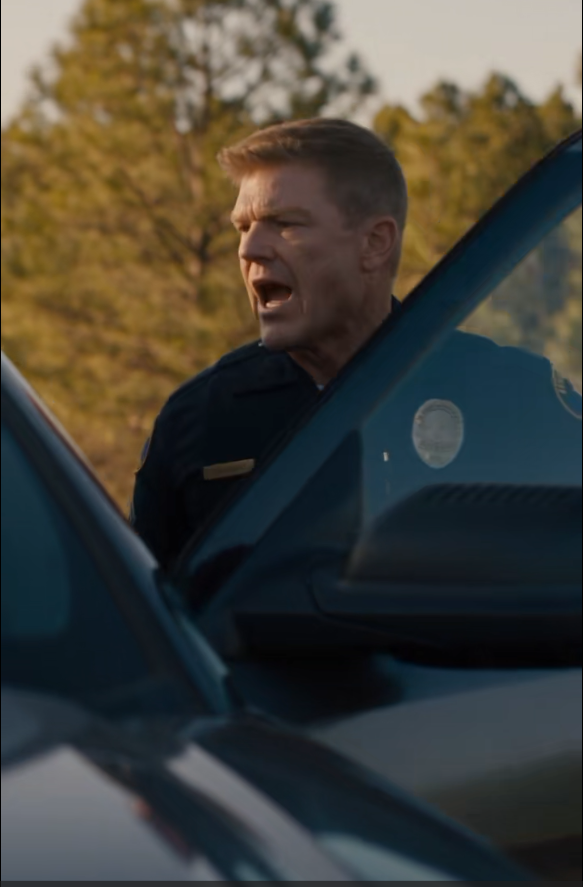
Renee walked over.
Barrett straightened.
“Deputy.”
“Commander.”
He almost stumbled over the title.
Renee’s expression did not change.
“You didn’t know who I was.”
“No, ma’am.”
“You shouldn’t have needed to.”
Barrett looked away.
There it was.
The point beneath everything else.
Not the insignia.
Not the government vehicles.
Not her rank, decorations, clearance, or history.
None of those facts should have been required to make restraint, procedure, and basic respect necessary.
Barrett’s throat moved.
“I know.”
“No,” Renee said. “You know now.”
He looked back at her.
That landed.
Renee did not press further.
She had learned long ago that humiliation rarely produced useful truth. People became interested in defending themselves instead of examining themselves.
The county supervisor approached.
“Commander Lawson?”
“Yes.”
“I’m Lieutenant Danner. I’ve been briefed—partially.”
“I imagine.”
“I want to make sure everybody stays calm.”
Renee glanced toward Mercer.
“He has been offered the opportunity to arrest me if he believes I asNextlted him unlawfully.”
Danner looked at Mercer.
Mercer stared at the pavement.
Danner looked back.
“I don’t think we’re going to do that.”
“Why?”
The lieutenant seemed surprised.
“Ma’am?”
“Why aren’t you going to arrest me?”
Danner took a breath.
“We need to review what happened.”
“Good. Then review all of it.”
“We will.”
Renee watched his face.
“Were their body cameras active?”
Danner looked toward the two officers.
“I don’t know yet.”
“I asked them during the stop. Neither answered.”
Danner’s expression tightened.
“We’ll determine that.”
“And dispatch?”
“We’ll pull the traffic.”
“Good.”
A pause.
Danner lowered his voice.
“Commander, I’d appreciate an opportunity to handle this internally before it becomes—”
He stopped.
Renee waited.
“Before it becomes what?”
Danner glanced toward the civilian phones.
“Bigger than it needs to be.”
Renee studied him.
She had heard versions of the sentence in different countries, different organizations, different crises.
Sometimes it meant: let professionals work.
Sometimes it meant: protect the institution.
The difficulty was knowing which one you were being offered.
“I’m not interested in making it bigger,” she said. “I’m interested in making it exact.”
Danner nodded slowly.
“That’s fair.”
“Then start with the facts.”
He did.
At least in front of her.
Both officers were removed from field duty pending review.
Their duty weapons, tasers, radios, and body cameras were secured.
Dispatch logs were preserved.
The patrol vehicles were photographed.
Witness contact information was collected.
Renee gave a brief factual statement and declined to speculate about motive.
When asked whether she wanted medical attention, she said no.
When asked whether she wanted to file an immediate criminal complaint, she said she wanted the evidence preserved first.
That answer confused Danner.
“You don’t want to file?”
“I didn’t say that.”
Renee closed the rear door of her SUV.
“I said preserve the evidence.”
Mercer, standing beside Danner’s vehicle, heard her.
His face had settled into something close to resentment.
Renee met his gaze.
She wondered whether he understood even now what he had done wrong.
Not legally.
Personally.
She could not tell.
Her team leader approached.
“Commander, vehicle’s good to move.”
Renee nodded.
She opened the driver’s door.
Barrett stepped forward.
“Commander.”
Everyone near him looked over.
Renee stopped.
Barrett swallowed.
“I’m sorry.”
Mercer’s head snapped toward him.
Renee regarded Barrett for several seconds.
“For what?”
He looked unprepared for the question.
“For putting my hands on you.”
“Why was that wrong?”
Barrett opened his mouth.
Closed it.
Renee waited.
Finally he said, “Because you were cooperating.”
That was not the whole answer.
But it was at least an answer he had found himself.
Renee nodded once.
Then she got into her SUV and drove away.
She did not look at Mercer in the mirror.
But twenty minutes later, when her phone began vibrating with calls, she knew the road had followed her.
Part III — Reversal
The first video reached social media before Renee reached her destination.
By midnight, there were six angles.
By morning, there were eleven.
One showed the patrol cars boxing in the SUV.
Another captured Mercer pulling Renee through the open door.
A third had clearer audio than Renee expected.
“You don’t ask the questions here.”
Another captured Barrett:
“People like you need to learn when to follow orders.”
The clearest video began seconds before Mercer grabbed Renee’s chin.
It showed her saying, “Take your hand off me.”
It showed him step back.
It showed his shoulder move.
It showed Renee’s single strike.
Then her immediate retreat.
Hands open.
“Do not touch me again.”
The internet did what it always did with partial evidence.
It chose sides faster than facts could move.
Renee did not watch more than the first three clips.
Her name had not been public at first. That changed after someone zoomed in on the open identification case.
By midmorning, reporters were trying to confirm whether the woman in the video was “a senior special operations commander.”
Renee’s phone filled with messages.
Some supportive.
Some angry.
Some congratulating her for the punch, which she disliked.
Some calling it staged, which she ignored.
Some asking why she had not “taken both officers down.”
Those she ignored even harder.
What happened on the roadside had not been a victory.
It had been a failure that stopped short of becoming worse.
That distinction mattered.
Renee sat at a plain desk in a secure office the following morning with a paper cup of coffee cooling untouched beside her.
Across from her, a legal adviser from her command reviewed the timeline.
“You’re not required to make any public statement.”
“I know.”
“You’re also under no obligation to cooperate with their internal investigation beyond what counsel recommends.”
“I know.”
The adviser looked over the rim of his glasses.
“You’ve said that three times.”
“Because you’ve told me three things I know.”
He almost smiled.
Almost.
Then he slid a folder across the table.
“This is what we have from the county so far.”
Renee opened it.
Dispatch transcript.
Preliminary supervisor report.
Property log.
Body camera status.
She stopped.
Both cameras had been powered on earlier in the shift.
Both had been manually switched to standby eleven minutes before the stop.
Renee read the line again.
“Eleven?”
“Yes.”
“They started following me about fifteen minutes before the stop.”
“Approximately.”
“So cameras went dark while they were already behind me.”
“That appears to be the sequence.”
Renee leaned back.
The room felt quieter.
“Accidental?”
“They both did it.”
“That wasn’t my question.”
“No.”
Renee closed the folder halfway.
“Do we have dispatch audio?”
The adviser slid another page toward her.
Renee read.
A theft complaint had been called in thirty-four miles north.
The suspect vehicle was described as a dark pickup truck.
Not an SUV.
Two occupants.
Male.
Traveling north.
Partial plate ending in seven-three.
Renee’s SUV was dark.
That was the end of the similarity.
She had been alone.
Driving south.
Different vehicle class.
Different plate.
Renee stared at the transcript.
“Who changed the description?”
“No one.”
She looked up.
“What did Mercer say?”
“That dispatch put out a vague alert for a dark SUV.”