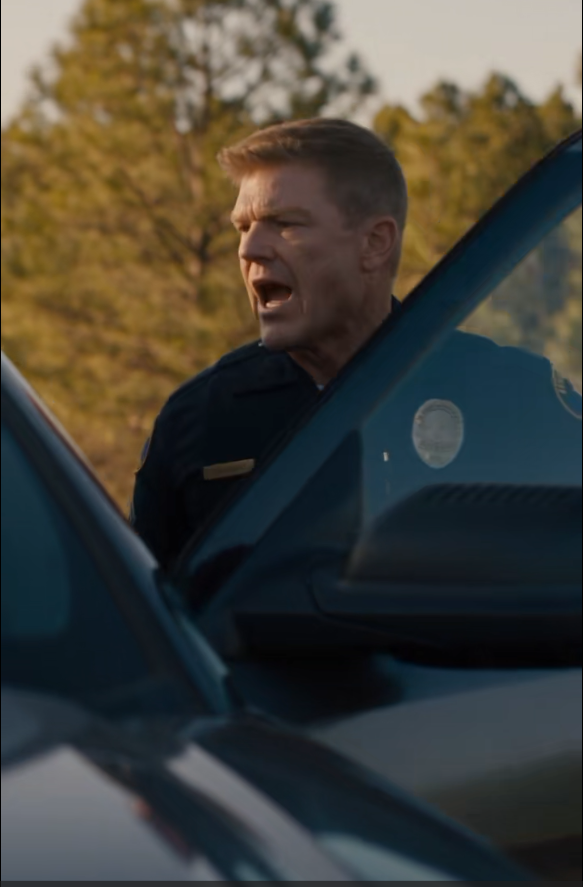
“That didn’t happen.”
“No.”
Renee sat still.
This changed the problem.
On the roadside, she had been willing to believe incompetence.
Poor judgment.
Escalation.
Ego.
Now there was something cleaner.
A lie that could be checked.
She turned the page.
One cruiser’s mobile terminal showed no plate query for her SUV before the stop.
No stolen-vehicle check.
No warrant query.
Nothing.
The second cruiser showed the same.
Renee closed the folder.
“What do they say now?”
“Barrett says Mercer told him the SUV matched a vehicle they were looking for.”
“And Mercer?”
“Says he believed it did.”
“Based on what?”
“He hasn’t explained beyond color.”
Renee tapped one finger against the folder.
“Why were they behind me for fifteen minutes?”
“That’s the question.”
The adviser paused.
“There’s more.”
Renee looked up.
“Barrett gave a supplemental statement last night.”
“What did he change?”
“He said Mercer noticed your SUV before the dispatch call about the pickup.”
Renee did not move.
“How much before?”
“Seven minutes.”
The quiet in the room changed shape.
Renee looked at the wall.
Not because there was anything to see.
Because she needed a blank surface.
Seven minutes.
Mercer had noticed her vehicle before the call he later used to justify the stop.
The dispatch alert had not caused the stop.
It had become cover for it.
“Why did Barrett tell us now?”
“He says he didn’t understand the timing until he reviewed the log.”
Renee’s mouth tightened.
“That may even be true.”
“You believe him?”
“I believe people are very good at seeing what they need to see after consequences arrive.”
The adviser let that sit.
Renee reopened the folder.
“What exactly does Barrett say Mercer told him?”
“He says Mercer radioed him directly and said, ‘Stay with me. I want to check this one.’”
“This one.”
“Yes.”
“Anything else?”
“Later, Mercer allegedly said, ‘She’s acting like she owns the road.’”
Renee’s eyes lifted.
“When?”
“After you slowed and they slowed.”
Renee thought back.
She had not changed lanes.
Had not accelerated.
Had not gestured.
Had not done anything that could reasonably be described as confrontational.
She had simply continued driving.
The adviser folded his hands.
“There’s already pressure to frame this as a bad traffic stop that escalated.”
“It was a bad traffic stop that escalated.”
“Only?”
Renee looked at him.
“No.”
That was the reversal.
The road incident no longer stood alone as a chain of split-second mistakes.
It had begun earlier.
In observation.
In assumption.
In a decision to follow.
Then in a decision not to verify.
Then in a decision to shut off recording devices.
Then in a decision to manufacture a reason afterward.
Each choice had created room for the next.
Renee understood systems.
That was part of why she had survived so long.
Catastrophes were rarely born at the moment of impact.
They were assembled.
One tolerated shortcut at a time.
Her phone buzzed on the desk.
She ignored it.
The adviser watched her.
“You’re being asked whether you want to support federal involvement.”
Renee’s expression sharpened.
“By whom?”
“You know who.”
“I want names.”
He gave them.
She knew two.
Did not know the third.
Renee stood and walked to the narrow window.
The office overlooked a parking lot.
Ordinary cars.
Ordinary people moving between buildings.
“I don’t want this turned into a jurisdiction fight.”
“That may not be your decision.”
“No. But my participation is.”
“What do you want?”
Renee took several seconds.
She had asked herself versions of that question after missions went wrong.
Want was often a luxury.
This time, it mattered.
“I want the truth established before everyone starts using me for whatever argument they already had.”
The adviser nodded.
“That won’t be easy.”
“I didn’t ask if it was.”
She turned.
“And I want Barrett’s statement protected.”
“Protected how?”
“If he’s telling the truth now, I don’t want his department burying him for contradicting Mercer.”
“That’s not entirely in our control.”
“Then make it visible enough that it can’t disappear quietly.”
The adviser studied her.
“You’re worried about him?”
“No.”
Renee sat again.
“I’m worried about evidence.”
That afternoon, Renee received a request from Lieutenant Danner for another interview.
She agreed.
The interview took place in a county administrative building, not the sheriff’s office.
Neutral ground, they called it.
Renee thought of it as a room with no history.
Danner sat across from her with two investigators. One handled questions. The other wrote notes.
“Commander Lawson,” the investigator began, “we want to go through the physical altercation.”
“Go ahead.”
“When Officer Mercer moved toward you, what did you perceive?”
“An incoming strike.”
“Why?”
“His shoulder rotated. His weight shifted. His hand was closed. He had already grabbed my face after I told him not to.”
“You reacted before he made contact.”
“Yes.”
“Why not simply move away?”
“I did.”
The investigator looked down.
“You also struck him.”
“I moved off line, broke Deputy Barrett’s grip, struck once, and disengaged.”
“You sound very precise.”
“I was there.”
Danner shifted in his chair.
The investigator continued.
“Would you characterize your training as advanced?”
“Yes.”
“Much more advanced than Officer Mercer’s?”
“I don’t know Officer Mercer’s training.”
“You’re a Delta Force commander.”
Renee watched him.
“That is not relevant to whether he tried to hit me.”
“It may be relevant to whether your response was proportionate.”
“My response stopped the strike and ended immediately.”
The investigator nodded.
He did not argue.
“Did you intend to injure Officer Mercer?”
“No.”
“Could you have?”
Danner looked up.
Renee’s expression flattened slightly.
“I’m not going to participate in that kind of question.”
“Why not?”
“Because this is an investigation, not mythology.”
The room went still.
Renee leaned forward.
“I used the minimum action necessary to stop what I reasonably perceived as an imminent strike. What I theoretically could have done is irrelevant.”
The investigator held her gaze, then nodded.
“Fair enough.”
They moved backward through the stop.
Window.
Orders.
Reason for detention.
Body cameras.
Then Danner asked the question Renee had been expecting.
“Did your status influence your expectations of how you should be treated?”
Renee looked at him.
“No.”
“Not at all?”
“No.”
Danner waited.
Renee continued.
“My status influenced my ability to remain calm. My training influenced how quickly I recognized Mercer’s movement. My position caused those government vehicles to arrive when I missed a security check.”
She paused.
“But none of that changed what I was entitled to before anyone knew who I was.”
Danner’s eyes dropped briefly.
Renee did not let him escape the point.
“If the identification case had stayed in my jacket, would you be asking different questions?”
No one answered.
She leaned back.
“That’s the question I care about.”
Part IV — Reckoning
Three days after the stop, Deputy Cole Barrett asked to speak with Renee directly.
Her counsel advised against it.
Renee agreed anyway.
They met in a conference room with glass walls that had been covered by blinds for privacy. Barrett arrived without a uniform.
Khaki pants.
Blue shirt.