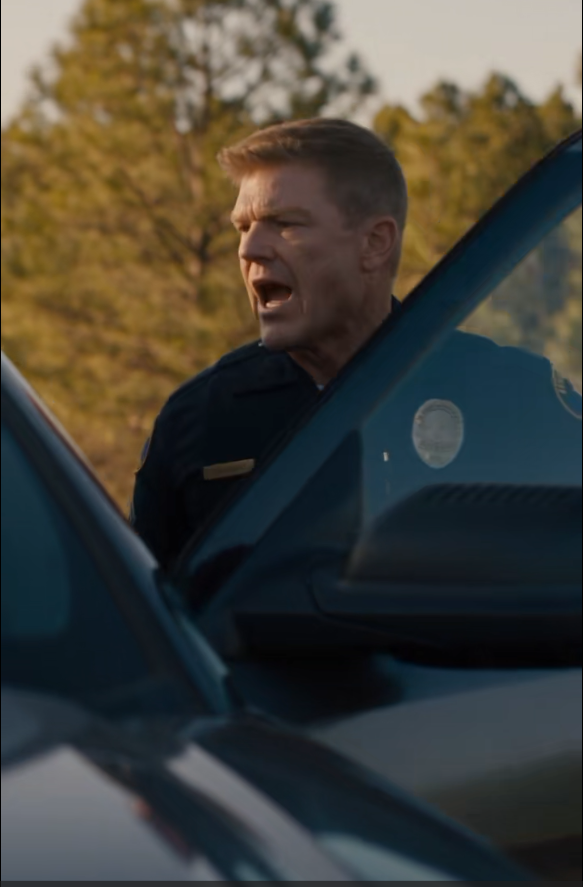
No badge.
Without equipment around his waist, he seemed less substantial than he had on the road.
He sat across from Renee but did not touch the water placed in front of him.
“Thank you for meeting me.”
Renee nodded.
“What do you need to say?”
Barrett looked at the table.
“I lied.”
Renee did not react.
“About what?”
“The stop.”
“Be specific.”
He breathed in slowly.
“When Lieutenant Danner first got there, Mercer told me we needed to keep it simple. Say the SUV matched the dispatch.”
“I heard that part later.”
Barrett nodded.
“I went along with it.”
“For how long?”
“Until after I got home.”
Renee waited.
Barrett rubbed his hands together.
“My wife saw the videos before I told her what happened.”
Renee’s face remained still.
Barrett gave a humorless little laugh.
“She asked me why I had my hand on your neck.”
He swallowed.
“I told her I was controlling the scene.”
Renee said nothing.
“She asked what you were doing.”
Another pause.
“I said you weren’t following commands.”
“What command?”
Barrett looked at her.
“That’s what she asked.”
He looked away again.
“I couldn’t answer.”
Renee folded her arms loosely.
“Why did Mercer start following me?”
Barrett’s jaw tightened.
This was why he had come.
“He saw you pull out of a roadside gas station.”
Renee remembered the stop.
She had bought coffee.
Nothing else.
“Go on.”
“He said you looked out of place.”
The room lost warmth.
Renee’s voice stayed level.
“What did that mean?”
Barrett closed his eyes briefly.
“I knew what he meant.”
“Say it.”
He looked at her.
“He said, ‘Woman like that in a truck like that this far out, something’s off.’”
Renee was silent.
Barrett continued before he could lose nerve.
“I told him maybe you were just driving.”
“And?”
“He said I was getting soft.”
Renee’s expression did not change, but something in her gaze did.
Barrett noticed.
“He called me when he got behind you. Told me to catch up. Then the dispatch came over about the theft call.”
“The pickup.”
“Yes.”
“Two male suspects traveling north.”
“Yes.”
“And Mercer used that to stop me.”
Barrett nodded.
“He said we could ‘check it out’ and clear it later.”
“Why didn’t you stop him?”
Barrett’s face tightened.
“I don’t have a good answer.”
“I didn’t ask for a good one.”
He looked down.
“I’d worked with him for four years. He was senior. He knew everybody. He was the guy who taught me which judges hated late paperwork and which roads flooded first and where to sit when the bars closed.”
Barrett’s mouth worked as if he were choosing what not to say.
“And?”
“And after a while, you stop noticing which things are normal because they happen all the time.”
Renee’s eyes narrowed slightly.
“What things?”
“Stops that start from a hunch.”
“Hunch about what?”
“Who looks wrong.”
“Wrong how?”
Barrett stared at the unopened water bottle.
“Black drivers. Young men in expensive cars. People from out of county. Sometimes just somebody who doesn’t look like they belong where he thinks they should.”
Renee sat very still.
“Complaints?”
“Yes.”
“How many?”
“I don’t know.”
“Enough that you know there were complaints.”
“Yes.”
“What happened to them?”
Barrett shook his head.
“Usually nothing. People got mad. Mercer wrote reports. Supervisors signed them.”
“Danner?”
Barrett hesitated.
“Sometimes.”
That answer was careful.
Renee heard the caution in it.
“You think Lieutenant Danner protected him?”
“I think the department treated Mercer like an inconvenience that was easier to defend than correct.”
That sentence was better than the ones Barrett had been giving her.
More precise.
Renee leaned back.
“Why tell me?”
Barrett finally looked directly at her.
“Because I put my hands on you.”
“You already apologized for that.”
“I apologized because you were cooperating.”
“And now?”
Barrett’s voice grew quieter.
“Now I know that wasn’t the whole thing.”
Renee waited.
He forced the words out.
“I shouldn’t have needed to see your military ID before I understood we were wrong.”
There it was.
The answer she had wanted him to find on his own.
Renee looked at him for a long moment.
Then she asked, “Are you willing to say all of this under oath?”
Barrett went pale.
His eyes moved toward the covered glass walls.
“You know what that means for me.”
“Yes.”
“They’ll say I’m saving myself.”
“Are you?”
Barrett did not answer quickly.
“Partly.”
Renee appreciated that more than a clean denial.
He continued.
“I don’t want to lose my job.”
“You may.”
“I know.”
“You may lose friends.”
“I know.”
“You may spend years being the man who turned on another officer.”
Barrett flinched.
Renee leaned forward.
“So don’t do it for me.”
He looked at her.
“I don’t need you to become brave because I have a title you respect. If you tell the truth, do it because it is true.”
Barrett’s breathing slowed.
Renee sat back.
“If you can’t do that, leave now.”
He did not leave.
The investigation widened the following week.
Dispatch records showed Mercer had requested information on Renee’s plate only after she had been pulled from the SUV.
Personnel records showed six prior complaints alleging aggressive or unsupported stops over three years.
Four had been closed as “unable to substantiate.”
One complainant had withdrawn.
One had been sustained only as “discourtesy.”
The reports were written carefully.
They always were.
No line said what the pattern became obvious only when the pages were placed side by side.
Dark SUV.
Young driver.
Out-of-county plates.
“Nervous behavior.”
“Refused to make eye contact.”
“Made excessive eye contact.”
“Delayed compliance.”
“Questioned authority.”
Renee read them all.
Not because she enjoyed it.
Because patterns disappeared when reduced to numbers.
One complaint involved a college student stopped after leaving a restaurant.
Another involved a retired mechanic pulled over because Mercer said the vehicle “fit burglary activity.”
Another came from a nurse driving home after midnight.
No charges.
No contraband.
No warrants.
No meaningful discipline.
Renee closed the final file.
Her counsel sat beside her.
“You don’t have to carry all of this.”
“I’m not carrying it.”
“What would you call it?”
“Reading.”
He sighed.
“You know what I mean.”
Renee did.
She also knew he was right in a way she did not want to admit.
Every report created a ghost version of the roadside stop.
The same rhythm.
A vague suspicion.
A driver confused by the reason.
A command replacing explanation.
The driver’s confusion reframed as resistance.
Resistance used to justify more force.
Then paperwork smoothing the jagged edges afterward.
Renee had spent her adult life in organizations that survived only if failure could be examined without sentiment.
After-action review.
What was supposed to happen?
What happened?
Why?
What changes?
No one was allowed to answer, We meant well.
Intent was not enough.
Yet here, complaint after complaint had been handled as isolated weather.
Unfortunate.
Unprovable.
Over.
Renee pushed the files away.
“What happens if Mercer resigns?”
Her counsel looked at her.
“That’s an interesting question.”