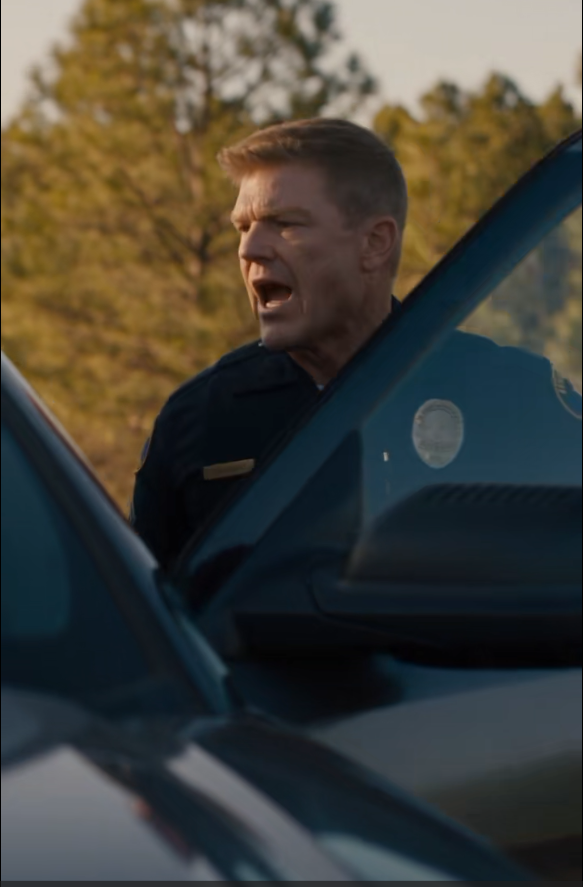
“Answer it.”
“He could avoid some internal disciplinary outcomes. Criminal review would continue if prosecutors believe there’s a case.”
“Could he be hired somewhere else?”
“Potentially.”
“Even with this?”
“Depends on what’s formally sustained, disclosed, and reportable.”
Renee’s jaw tightened.
That was the next problem.
Consequences that ended on paper but not in practice.
She looked toward the window.
“What does Barrett’s testimony change?”
“A lot.”
“Enough?”
“Maybe.”
Renee disliked that word.
Maybe was where systems hid.
Two days later, Lieutenant Danner requested a private meeting.
Renee almost refused.
Then she accepted.
Danner looked tired.
Not performatively tired.
Actually tired.
His shirt collar had gone soft. There were folders under one arm.
He set them down and did not sit immediately.
“I owe you an apology.”
Renee waited.
Danner lowered himself into the chair.
“When I got to the roadside, I was thinking about containment.”
“Containment of what?”
“The scene. The cameras. The department. Lawsuits. News.”
“Not what happened.”
He looked at her.
“Not first.”
Renee appreciated the admission.
Danner rubbed his forehead.
“I told myself I was trying to keep everybody calm.”
“You told me you wanted to keep it from getting bigger.”
“Yes.”
“What you meant was public.”
He nodded.
“Yes.”
Renee said nothing.
Danner opened one folder.
“I reviewed every complaint Mercer has had since he came under my supervision.”
“Why now?”
His face tightened.
“Because I should have done it together before.”
Renee looked at him.
“You reviewed them separately.”
“Yes.”
“And each one seemed explainable.”
“Enough to close.”
“Convenient.”
Danner did not defend himself.
“That word is fair.”
He slid a document toward her.
“I recommended termination.”
Renee did not touch it.
“On what grounds?”
“Dishonesty. Failure to activate body camera. Unsupported detention. Unreasonable escalation. Conduct unbecoming.”
“What about attempted force?”
“Still under criminal review.”
“And Barrett?”
“Suspension. Formal discipline. Retraining. Probationary status if he remains.”
“If?”
Danner looked down.
“He may not.”
“His choice?”
“Partly.”
Renee studied him.
“What aren’t you saying?”
Danner inhaled.
“Mercer has allies.”
“In the department?”
“Yes.”
“Above you?”
Danner did not answer.
That was enough.
Renee leaned back.
“So this is not finished.”
“No.”
“Then why show me the recommendation?”
“Because I wanted you to know someone is taking it seriously.”
Renee’s gaze hardened.
“Lieutenant, don’t make me the audience for your conscience.”
The words struck him.
He sat straighter.
“That’s not what I’m doing.”
“Then don’t ask whether I feel reassured.”
“I didn’t.”
“You came here hoping I would.”
Danner looked at the folder.
For several seconds, the only sound was an air vent clicking overhead.
Finally he said, “Maybe I did.”
Renee’s tone softened by a fraction.
“Do the work because it needs to be done.”
Danner nodded.
“Yes, ma’am.”
“No.”
He looked up.
“Don’t ‘ma’am’ me out of this. Do it because the next person may not have government vehicles coming around the bend.”
Danner absorbed that.
Then he closed the folder.
“I understand.”
Renee watched him stand.
“No,” she said. “You understand now.”
He paused at the door.
The same words she had given Barrett.
This time they sounded less like accusation.
More like a standard.
Part V — Final Confrontation
Mercer’s termination hearing took place behind closed doors.
The criminal review did not.
By then the case was no longer about a famous video.
Investigators had reconstructed the stop minute by minute.
Mercer had followed Renee before the unrelated theft dispatch.
He had not run her plate.
He had told Barrett to join him.
Both cameras had been moved to standby.
He had used an unrelated call as justification after the fact.
He had physically removed Renee from the SUV without articulating a specific offense.
He had placed a hand on her face after she was controlled.
And the civilian video showed his attempted strike clearly enough that even frame-by-frame review did not help him.
Mercer’s defense shifted.
First the SUV matched a description.
Then Renee had behaved suspiciously.
Then officer safety required control.
Then she had escalated by “challenging lawful authority.”
Finally, when those arguments thinned, the defense focused on her military training.
A decorated special operations commander, they suggested, was not an ordinary detainee.
She represented an unknown threat once outside the vehicle.
Renee heard that argument without visible reaction.
Then her attorney leaned toward her.
“That’s desperate.”
Renee kept her eyes forward.
“It’s also useful.”
“How?”
“They’ve finally admitted the thing they’ve been avoiding.”
“What?”
“They’re saying my capacity justified their fear after they discovered it.”
Her attorney frowned.
“And?”
“They didn’t know my capacity when they stopped me.”
He looked at her.
Renee’s gaze remained on Mercer.
“So it cannot explain what they did before.”
That became the center of her testimony.
The hearing room was plain.
No dramatic architecture.
No crowded gallery.
Wood table.
Flags.
Fluorescent light.
Mercer sat with counsel on one side.
Renee sat opposite.
Barrett waited outside until called.
The examiner asked Renee to state her name and occupation.
She did.
Then the questioning moved through the stop.
Everything was familiar now.
The follow.
The roadblock maneuver.
The commands.
The window.
The missing reason.
The camera question.
The door.
The force.
The chin.
The swing.
The punch.
The ID.
The vehicles arriving.
When Mercer’s attorney stood, his voice was controlled.
Professional.
“Commander Lawson, you have extensive combat training.”
“Yes.”
“Close-quarters training.”
“Yes.”
“Defensive tactics.”
“Yes.”
“You’ve operated in hostile environments.”
“Yes.”
“Would you agree that your ability to physically harm someone exceeds that of an average civilian?”
Renee looked at him.
“I would agree that I have significant training.”
“That wasn’t my question.”
“It was the relevant answer.”
The attorney paused.
“Could you have seriously injured Officer Mercer?”
“Possibly.”
“Possibly?”
“Yes.”
“You struck him.”
“Once.”
“Before he struck you.”
“As he attempted to.”
The attorney walked slowly along the table.
“You made that judgment in less than a second.”
“Yes.”
“Based on your training.”
“Based on his movement.”
“Interpreted through your training.”
“Yes.”
“So your specialized training affected your decision to strike a police officer.”
“Yes.”
Mercer’s attorney turned slightly, as though the admission helped him.
Renee continued before he could sit.
“It also allowed me to stop after one strike.”
The attorney faced her again.
“I didn’t ask that.”
“No. But it is relevant.”
The examiner allowed it.
Mercer’s attorney returned to the table.
“Commander Lawson, when the officers approached your vehicle, why did you not immediately roll your window down completely?”
“Because they had not told me why I was being stopped.”
“Is that required before you comply?”
“I complied with instructions necessary for officer visibility. I kept my hands visible and lowered the window enough to communicate.”
“You refused a direct command.”
“I asked for the reason for the stop.”
“That is not compliance.”
Renee looked toward the examiner, then back.
“It is not resistance either.”
Mercer’s attorney leaned forward.
“Officer Mercer did not know who you were.”
“No.”
“He did not know your rank.”
“No.”
“He did not know your military history.”
“No.”
“He did not know three government vehicles would soon arrive.”