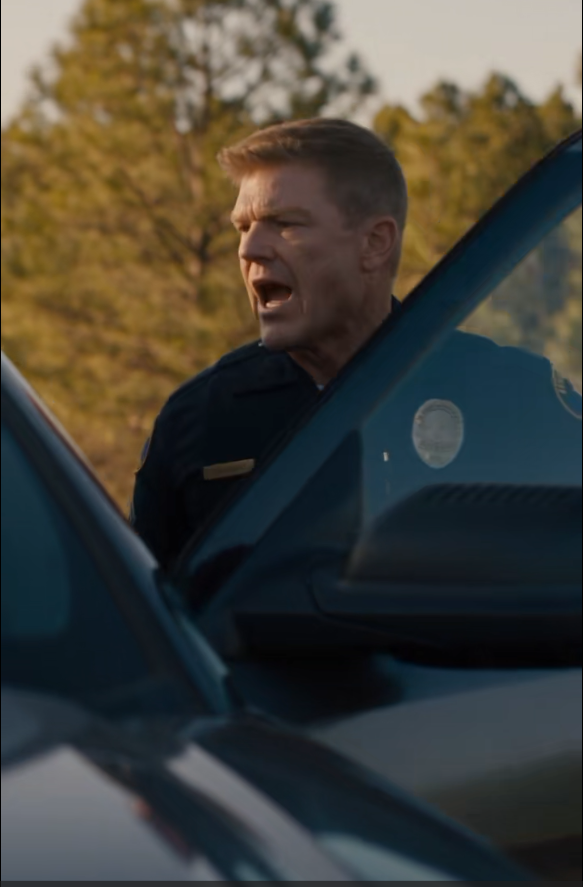
“No.”
“He was dealing with an unknown driver.”
“Yes.”
The attorney spread one hand.
“Then isn’t it reasonable that an officer facing an unknown person on an isolated road would prioritize control?”
Renee let a second pass.
Then another.
“No.”
The attorney blinked.
“No?”
“Not the way you’re using the word.”
“Explain.”
Renee folded her hands on the table.
“Control is not the same as clarity. It is not the same as safety. And it is not a substitute for lawful purpose.”
The room stayed quiet.
She continued.
“Officer Mercer had fifteen minutes to observe my vehicle. He had the ability to run my plate. He had dispatch access. He had backup. He had time.”
She looked at Mercer.
“He made a series of decisions before I ever spoke to him.”
Mercer shifted in his chair.
Renee returned her attention to the attorney.
“My identity did not make those decisions wrong.”
A pause.
“It made them harder to hide.”
No one moved.
Mercer’s attorney waited, then asked, “Are you suggesting Officer Mercer targeted you because you are Black?”
The question was the one everyone had orbited for days.
Renee did not rush.
“I’m saying his stated reason for the stop was false.”
“That wasn’t the question.”
“I’m saying Deputy Barrett testified that Officer Mercer described me as looking out of place before there was any dispatch matching my vehicle.”
“Again—”
“I’m saying there is a documented pattern of unsupported stops involving drivers he described in similarly vague ways.”
The attorney’s expression tightened.
“Commander—”
“And I’m saying I cannot see inside Officer Mercer’s mind.”
That stopped him.
Renee’s voice remained calm.
“I can tell you what he did. I can tell you what he said. I can tell you what his records show. Motive can be argued from evidence. I won’t invent certainty because it makes a cleaner headline.”
The examiner wrote something down.
Mercer looked at Renee for the first time in several minutes.
Not angry.
Something else.
Perhaps confusion.
Perhaps the discomfort of being denied both absolution and caricature.
Renee was not interested in turning him into a monster.
Monsters were easy.
Men who made repeated choices and were protected from the consequences were more useful to understand.
Barrett testified next.
His voice shook at first.
Then steadied.
He admitted everything.
Mercer’s call.
The phrase “this one.”
The comment about Renee being out of place.
The unrelated dispatch.
The decision to follow anyway.
The body cameras.
Renee learned one new detail from Barrett’s testimony.
Mercer had told him to place his camera in standby.
Barrett had done it without asking why.
“Why?” the examiner asked.
Barrett swallowed.
“Because he told me to.”
The examiner waited.
Barrett looked toward Renee, then away.
“That’s not an excuse.”
“No,” the examiner said. “It isn’t.”
Mercer’s attorney attacked Barrett hard.
Suggested he changed his account to save his career.
Barrett admitted he wanted to save it.
Suggested he blamed Mercer only after public criticism.
Barrett admitted public criticism forced him to reconsider his actions.
Suggested he resented Mercer.
Barrett said no.
Then corrected himself.
“I resent that I let him make his judgment become mine.”
Renee looked at him.
That was the most honest sentence he had spoken.
The real confrontation came after testimony ended.
Not in the hearing room.
In the corridor.
Renee had stepped away from counsel to take a call when Mercer appeared near the opposite wall.
His attorney was several steps behind.
Danner stood farther down the hallway.
Mercer stopped.
“Commander.”
Renee ended the call.
“Officer Mercer.”
“Former officer, probably.”
She said nothing.
His mouth twisted.
“You got what you wanted.”
“No.”
He laughed quietly.
“You expect me to believe that?”
“Yes.”
Mercer glanced toward the people in the hall.
“You’re going to walk out of here and everybody’s going to tell you how brave you were.”
Renee’s gaze remained on him.
“You think this was about that?”
“I think you had powerful friends, cameras showed up, and suddenly everybody who worked with me for years forgot who I was.”
“Who are you?”
The question threw him.
Mercer stared.
Renee continued.
“You keep talking about what everyone else did after the stop. The witnesses. Your department. My team. The investigators.”
She took one step closer.
“What did you do before any of them mattered?”
His jaw tightened.
“I was doing my job.”
“Then explain the stop.”
“I already have.”
“No. You gave a reason disproved by dispatch records.”
Mercer looked away.
Renee’s voice stayed quiet.
“Why did you follow me?”
He said nothing.
“Why did you tell Barrett I looked out of place?”
Still nothing.
“Why did you shut off your camera?”
His eyes snapped back to hers.
“I didn’t shut it off. Standby isn’t off.”
The answer was technical.
And therefore revealing.
Renee nodded once.
“You knew the difference.”
Mercer’s face changed.
A small mistake.
Maybe the biggest one he had made since the roadside.
Renee saw Danner look over.
Mercer saw it too.
His attorney moved quickly.
“Travis, don’t say anything else.”
Mercer ignored him.
“You came through there acting like you owned the place.”
Renee stared at him.
“At what point?”
“You wouldn’t roll the window down.”
“That was after you stopped me.”
“You were driving like—”
He stopped.
Renee waited.
“Like what?”
Mercer looked around.
He had nowhere useful to put the sentence.
Renee did not rescue him from it.
He tried again.
“You didn’t act nervous.”
That surprised even his attorney.
Mercer heard himself too late.
Renee’s eyes narrowed.
“You stopped me because I didn’t act nervous?”
“No.”
“You thought my calm was suspicious.”
“You were watching us in the mirror.”
“Two patrol cars followed me for fifteen minutes.”
“You kept checking.”
“Yes.”
Mercer’s frustration rose.
“Normal people don’t track everything like that.”
Renee’s voice softened.
“Normal people notice when they’re being followed.”
Mercer opened his mouth.
Renee continued.
“And people who have learned that a mistake can become evidence notice more.”
Something passed across his face then.
Not remorse.
Not yet.
Recognition, perhaps.
The first flicker that the woman in front of him had not become dangerous because of the military ID.
She had become careful long before he met her.
Mercer’s attorney touched his arm.
“We’re done.”
Mercer pulled away.
“No.”
He looked at Renee.
“You want me to say I saw a Black woman in a nice SUV and decided she was a criminal.”
Renee’s face remained unreadable.
“I want you to tell the truth.”
“What if that isn’t the truth?”
“Then tell the one that is.”
Mercer’s breathing became uneven.
He looked toward the floor.
For a moment, Renee thought he might finally answer.
Instead he said, “I had a feeling.”
There it was.
Small.
Almost pathetic.
Not a conspiracy.
Not a grand plan.
A feeling.
Renee’s voice was barely above conversational.
“And you treated your feeling like evidence.”
Mercer looked at her.
She continued.
“You followed me. You found a dispatch call that didn’t match. You stopped me anyway. You turned off the recording indicator. You refused to explain yourself. You put your hands on me. Then you lied about why.”