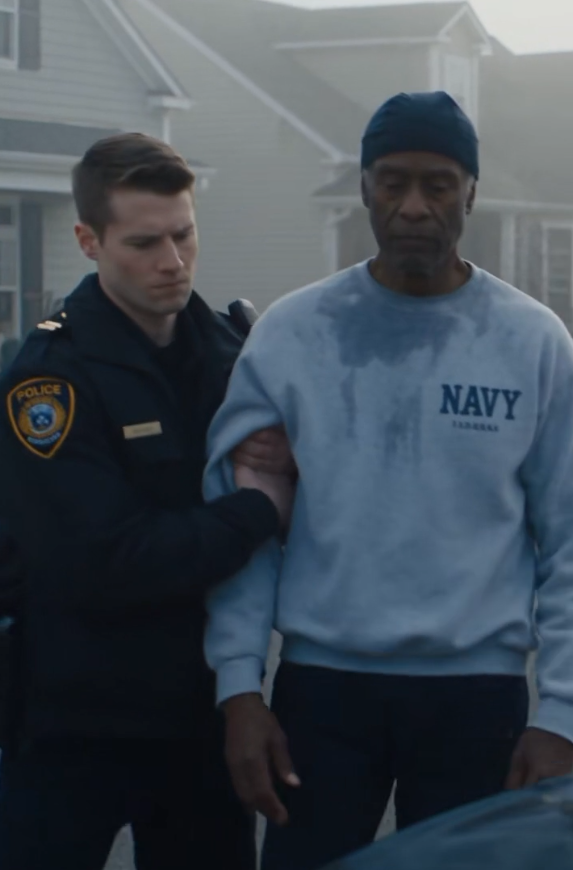
Carter looked at him.
Isaiah continued.
“You have a young officer who believes his instincts justified escalating a stop without verification. You have a sergeant who saw enough to question it and didn’t act until later. And you have a department that now knows my title.”
He let his eyes move across the room.
“If I walk into a private office with you, the lesson becomes that they arrested the wrong man.”
No one shifted.
Isaiah’s voice remained low.
“The lesson needs to be that they treated a man wrongly.”
The chief leaned one hand against the counter.
For several seconds he said nothing.
Then he nodded.
“That’s fair.”
Higgins exhaled through his nose.
Isaiah heard it.
“So what now?” Higgins asked.
The chief turned toward him with a look that stopped whatever else Higgins planned to say.
Isaiah answered instead.
“Now you tell the truth in your report.”
“I was going to.”
Carter looked at him.
Higgins noticed.
“What?”
Carter said, “Write exactly what happened.”
“I know how to write a report.”
“Then do that.”
Isaiah retrieved his key from the evidence pouch.
He closed his hand around it.
For the first time since the siren sounded behind him, he felt the shape of home.
The chief said, “I can have a car take you back.”
“No.”
“General—”
“I’m going to walk.”
The chief looked at his running clothes.
“It’s over a mile.”
“I intended to run six.”
Nobody argued.
At the exit, Carter followed him.
“General.”
Isaiah stopped but did not turn immediately.
When he did, Carter seemed to have misplaced the practiced neutrality he wore on the street.
“I should’ve stepped in earlier.”
Isaiah waited.
Carter glanced toward the station interior.
“I knew we could verify the address. I knew there wasn’t much there.”
“Why didn’t you?”
Carter looked at him.
The answer came slowly.
“Because I’ve worked with Higgins for two years. Because nothing bad had happened yet. Because I thought it would be easier to let him finish the stop and sort it out after.”
Isaiah nodded once.
“That answer is probably true.”
Carter almost flinched.
“It’s not a good answer.”
“No.”
Isaiah opened the door.
Cold morning air moved in.
Carter said, “I’m sorry.”
Isaiah stopped again.
“I believe you.”
Carter’s face loosened slightly.
Isaiah continued.
“That doesn’t make the decision disappear.”
Then he stepped outside.
He walked home through a neighborhood that looked unchanged.
That was the strange part.
Sprinklers still clicked.
Cars still backed from driveways.
A woman in a running jacket passed him on the opposite sidewalk and gave a distracted nod.
The houses did not know what had happened.
The pavement did not care.
At 442 Willow Creek Lane, Isaiah slid the key into the front door.
He stood inside for a while without moving.
The house smelled new.
Wood.
Paint.
Cardboard boxes.
Sunlight had begun to push through the tall rear windows.
He walked through the living room, then down the wide hallway he had measured twice before buying the property.
Leah’s room was at the end.
A low bed.
A chair near the window.
Nothing that resembled a hospital.
He sat on the edge of the mattress.
His hands rested on his knees.
The red marks around his wrists had darkened.
His phone, left on the kitchen counter before his run, had seventeen missed calls.
Most were from his command.
Three were from Walter Reed.
One was from Leah.
He called her first.
She answered on the fourth ring.
“You vanish for two hours on the morning I’m finally getting out?”
Her voice was dry, slightly rough from sleep.
Isaiah looked at his wrists.
“Good morning to you too.”
“Where were you?”
“Running.”
“That is the least convincing answer you’ve ever given me.”
“I took a detour.”
“Dad.”
He heard the warning in the single word.
He smiled despite himself.
“I’m home.”
“You’re weird.”
“I’ve been called worse.”
“Pick me up on time.”
“I will.”
“And don’t bring flowers.”
“I wasn’t going to.”
“You absolutely were.”
Isaiah looked toward the boxes by the doorway.
A bouquet had been delivered the previous evening and was hidden in the laundry room.
“Get some rest.”
“Dad.”
“Yes?”
A brief pause.
“You okay?”
Thirty-five years of command had made Isaiah good at answering questions without lying.
“Not entirely.”
Leah went quiet.
“What happened?”
“I’ll tell you when I see you.”
“Is this work?”
“No.”
Another pause.
“Then it’s worse.”
Isaiah leaned back slightly.
“You always were too observant.”
“You trained me.”
The line stayed with him after they hung up.
He looked again at the marks around his wrists.
Then at the bright room he had prepared for her.
He had spent most of his adult life teaching younger officers that command was not about having authority.
It was about what you did when authority would make the easier choice available.
By eight that morning, Isaiah knew he was going to be offered many easy choices.
He did not yet know which one would cost the most to refuse.
Part III — The Version That Almost Became Official
Leah noticed the bruising before Isaiah finished telling her about the kitchen.
She had arrived after two that afternoon in a wheelchair, one trouser leg pinned neatly below the knee, her hair pulled back, her posture still carrying the rigid economy of someone accustomed to military spaces.
She ignored his tour of the living room.
She ignored the windows.
She ignored the wide hallway she had once said she wanted.
Her eyes went directly to his wrists.
“What happened?”
Isaiah looked down.
The marks had become impossible to dismiss.
“Coffee first.”
“No.”
“Leah.”
“You bought the house. I’m impressed. The hallway is wide. The light is nice. What happened to your wrists?”
He knew that tone.
He had heard it from her at sixteen when she discovered he had quietly intervened in a school disciplinary issue.
He had heard it again when she was twenty-three and learned he had made calls after she was injured during training.
Leah hated being managed.
It was one of the traits he admired least while parenting and most after she became an officer.
Isaiah took two mugs from the cabinet.
“I was detained this morning.”
Her face became still.
“By whom?”
“Pine Valley police.”
“For what?”
He poured coffee.
“They thought I might be connected to burglaries in the area.”
Leah watched him.
“You were running.”
“Yes.”
“In this neighborhood.”
“Yes.”
“Where you live.”
“Yes.”
“And somehow that ended with handcuffs?”
“Yes.”
Leah rolled her chair closer.
“What did you do?”
Isaiah handed her the mug.
“I followed instructions.”
“That’s not what I asked.”
He sat across from her.
“I told them where I lived. I offered to provide identification at the house. One officer decided to detain me anyway.”
Leah stared into her coffee.
“Did they know who you were?”
“No.”
Her head came up.
There was something dangerous in the quietness of her expression.
Isaiah recognized it because he had seen the same expression in mirrors.
“Who?”
“Officer Blake Higgins made the stop. Sergeant Mitchell Carter was with him.”