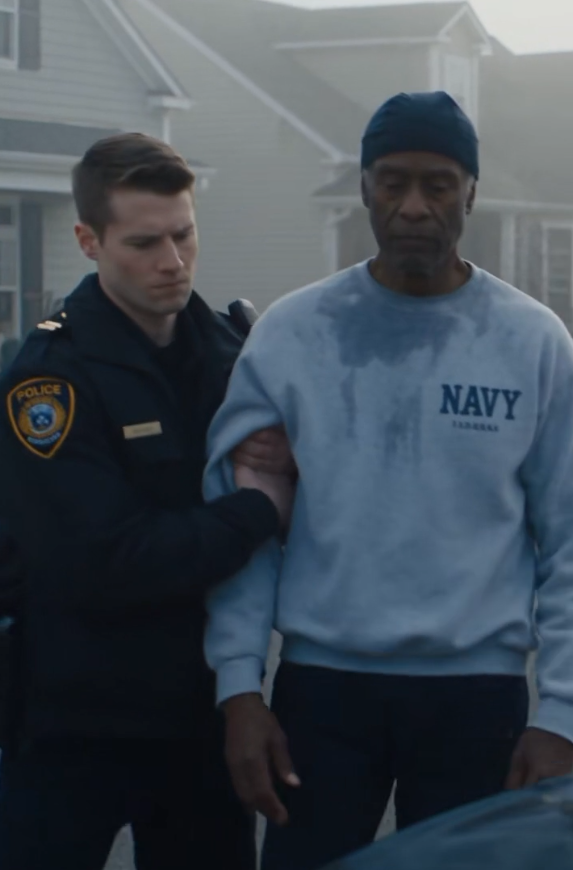
Officer Blake Higgins had lacked reasonable grounds to prolong the stop once Isaiah provided a verifiable address and offered cooperation. His decision to handcuff and transport Isaiah had violated departmental policy. More seriously, investigators concluded that portions of his written report were inconsistent with the body-camera footage.
Sergeant Mitchell Carter had failed in his supervisory responsibility by not intervening.
The chief announced disciplinary proceedings for Higgins and a formal supervisory sanction and retraining requirement for Carter.
Then came the part Isaiah had not expected.
The chief requested a public community review of stop-and-detention practices.
He asked Isaiah to speak.
Isaiah declined.
The chief called again.
Isaiah declined again.
Leah watched both conversations.
The third time the chief called, Isaiah placed the phone on the kitchen counter without answering.
Leah said, “You’re going.”
“No.”
“Yes.”
“Why?”
“Because you keep staring at the phone.”
“That proves nothing.”
“It proves you haven’t decided.”
“I have.”
“Then turn it off.”
Isaiah looked at her.
Leah was standing between parallel bars, both hands gripping the supports.
She had progressed from the wheelchair to short assisted sessions upright. Sweat darkened the collar of her T-shirt.
Isaiah said, “Focus on your footing.”
“I am.”
“You’re arguing with me.”
“I can multitask.”
“You inherited that from your mother.”
“You say that about every trait you don’t like.”
Isaiah nearly laughed.
Leah shifted her weight carefully.
“Why won’t you speak?”
“Because the investigation is doing its job.”
“That isn’t why.”
“It’s enough.”
“No.”
She took another controlled movement forward.
Isaiah stayed close without touching her.
Leah breathed through the effort.
“You’re afraid the room will listen because of your stars.”
Isaiah’s face became still.
Leah saw she had reached the right place.
She continued.
“And you hate that.”
“Yes.”
“Good.”
“Good?”
“You should hate it.”
She stopped at the end of the bars.
“But that doesn’t mean you get to waste it.”
Isaiah looked at her.
Leah lowered herself carefully into the chair.
Her breathing slowed.
“When that transport caught fire,” she said, “I had rank on some of the Marines I pulled out.”
Isaiah’s jaw tightened.
They rarely discussed the ambush directly.
Leah looked at her hands.
“You know what none of them cared about?”
He waited.
“My bars.”
She looked at him.
“They cared that I could reach them.”
Isaiah said nothing.
Leah nodded toward the silent phone.
“Reach them.”
The public review filled the municipal chamber.
Isaiah entered without uniform.
Leah came beside him using forearm crutches rather than the wheelchair.
The choice was hers.
He did not comment on how much effort it cost her.
Carter sat in the front row.
Higgins sat with counsel several seats away.
The chief stood at a lectern.
There were reporters at the back, residents along both walls, cameras outside the doors.
When Isaiah’s name was called, the room shifted.
He took the seat at the witness table.
No stars.
No medals.
No Army dress blue.
Just a dark suit and the faint remaining shadow of bruising around one wrist.
He looked at the panel.
Then at the audience.
Then at Higgins.
Isaiah had briefed defense officials, congressional committees, commanders with access to weapons that could alter history.
This room was smaller.
The question felt larger.
He began without notes.
“My name is Isaiah Montgomery. I am fifty-eight years old. I live at 442 Willow Creek Lane.”
He paused.
“That is the information I gave Officer Higgins the morning he stopped me.”
No one moved.
“I am also a general in the United States Army.”
He looked toward the press.
“That is the information he learned later.”
A camera shutter clicked.
“The order of those facts matters.”
Higgins stared at the table.
Isaiah continued.
“I have been asked repeatedly whether I believe this incident happened because I am Black.”
He paused.
“I cannot testify to what was inside another man’s mind. I can testify to what he did.”
The room remained quiet.
“He saw me running. He stopped me without a specific description connecting me to a reported crime. I provided an address. I offered a direct method of verifying my identity. I followed his instructions. He chose to handcuff me and transport me anyway.”
Isaiah rested his hands on the table.
“Then he wrote a version of that encounter that the video does not support.”
He looked toward Carter.
“Sergeant Carter saw the same stop and did not intervene when he should have.”
Carter held his gaze.
“He later told the truth at personal cost.”
Isaiah turned back to the panel.
“I do not mention that to excuse his first decision. I mention it because accountability that leaves no path back to integrity teaches people to hide mistakes more carefully.”
The chief lowered his eyes.
Isaiah breathed once.
“When the station confirmed who I was, everything changed. The cuffs came off. Voices lowered. The police chief arrived. Calls came from the Pentagon.”
He looked toward Leah.
She stood near the wall on her crutches.
“And that is the part that concerns me most.”
The room shifted again.
“If I had been nobody you recognized, what would have changed?”
The question hung there.
“No Pentagon would call. No national press would arrive. No four stars would embarrass anyone into reviewing footage before breakfast.”
Higgins finally looked at him.
Isaiah met his eyes.
“A person should not need to be powerful before restraint becomes important.”
Nobody applauded.
Isaiah was grateful.
Applause would have made the moment smaller.
One panel member asked, “General, what outcome are you requesting?”
There it was.
The choice.
Isaiah could ask for Higgins’s dismissal.
The room expected it.
The press wanted a clean ending.
The military people who had called him privately wanted a demonstration that senior leaders would not be treated this way.
He thought of Leah telling him rank did not matter when a person needed to be reached.
He thought of Carter standing on the porch with a resignation in his hand.
He thought of Higgins’s unfinished sentence.
If I’d known.
Isaiah leaned toward the microphone.
“I am not requesting a specific personnel outcome.”
A murmur moved through the chamber.
The panel member looked surprised.
“Why not?”
“Because if Officer Higgins is disciplined, that decision should be based on his conduct and the standards of his department, not on my ability to create pressure.”
He looked toward the chief.
“I am asking for three things.”
The chief listened.
“First, that officers be required to document the specific facts that justify prolonging an investigative stop, not conclusions such as suspicious or evasive.”
He held up a second finger.
“Second, that supervisors be trained and evaluated on intervention, not merely review after the fact.”
Carter lowered his gaze.
“Third, when body-camera footage materially contradicts an officer’s written account, review should be automatic.”
The panel member said, “Those are policy requests.”
“Yes.”
“What about what happened to you personally?”
Isaiah sat back.
“It happened.”
“That’s all?”
“No.”
He glanced at Leah.
“It mattered.”
Then back to the panel.
“But I have spent my career around people entrusted with force. You cannot build a system around the assumption that everyone will make the right decision every time.”