He paused.
“You build it so one bad decision has fewer places to hide.”
This time the silence felt different.
Not stunned.
Attentive.
Then Higgins stood.
His attorney reached for his arm.
Higgins pulled away.
The chief said, “Officer, sit down.”
Higgins remained standing.
“I want to say something.”
His attorney whispered sharply.
Higgins shook his head.
Isaiah watched him.
The panel chair hesitated, then said, “You may make a brief statement.”
Higgins walked to the second microphone.
He did not look at the cameras.
He looked at Isaiah.
“For the last week, everybody’s been asking if I knew he was a general.”
His voice was tight.
“I didn’t.”
Isaiah waited.
Higgins swallowed.
“And I kept thinking that helped me.”
His attorney closed his eyes.
Higgins looked toward Carter.
“It doesn’t.”
Carter said nothing.
Higgins faced the room.
“I saw him and thought he didn’t belong there.”
The chamber went completely quiet.
He did not add a qualifier.
Did not say because of recent burglaries.
Did not say because it was early.
Did not say because Isaiah had no identification.
“I decided that before I talked to him.”
Isaiah watched the younger man struggle with the next words.
Higgins said, “Then every answer he gave me became something I used to prove I’d been right.”
His eyes dropped.
“When he told me to call my commander, I thought he was challenging me. When he offered the address, I thought he was lying. When he looked at my hand, I wrote that he moved aggressively.”
He rubbed both palms against his trousers.
“I knew what the camera showed when I wrote the report.”
The chief stared at him.
Carter closed his eyes.
Higgins’s attorney whispered, “Stop.”
Higgins did not.
“I was scared of what would happen if the report showed I had made the whole thing worse.”
He looked directly at Isaiah.
“So I wrote it like you had.”
That was the final revelation.
Not that Higgins had made a mistake.
Everyone knew that.
Not even that he had lied.
The footage had already established it.
The revelation was that he finally understood the architecture of his own decision.
Isaiah felt no triumph.
Only weight.
Higgins turned to the panel.
“I don’t know what happens to my job.”
His voice thinned.
“But the general is right about one thing.”
He took a breath.
“I should’ve treated him differently before I knew who he was.”
Higgins stepped away from the microphone.
No applause followed him either.
The panel chair called a recess.
People began moving.
Reporters pushed toward the doors.
Isaiah remained seated.
Leah came slowly across the room on her crutches.
He stood to meet her.
“You knew he was going to do that?” she asked.
“No.”
“Neither did his lawyer.”
“No.”
She looked toward Higgins disappearing through the side doorway.
“What now?”
Isaiah offered his arm.
Leah shook her head.
“I’ve got it.”
He withdrew it.
“What now?” she repeated.
Isaiah looked around the chamber.
“Now everybody has to live with what they said.”
Part VI — Aftermath
Officer Blake Higgins resigned before the disciplinary board issued its final decision.
Not that day.
Not dramatically.
Three weeks later.
His resignation letter acknowledged that his report had failed to accurately describe the stop and that his conduct had damaged public trust.
The department still completed its findings.
The record did not disappear because he left.
Sergeant Mitchell Carter remained.
He received a formal suspension, lost his supervisory assignment temporarily, and was required to complete remedial training.
Then he did something the department had not ordered.
He began attending new-officer scenario reviews.
Not as an instructor.
At first, only as the example.
The first time, he stood before a room of younger officers and played the body-camera footage himself.
He paused it at the moment Higgins ordered Isaiah to turn around.
“This,” Carter told them, “is where I should have stepped in.”
One recruit asked, “Were you worried about undermining your partner?”
Carter answered, “Yes.”
Then he played the rest.
“Watch what protecting his authority cost him.”
The department adopted all three reforms Isaiah had requested.
The chief added a fourth.
Supervisors were now required to document when they overruled or de-escalated a subordinate officer in the field, not as punishment but as part of performance evaluation.
Intervention would count as leadership.
Not disloyalty.
The policy attracted less national attention than the arrest had.
Isaiah considered that normal.
Failures were more interesting than maintenance.
Leah’s recovery continued without regard for headlines.
Some mornings were good.
Some were not.
There were days when she moved down the hallway with controlled patience.
There were days when a simple transfer from chair to standing left her exhausted and furious.
Isaiah learned not to encourage too quickly.
One afternoon, he watched her struggle with a new prosthetic fitting and made the mistake of saying, “You’re making progress.”
Leah froze.
“Do not.”
Isaiah knew immediately.
“All right.”
“I hate that sentence.”
“I know.”
“No, you forgot.”
“I remembered too late.”
She looked at him.
Then laughed.
The tension vanished.
It became easier after that.
Not easy.
Easier.
Months after the arrest, Leah walked the full length of the hallway without touching the wall.
Isaiah stood in the kitchen pretending not to watch.
She reached the end.
Turned.
Caught him looking.
“You’re terrible at subtlety.”
“I command joint forces. Subtlety is delegated.”
“That doesn’t even make sense.”
“It sounded authoritative.”
“That part you’re good at.”
She walked back.
Slowly.
Carefully.
On her own.
At the kitchen doorway, she stopped beside him.
“You still running?”
Isaiah looked at her.
“Yes.”
“Same route?”
“Mostly.”
“Why?”
He understood the question beneath the question.
Why go back?
Why run past the same lawns?
Why place himself again where the memory waited?
Isaiah picked up his water bottle.
“Because it’s six miles.”
Leah rolled her eyes.
“That is such a Dad answer.”
“It is also accurate.”
She considered him.
“Can I come?”
He looked down at her prosthetic.
She caught the glance.
“Not run.”
“I didn’t say anything.”
“You looked.”
“I have eyes.”
“I can walk to the corner.”
Isaiah smiled.
“All right.”
They went out just after sunrise.
The morning resembled the one months earlier.
Cold air.
Low fog.
Wet lawns.
But the season had shifted.
Leaves had thinned along the street.
The expensive houses still stood behind the same stone walls and perfect hedges.
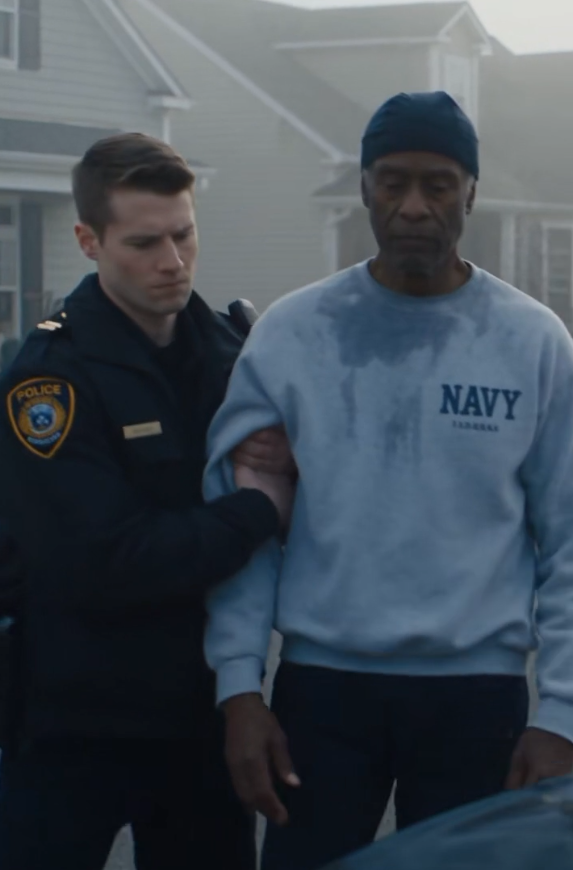
Isaiah wore the faded gray Navy sweatshirt again.
Leah laughed when she saw it.
“You still own that?”
“It was a gift.”
“It was a joke.”
“Those are not mutually exclusive.”
She wore a dark jacket and moved with a measured gait, her prosthetic still new enough that every uneven seam in the sidewalk demanded attention.
Isaiah adjusted his pace without announcing it.
They passed the place where the cruiser had first slowed behind him.
He knew the exact spot.
He did not look toward it.
Leah did.
“That was here?”
“Yes.”
She stopped.
Isaiah turned.
Leah looked down the long street.
“So this is where you decided not to tell them who you were.”
Isaiah frowned.
“That isn’t exactly what happened.”