Written sixteen months earlier after a building contractor named Hector Ruiz was arrested during a traffic stop.
Ruiz later became a cooperating witness in Orchard.
I read the highlighted sentence.
The subject's conduct was consistent with pre-asNextlt indicators, including target glancing, bladed posture, verbal deflection, and strategic movement toward a concealed access point.
Identical.
Word for word.
I looked at Cho.
"No."
He placed down another.
ORCHARD-344.
Same sentence.
Another.
ORCHARD-351.
Same sentence.
Different officers.
Different departments.
Different years.
Different suspects.
Same language.
My anger disappeared.
In its place came something much more dangerous.
Attention.
Ray leaned forward.
"What exactly are we looking at?"
Cho answered.
"Six months ago, we started noticing repeated phrases in use-of-force and obstruction reports connected to contractors under investigation in Orchard. We assumed they were copied from common training material."
"They aren't?" Marisol asked.
"We couldn't locate the phrasing in any state-certified manual."
I stared at Harlan's draft.
"How many reports?"
"Twenty-seven that we know of."
"Departments?"
"Five."
"And Harlan?"
Cho's voice lowered.
"His name wasn't anywhere in Orchard."
Until now.
The room became very quiet.
Marisol slowly sat down.
I read Harlan's sentence again.
Target glancing.
Bladed posture.
Verbal deflection.
Strategic movement.
It was professional-sounding nonsense arranged to make innocent movement sound predictive.
"Maybe they all attended the same private training."
"That's been our working theory," Cho said.
"What company?"
"We didn't know."
I looked at him.
"Didn't?"
Cho slid another page across the table.
A payment ledger seized two weeks earlier from a subcontractor tied to Orchard.
Most entries used initials.
One column was labeled CONSULTING.
Another, TRAINING.
Beside several cash disbursements appeared the same two letters.
GH.
I looked through the conference-room window.
At the far end of the corridor, Grant Harlan sat in an interview room.
"Grant Harlan," I said.
Cho nodded.
"We need his personnel file."
Marisol looked at me.
"We are not turning your wrongful arrest into an investigative shortcut."
"It already turned itself into one."
"Sloane."
"I'm not touching the case."
"You are the case."
"Exactly."
I pushed the report toward Cho.
"This is now evidence."
Marisol crossed her arms.
"You were arrested forty minutes ago."
"And forty minutes ago I thought this was one officer with a control problem."
I looked again through the glass.
"Now I think he recognized a script."
Cho nodded.
"That was my reaction."
Ray frowned.
"What script?"
I answered.
"A report template."
A cold thought took shape.
Not a document template.
A story template.
A vocabulary designed to justify escalation after the fact.
Words officers could use to make behavior sound dangerous.
To make a stop sound lawful.
To turn questions into defiance.
Fear into aggression.
Movement into pre-attack preparation.
I leaned back.
"Whoever trained these officers wasn't teaching them how to manage danger."
Cho's expression hardened.
"They were teaching them how to document it."
And suddenly the arrest on my porch was no longer just about me.
Grant Harlan was placed on administrative leave before noon.
By one o'clock, an internal affairs team had copied his department-issued phone and laptop.
By two, I was back home.
The police cars were gone.
The neighbors were not.
Fairview Estates had never looked so occupied.
Curtains twitched.
Garage doors opened unnecessarily.
Phones appeared whenever I stepped outside.
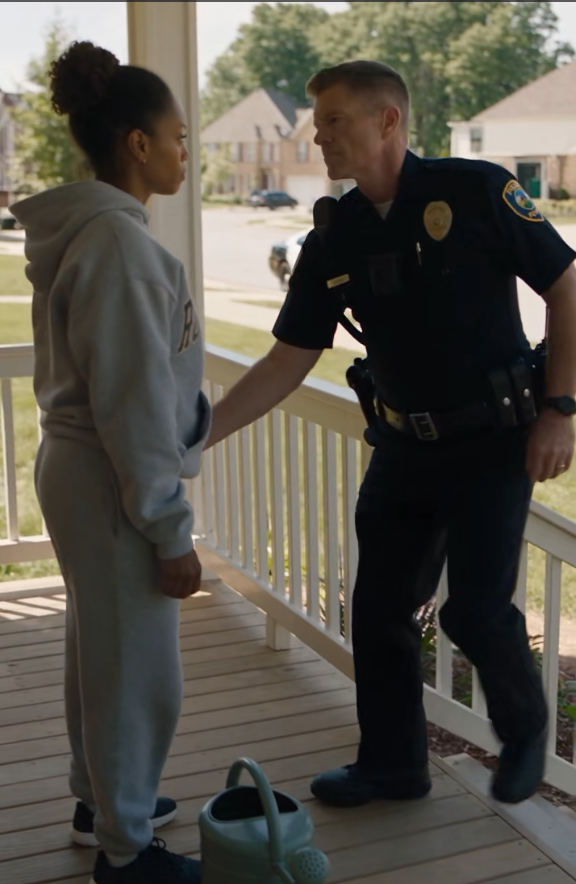
Someone had picked up my watering can and placed it neatly beside the porch.
The hydrangeas sagged under the afternoon sun.
Marisol stood behind me.
"You don't have to stay here tonight."
"I just bought it."
"I'm serious."
"So am I."
"Sloane."
I looked at the house.
"For seventeen years I've listened to defendants tell witnesses they should move, hide, disappear, stop going places, change routines."
"This is different."
"Everything is different when it happens to you."
Marisol sighed.
I picked up the watering can.
She gave me an incredulous look.
"What are you doing?"
"The hydrangeas didn't commit a felony."
That almost earned a smile.
I filled the can from the garden spigot.
Across the street, Lillian Vaughn's curtains moved.
I froze.
Marisol followed my gaze.
"That's the caller?"
"Apparently."
"You going over there?"
"No."
"Good."
"Not yet."
She groaned.
"Sloane."
Before she could continue, a sedan pulled up.
Nolan Quinn stepped out.
He was not in uniform.
He wore jeans, a gray shirt, and the expression of a man who had spent the last four hours arguing with himself.
Marisol moved beside me.
Quinn stopped at the sidewalk.
"Ms. Mercer."
"Officer Quinn."
He swallowed.
"I'm off duty."
"I assumed."
"Can I speak with you?"
Marisol said, "You have counsel?"
"No."
"Then you should probably get some."
He looked at her.
"I don't want a lawyer."
"That feeling has ruined many afternoons."
He almost smiled, but couldn't.
His eyes returned to me.
"I came to apologize."
I set down the watering can.
"Don't."
He flinched.
"I mean—"
"Don't come here to make yourself feel better."
His face reddened.
"I know I should've stopped him."
"Yes."
"I knew the property check could've resolved it."
"Yes."
"I heard you give your name."
"Yes."
His voice broke slightly.
"I still put my hand on you."
I let the silence stand.
Quinn stared at the sidewalk.
Finally he said, "Harlan told me something in the car."
That changed everything.
Marisol became very still.
"What?" I asked.
"After we put you in the back."
Quinn glanced around.
"He said, 'She's clean enough to be trouble.'"
A chill moved through me.
"What does that mean?"
"I don't know."
"Exact words?"
"Yes."
Marisol said, "Did your body camera capture it?"
Quinn shook his head.
"He muted his."
"And yours?"
Another pause.
"I didn't."
My eyes locked onto his.
Quinn nodded.
"It's there."
My pulse accelerated.
"What else?"
"He made a call before we reached the station."
"To whom?"
"I don't know. Bluetooth through his personal phone."
"What did he say?"
Quinn hesitated.
Then quietly:
"He said, 'I may have one tied to Vale's place.'"
The air seemed to leave the porch.
"Vale," I repeated.
"The previous homeowner," Quinn said.
Dr. Edwin Vale.
Marisol looked at me.
"I thought the call was about you."
"So did I."
Quinn shook his head.
"Harlan didn't know who you were when we arrived. But after you said the deed was recorded three weeks ago, something changed."
I remembered it.
His insistence.
His refusal to run the property.
His urgency.
"What else did he say on the phone?"
Quinn looked genuinely frightened now.
"Just one other thing."
"What?"
"He said, 'I'll know if she gets inside.'"
We did not enter my house again until the FBI arrived.
That statement sounds absurd when I write it now.
At 8:00 that morning, I had been annoyed by aphids.
At 4:30 that afternoon, six federal agents were searching the home I had bought three weeks earlier because a police officer's recorded words suggested he had arrested me to prevent me from reaching something inside.
Daniel Cho supervised.
I sat on the porch while agents moved room to room.
Marisol remained beside me.
Across the street, Lillian's curtains stayed closed.
"What did Vale do?" Marisol asked.
"Cardiologist. Retired eight years ago."
"Family?"
"Estate documents listed one nephew. Lives overseas."
"Connection to Orchard?"
"None that I know."
Cho stepped outside.
"Sloane."
I stood.