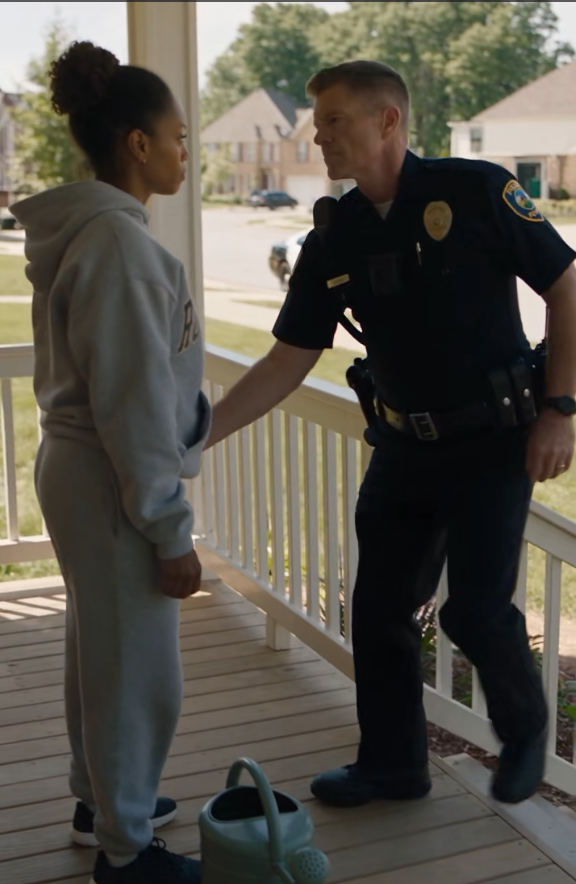
His expression told me they had found something.
"What?"
"Basement."
The basement was unfinished except for a laundry room, storage shelves, and an old workbench built against the foundation.
An agent had pulled the bench away from the wall.
Behind it was a square of concrete slightly different in color from the surrounding block.
Fresh patching.
They scanned it.
Hollow space.
Twenty minutes later, a technician removed a rectangular section.
Inside the wall sat a metal document case wrapped in plastic.
I stared at it.
"That was inside my house?"
Cho wore gloves.
"Apparently."
The case was locked.
They opened it under camera.
Inside were three things.
A stack of photocopied financial records.
A flash drive.
And a handwritten letter.
The outside of the envelope contained four words.
IF I DIE FIRST.
No recipient.
Cho photographed it before opening.
The letter was written by Dr. Edwin Vale.
The dead previous owner of my house.
The first paragraph read:
I have spent forty-one years believing that institutions fail because bad people enter them. I was wrong. Institutions fail when good people learn to survive beside bad ones.
I looked at Cho.
"Keep reading."
Vale's letter described a patient who had come to him seven years earlier.
A city contractor.
The man had suffered a cardiac emergency in Vale's office after arriving for a routine examination.
Before paramedics came, the patient believed he was dying.
He gave Vale a flash drive.
Told him that if anything happened, people would come looking for it.
He did not die.
But three weeks later, he disappeared.
The patient's name was Marcus Pell.
I knew it immediately.
Pell had been a minor contractor whose company collapsed after a federal tax investigation six years ago.
At least that was the official history.
Vale's letter continued.
Pell claimed he had records proving police officers were being paid by private contractors to create arrests, inspections, disturbances, and enforcement pressure against business rivals, reluctant property owners, and inconvenient witnesses.
Vale did not believe him at first.
Then two officers appeared at the medical office asking whether Pell had left property behind.
No warrant.
No subpoena.
Just questions.
Vale lied.
He kept the drive.
Over the next several years, he quietly copied records when he could, documenting vehicles that sat outside his home and unfamiliar people who approached him.
Then, eighteen months before his death, someone broke into his house.
Nothing obvious was taken.
But the workbench in his basement had been moved.
Vale hid the drive inside the foundation after that.
At the bottom of the letter, one sentence had been underlined twice.
If the person reading this owns my house, then they may already believe you have what they want.
My skin went cold.
Marisol whispered, "Jesus."
Cho looked at the flash drive.
"I want this imaged in the lab."
An agent sealed it.
I stared at the open wall.
Three weeks earlier I had thought I was buying crown molding, old plumbing, and a garden.
Instead, I had purchased a dead man's hiding place.
Then another thought struck me.
"The 911 call."
Cho looked at me.
"What about it?"
"Harlan said, 'I may have one tied to Vale's place.'"
Marisol understood first.
"He expected a call there."
I turned toward the basement stairs.
"Or someone expected him to respond."
We crossed the street together at 5:42 p.m.
Lillian Vaughn opened her door before we reached it.
She looked smaller than she had that morning.
Her eyes moved from me to Cho's badge.
"I suppose you're here about the call."
I folded my arms.
"Why did you make it?"
She looked past us toward my house.
"I thought you were trespassing."
"You brought me lemon bars."
Lillian's face tightened.
"That doesn't mean I knew you owned it."
"I told you I had just moved in."
"You said you were moving things."
"I walked out of the front door."
She said nothing.
"Why did you call?"
"I was worried."
"About what?"
"The neighborhood."
Cho stepped forward.
"Mrs. Vaughn, did anyone ask you to report activity at Dr. Vale's former residence?"
Her eyes flickered.
That was enough.
"Lillian," I said, "look at me."
She did.
"Were you told to call?"
Tears appeared instantly.
She closed her eyes.
"Oh, God."
Marisol exhaled.
Cho said, "Who?"
Lillian backed into the house.
We followed her into a spotless living room full of family photographs and crocheted blankets.
She sank onto the sofa.
"A man came by after Edwin died."
"Name?"
"He said his name was Mr. Keller."
Description.
Late forties.
White.
Tall.
Gray SUV.
Polite.
He said he worked with the estate insurer.
He told Lillian the house had experienced attempted break-ins because people believed Dr. Vale had kept prescription drugs inside.
If she saw anyone unfamiliar around the property, she should call police immediately.
"Did he tell you which officer to request?" Cho asked.
"No."
"Did he give you a number?"
"No."
"Did he contact you again after I bought the property?" I asked.
She nodded.
"When?"
"Four days ago."
My stomach dropped.
"What did he say?"
"He asked whether the new owner had moved in."
Cho and Marisol exchanged a look.
"What did you tell him?" I asked.
Lillian started crying.
"That I wasn't sure. That I'd seen a woman coming and going."
"Me."
"I didn't know."
"You did know."
"I'm sorry."
I sat opposite her.
"Lillian, why didn't you just knock on my door?"
She looked at me.
The answer was painful because it was simple.
"I was afraid."
"Of me?"
She began to deny it.
Then stopped.
I waited.
Finally she whispered, "For a moment, yes."
Silence filled the room.
There are admissions that arrive with excuses.
And there are admissions that arrive stripped bare.
Hers was the second kind.
She wiped her eyes.
"I saw you in those clothes. I saw you walking around. I remembered what that man said. And I thought..."
She could not finish.
I could.
"You thought I looked like I didn't belong in my own house."
She covered her mouth.
I stood.
"I need the number he called from."
She nodded.
"I still have it."
Cho took over.
As Lillian searched her phone, I walked toward the window.
From her living room, my house filled almost the entire view.
My porch.
My flowers.
My open garage.
Anyone watching from here would have seen everything.
Then I noticed a framed photograph on Lillian's side table.
She stood beside Dr. Vale at a neighborhood picnic.
They were younger.
Vale had one arm around a man I did not recognize.
A broad-shouldered Black man in his forties.
I leaned closer.
"Who is that?"
Lillian looked up.
Her face changed again.
"Marcus."
Cho walked over.
"Marcus Pell?"
"Yes."
I turned.
"You knew him?"
"He was Edwin's godson."
Nothing in Vale's letter had mentioned that.
Cho said, "Mrs. Vaughn, you need to tell us everything."
Lillian sat down slowly.
"Marcus wasn't just Edwin's patient."
Her voice trembled.
"He was practically family."
The flash drive contained enough material to turn Orchard from a difficult corruption investigation into a catastrophe.
Payment ledgers.
Recorded phone calls.
Photographs.
Invoices.
Names.
Officers.
Inspectors.
Contractors.
A private security company called Sentinel Civic Solutions.
Sentinel marketed itself as a law-enforcement consulting company specializing in "risk-based intervention, officer articulation, and liability-resistant documentation."