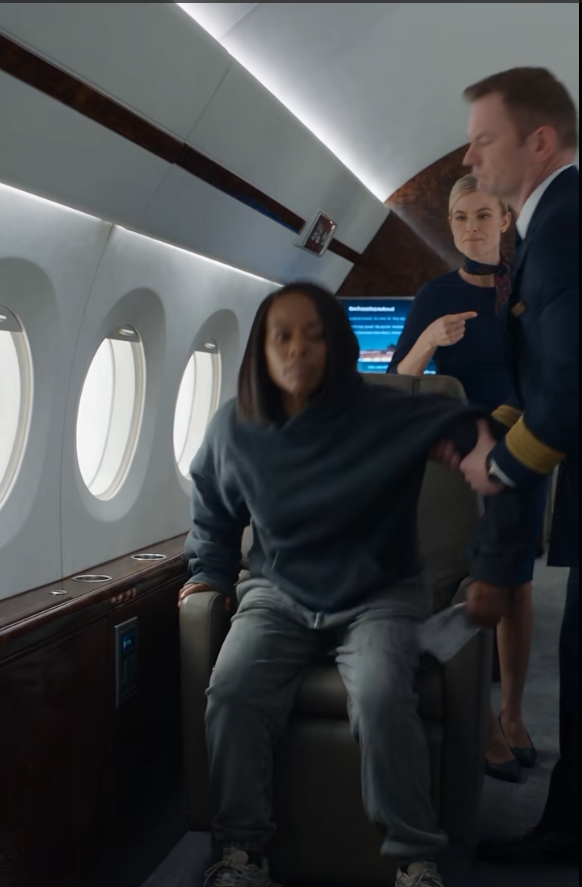
“How many formal bias complaints?”
“We track substantiated complaints.”
“That wasn’t my question.”
He shifted.
“Nine substantiated.”
“How many allegations?”
“We’d need to pull—”
“It was pulled overnight. One hundred eighty-three.”
His jaw tightened.
“Many were unfounded.”
“I assume so. How many were investigated beyond local station review?”
He looked toward the general counsel.
She answered.
“Twenty-six.”
“How many involved interviews with other passengers?”
“Seven.”
“How many cases were closed through service recovery?”
The head of customer operations said, “Service recovery is not the same as closing a conduct investigation.”
“Correct.”
I clicked the remote.
A chart appeared.
One hundred seventeen complaints that included terms related to discrimination, differential treatment, or profiling had been coded primarily as service failures.
Miles.
Credits.
Refunds.
Apologies.
The customer was compensated.
The employee conduct question often ended there.
The board chair leaned forward.
“Where did this come from?”
“My team cross-referenced free-text complaints against disposition codes.”
The customer operations chief said, “That methodology will overcount.”
“Probably.”
He blinked.
I continued.
“It may also undercount. We don’t know. That’s the problem.”
Another director asked, “What exactly are you proposing?”
“Independent review of removal practices, complaint coding, escalation incentives, and crew discretion.”
“That could take months.”
“Yes.”
“And meanwhile?”
“We change what we already know is indefensible.”
The customer operations chief stiffened.
“Which is?”
“Passenger attention cannot be evidence of passenger misconduct.”
He looked away.
I went on.
“Ticket validity must be independently confirmed before police are requested for a ticket dispute unless there is an actual safety threat. Crew safety authority stays intact. But disagreement is not automatically danger.”
The airline attorney nodded slowly.
A director said, “We cannot second-guess flight crews from corporate headquarters.”
“We can absolutely distinguish safety judgments from status judgments.”
“That is easy to say in a boardroom.”
I looked at him.
“You’re right.”
He appeared surprised.
“So we include working flight attendants, pilots, station staff, disability advocates, and passenger safety specialists in the redesign.”
The head of customer operations said, “This is an enormous reaction to one employee making one mistake.”
I turned toward him.
“Do you believe yesterday was one mistake?”
“Yes.”
“Which one?”
He paused.
“Megan’s judgment.”
“Only hers?”
His silence answered.
I clicked again.
The screen displayed the sequence.
5:32 — boarding scan successful.
5:35 — identity requested by cabin crew.
5:37 — station employee confirms reservation valid.
5:38 — police request initiated.
5:41 — police board aircraft.
5:44 — passenger restrained.
5:48 — irregular-passenger note created.
5:56 — note edited.
The head of customer operations stared at the timeline.
I asked, “At 5:37, when the ticket was confirmed, what should have happened?”
“The dispute should have ended.”
“It didn’t.”
“No.”
“Why?”
He looked at the policy on the next slide.
Because the system allowed the label to change.
Ticket issue became behavior issue.
Behavior issue became compliance issue.
Compliance issue became safety issue.
At each stage, a different person could say they were only following the judgment of the person before them.
That was how responsibility dissolved.
The board chair exhaled.
“What about the flight attendant?”
“Megan Wilson is suspended from duty pending investigation.”
“And the station manager?”
“Same, with pay, pending review.”
“The officers?”
“Airport authority controls them. Our counsel will provide evidence and cooperate with their investigation. I’ll decide separately whether to file a civil claim.”
One director studied me.
“You haven’t decided?”
“No.”
“After they put you in handcuffs?”
“That is precisely why I should not decide today.”
The room stayed quiet.
My phone vibrated.
General counsel had sent a new file.
I opened it.
Then I stopped.
“Megan Wilson has prior complaints.”
The customer operations chief answered too quickly.
“Every senior flight attendant does.”
“Three involving premium-cabin seat challenges.”
That changed the room.
He looked at the screen.
I read the summaries.
The first involved Tasha Green’s mother.
The second involved a Latino business traveler whose corporate upgrade had been questioned despite correct documentation.
The third involved a young man in first class traveling on points. Megan had written that his “presentation and conduct created uncertainty regarding ticket ownership.”
All three customers had valid reservations.
All three received compensation.
None of the incidents had produced formal discipline.
“Who reviewed these?” I asked.
The customer operations chief looked at the cases.
“Local management.”
“Who saw the pattern?”
“They occurred in different stations.”
“That’s not what I asked.”
No one answered.
The system had stored all three.
Nobody had been responsible for connecting them.
I closed the file.
The director who had challenged me earlier leaned back.
“So there’s your answer.”
“No.”
He frowned.
“Megan had a pattern.”
“Yes.”
“Then fire her.”
“Maybe.”
“Maybe?”
I looked around the table.
“If I fire one woman, issue an apology, rewrite one policy paragraph, and declare victory, we will have learned nothing.”
The director’s patience thinned.
“What more do you want?”
“I want to know why the company had the information required to act and did not act.”
That question took us into the afternoon.
And by the afternoon, the story had become worse.
Not because of another dramatic video.
Because of spreadsheets.
Megan’s previous complaints had been routed into separate systems.
Customer relations recorded compensation.
Cabin management recorded coaching.
Legal recorded exposure.
Operations recorded delays.
Nobody’s performance metric penalized repetition unless an incident crossed a formal disciplinary threshold.
Managers were rewarded for resolving complaints quickly and reducing open cases.
Compensation closed cases.
Closed cases disappeared from dashboards.
The company had built an efficient machine for ending complaints.
Not necessarily for learning from them.
At 4:10, the head of customer operations asked to speak with me privately.
We moved into a smaller room.
He closed the door.
“You think I buried these cases.”
“I think your system did.”
“You control the company now. You can say anything you want.”
“No. I can ask anything I want.”
His face tightened.
“I’ve spent twenty-two years here.”
“I know.”
“We move one hundred and fifty thousand people on a busy day. Crews get screamed at. Gate agents get threatened. People lie about upgrades. They fake disability needs. They abuse employees and then edit the video. If you make everyone terrified to enforce rules, you will create a safety problem.”
I listened.
He was not entirely wrong.
That mattered.
“So what do you recommend?” I asked.
He seemed caught off guard.
“You actually want my answer?”
“Yes.”
“Don’t let one ugly incident turn into a corporate confession that every disputed removal is discrimination.”
“I agree.”
He stared at me.
“Then why does it feel like you’re dismantling the department?”
“Because your department confused protecting discretion with eliminating accountability.”
His expression hardened.
“That’s a slogan.”
“No.”
I leaned forward carefully, guarding my shoulder.
“A flight attendant should be able to act immediately when a passenger threatens safety. But when she says a passenger’s clothing is inconsistent with a cabin profile, that is not safety expertise.”
He looked away.
“You know what frightens me?” I said.
He looked back.
“Not that Megan Wilson may be prejudiced. Companies know how to discipline an employee. What frightens me is that she made a bad judgment, a station employee knew it was bad, the police acted on it, the complaint system had already seen similar behavior, and every process still moved in the same direction.”