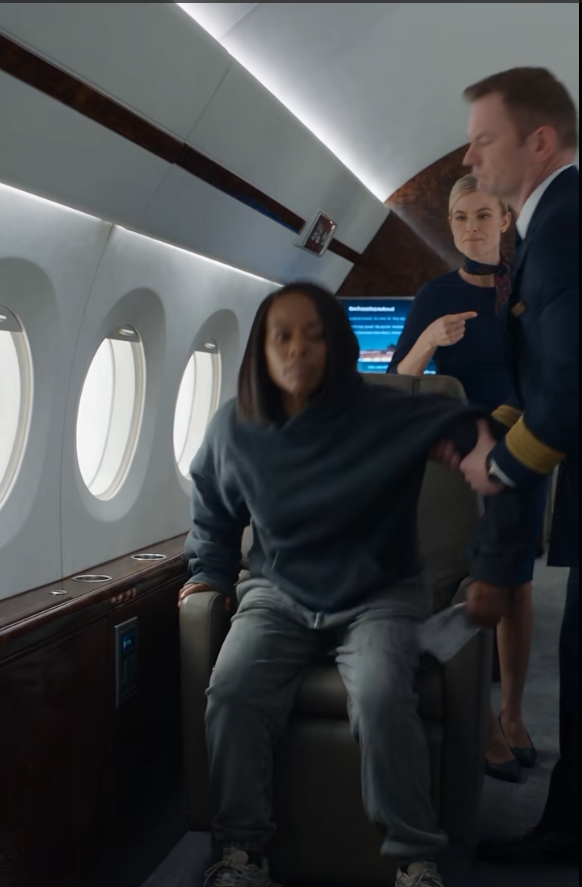
He said nothing.
“That’s not one employee.”
“No.”
“It’s not one department either.”
“No.”
He rubbed his forehead.
Then he gave me the first piece of information all day that nobody had expected.
“There’s a report.”
“What report?”
“Internal audit. Two years ago.”
I became still.
“On removals?”
“On customer escalations. Including cabin disputes.”
“Where is it?”
“Legal archived it.”
“Why?”
“It was commissioned after a series of complaints. The findings were considered inconclusive.”
“Who considered them inconclusive?”
He looked at me.
“The executive committee.”
Part IV — The Report
The report was eighty-six pages.
It had never gone to the full board.
By 6:00 that evening, copies sat in front of the directors.
The title was deliberately dull:
PASSENGER ESCALATION PROCESS REVIEW — OPERATIONAL CONSISTENCY ASSESSMENT.
The findings were not.
The audit team had sampled hundreds of incidents across twenty airports.
It found that once a passenger was labeled “noncompliant,” later reviewers rarely revisited the original cause of the disagreement.
It found inconsistent documentation.
It found wide variation in when police were called.
It found that employees often used behavior language—aggressive, disruptive, suspicious—without describing observable conduct.
And buried on page sixty-three was the sentence that changed the acquisition for me:
There is evidence that subjective expectations regarding passenger appearance, status, language, and cabin “fit” may influence escalation decisions in a subset of premium-cabin disputes.
The report recommended standardized verification steps, mandatory descriptive rather than interpretive reporting, cross-station pattern analysis, and independent review of bias complaints.
Only one recommendation had been implemented fully.
A new training video.
I closed the report.
The board chair looked older than he had the day before.
“Why wasn’t this disclosed during diligence?”
The airline’s general counsel answered.
“It was included in the compliance archive.”
My own general counsel looked at me.
I knew what she was thinking.
We had missed it.
Not technically.
The file had been available.
But during a five-billion-dollar acquisition, teams triaged thousands of documents according to material risk.
An internal operational report with no pending regulatory action, no major litigation exposure, and no quantified financial impact had been categorized low priority.
One of my own teams had marked it reviewed.
Not me.
But Pinnacle’s process had done its own version of what the airline had done.
We had valued what fit our model.
Fleet liabilities mattered.
Debt mattered.
Fuel mattered.
Customer harm without an obvious price tag did not rise.
I had spent the day demanding to know why nobody connected information that was already available.
Now I had my answer reflected back at me.
Sometimes because nobody wanted to see it.
Sometimes because seeing it was not anyone’s job.
I asked my general counsel, “Who reviewed this in diligence?”
“I’m finding out.”
“No.”
She stopped.
“It doesn’t matter tonight.”
“It may matter if—”
“It passed through our system. That makes it ours.”
A director across the table watched me carefully.
He said, “You didn’t own the airline two years ago.”
“No.”
“You cannot accept responsibility for management decisions made before you arrived.”
“I’m not.”
“Then what are you saying?”
“That I bought the company yesterday after claiming we understood its operational risks. This report was available to us. We assigned it low significance.”
The director folded his hands.
“That is not the same thing.”
“No.”
I looked at the title again.
“But it rhymes.”
That night, I finally called my mother.
She had left six voicemails.
The first four were angry.
The fifth was worried.
The sixth simply said, Call me before I get on a plane myself.
I called.
She answered before the first ring finished.
“Vanessa.”
“I’m okay.”
“You have bruises.”
“They look worse on video.”
“You were in handcuffs.”
“I noticed.”
“Do not make jokes with me.”
“I’m sorry.”
Silence.
Then softer: “Does your shoulder hurt?”
“Yes.”
“Did you get it checked?”
“Yes.”
Another silence.
My mother had spent thirty-four years as a public-school principal.
She could communicate judgment without moving a muscle.
“Are you sleeping?”
“Some.”
“That means no.”
“I have work.”
“You always have work.”
“This is different.”
“No. The work is different. You are the same.”
I leaned back in the hotel chair.
Outside, Los Angeles was a field of lights stretching toward darkness.
She asked, “Are they going to fire that woman?”
“I don’t know.”
My mother exhaled sharply.
“Vanessa.”
“What?”
“You know what she did.”
“Yes.”
“You heard what she said.”
“Yes.”
“And you don’t know?”
“I need the investigation finished.”
“What more investigation do you need for the sentence I heard?”
I closed my eyes.
“She deserves due process.”
“And you deserved first class.”
That landed.
I said nothing.
My mother’s voice softened.
“You’re worried about becoming the rich woman who destroys somebody because she embarrassed you.”
I stared out the window.
She knew me too well.
“Yes.”
“So you’re going to overcorrect.”
“Maybe.”
“You do that.”
“Thanks.”
“You asked.”
“I didn’t.”
“You called your mother. Same thing.”
I smiled despite myself.
Then she said, “Due process doesn’t mean pretending you don’t know anything until a committee hands you permission to know it.”
I opened my eyes.
She continued.
“You have video. You have witnesses. You have her report. You have her old complaints. Let the woman answer. Then make a decision you can defend if nobody ever learns your name.”
That sentence stayed with me.
If nobody ever learns your name.
That was the test.
Not whether I could punish Megan.
Whether I would have demanded the same response if the woman in handcuffs had been Tasha Green’s seventy-one-year-old mother.
If she had been a nurse.
A teacher.
A college student using points.
A warehouse supervisor who saved for three years.
Someone without Protocol Executive Omega.
Someone whose lawyer did not call the airport command desk eight minutes after detention.
Someone whose complaint became fifteen thousand miles and an apology.
At 11:40 p.m., I sent one instruction to the board committee.
Apply the remedy test anonymously. Remove my name, ownership, and title from the case summary before final disciplinary recommendation.
Then I turned off my phone.
For four hours.
It was the longest I had been unreachable in years.
Megan’s interview took place the following afternoon.
I did not attend.
I watched the recording afterward.
She sat across from two independent investigators with an attorney beside her.
Without the uniform, she looked smaller.
That observation annoyed me.
People did not become more or less responsible because they looked vulnerable.
The investigator asked why she challenged my seat.
Megan replied, “Her appearance was inconsistent with what I normally see in first class.”
“Meaning?”
“Casual.”
“Other passengers wore casual clothing.”
“Not like that.”
“What specifically?”
She hesitated.
“Hoodie. Old shoes.”
“Anything else?”
“No.”
“Race?”
Her attorney shifted.
Megan said, “No.”
“Did race influence you?”
“No.”
“Did socioeconomic assumptions influence you?”
“I don’t know.”
That was the first honest answer.
The investigator asked why she continued after the station employee verified my ticket.
Megan stared at the table.
“I thought she had become hostile.”
“What did she do?”
“She challenged me.”
“Describe the behavior, not your interpretation.”
Another pause.