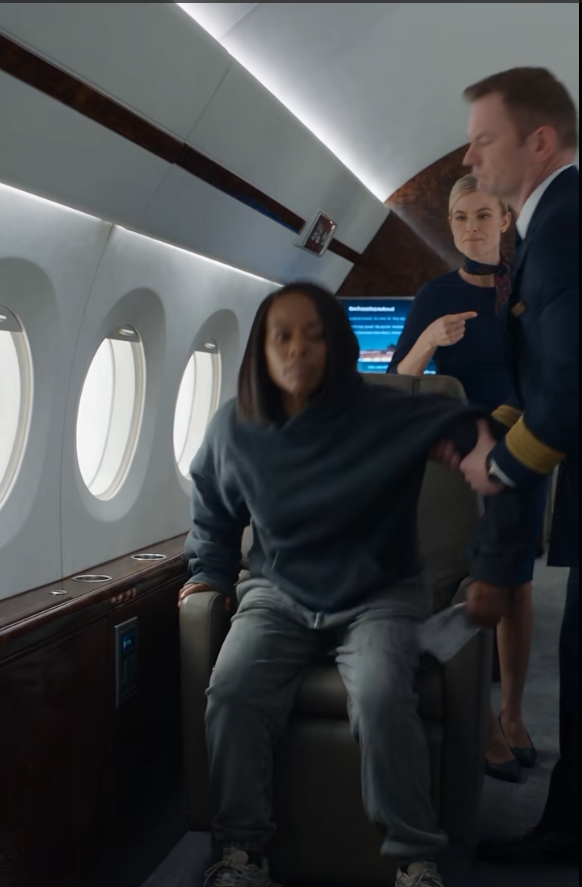
“She kept asking me to check the ticket.”
“Did she threaten you?”
“No.”
“Raise her voice?”
“Not initially.”
“Profanity?”
“No.”
“Physical gesture?”
“No.”
“What made the situation unsafe?”
Megan’s mouth tightened.
“People were watching.”
I stopped the recording.
Passenger attention.
There it was.
I resumed.
The investigator asked about her statement: People who look like you don’t belong in 14A.
Megan denied remembering the exact wording.
Then they played Claire’s recording.
Her own voice filled the interview room.
Clear.
Sharp.
Unmistakable.
Megan closed her eyes.
When the clip ended, nobody spoke for several seconds.
Finally she said, “I heard myself.”
“Yes,” the investigator replied.
“I don’t know why I said that.”
The investigator did not rescue her.
Megan’s voice became quieter.
“I thought she was trying to get away with something.”
“Why?”
“I already answered.”
“No. You described what she wore.”
Megan looked up.
“I guess I decided what kind of person she was.”
There was no dramatic breakdown.
No cinematic confession.
Just a tired woman sitting under fluorescent lights, realizing that the story she had told herself in the cabin did not survive contact with the evidence.
The investigator moved to the prior complaints.
Megan remembered Tasha Green’s mother.
“She had an upgrade discrepancy.”
“No discrepancy existed.”
“That was determined later.”
“Records show it was confirmed before departure.”
Megan went silent.
The investigator showed her the second case.
Then the third.
By the end, her posture had changed.
Not collapsed.
Changed.
She stopped defending each incident individually.
“When did anyone show me these together?” she asked.
The investigator replied, “That’s not the question.”
“I know.”
Megan rubbed her temple.
“I’m asking because I didn’t know.”
“You knew each one.”
“Yes.”
“But not the pattern.”
“No.”
“Would knowing the pattern have changed your behavior?”
“I’d like to say yes.”
“Would it?”
Megan stared at the tabletop.
“I don’t know.”
That answer was harder to hate than an excuse.
It did not absolve her.
It simply sounded true.
Part V — The Choice
Three days after the incident, the board committee delivered its findings.
Megan had violated ticket-verification procedures.
She had made an unsupported assumption based in part on my appearance.
She had disregarded contrary information from station personnel.
She had escalated an administrative disagreement into a safety issue without sufficient behavioral basis.
She had provided inaccurate initial documentation and later edited language in a way that made the record appear more objective than her original reasoning.
The committee also found significant organizational failures.
Prior complaints had not been aggregated.
Managers had treated recurring conduct as isolated service issues.
Training emphasized crew authority but gave insufficient guidance on separating genuine threats from challenges to employee decisions.
Station personnel were culturally and procedurally discouraged from interrupting a crew escalation even when they possessed contradictory factual information.
The recommendation regarding Megan was termination.
The recommendation regarding the duty manager was formal discipline, retraining, and removal from supervisory responsibility pending certification.
The head of customer operations was to be placed under board review.
The policies were to be rewritten.
I read the recommendation twice.
Then I asked for one more meeting.
Not because I doubted the findings.
Because something else had happened.
At 9:15 that morning, the airline’s lenders had contacted us.
By 10:00, two major corporate travel partners had requested assurances.
By noon, employees were circulating internal rumors that Pinnacle intended to use the scandal as justification for mass firings.
The acquisition had already made people nervous.
Now tens of thousands of employees believed one viral video might become cover for a purge.
The board chair wanted a decisive public act.
Terminate Megan.
Announce reforms.
Move on.
It was clean.
Too clean.
At four in the afternoon, I entered the same boardroom where we had reviewed the audit.
The head of customer operations was there.
So were labor representatives, directors, counsel, and senior operational leaders.
Megan was not.
Her employment decision was mine under the new governance arrangement, but the process remained private.
The board chair said, “We need closure.”
“No,” I said. “We need a decision.”
“A decision creates closure.”
“Sometimes.”
I placed three documents on the table.
The first was Megan’s termination recommendation.
The second was the hidden audit report.
The third was Pinnacle’s acquisition diligence summary.
I pushed the third toward the center.
“One of these documents belongs to my company.”
The board chair looked at it.
I continued.
“We classified the operational audit as low materiality because it showed no quantified financial exposure.”
A director frowned.
“This is not relevant to employee discipline.”
“It is relevant to what we do afterward.”
The head of customer operations watched me.
I said, “I’ve spent three days hearing explanations for why people failed to connect information. Different systems. Different departments. Different definitions of risk. My firm had the report too.”
The board chair said, “Vanessa, you cannot equate acquisition diligence with removing a passenger from an aircraft.”
“I’m not.”
“Then be precise.”
He was right.
I nodded.
“Megan Wilson made decisions for which she is personally responsible. Officer Miller made decisions for which he is personally responsible. The duty manager failed to intervene when he knew the ticket was valid. Those actions are not erased by a bad system.”
I rested my hands on the table.
“But if we punish individuals and preserve the incentives that shaped the event, we are protecting the company from embarrassment, not protecting passengers from recurrence.”
The labor representative asked, “So what are you proposing?”
“Accountability in both directions.”
I opened a folder.
“Megan Wilson’s employment will be terminated for documented conduct and falsification-related integrity concerns in the incident record.”
No one moved.
I felt no satisfaction saying it.
“She will receive the normal contractual review rights available to any employee. Not less because the passenger was me. Not more because the case became public.”
The labor representative nodded once.
“The station duty manager remains employed.”
The customer operations chief looked surprised.
“He will lose supervisory authority temporarily, undergo retraining, and be required to complete independent safety-escalation certification before reinstatement.”
A director asked, “Why keep him?”
“Because he told the truth quickly, preserved records, and acknowledged his failure without altering documentation. Discipline should distinguish cowardice from dishonesty.”
That produced uncomfortable looks.
Good.
Comfort had done enough.
“And customer operations?” someone asked.
I turned toward its chief.
He met my eyes.
“You ignored the internal audit.”
“We disagreed with parts of it.”
“You implemented one minor recommendation and allowed the rest to disappear.”
“We had operational concerns.”
“Then you should have documented why.”
He said nothing.
“You also built performance metrics that rewarded closing complaints without measuring recurrence.”
“That system predates me.”
“You ran it for six years.”
“Yes.”
“Do you believe you can rebuild it?”
The question surprised everyone, including him.
He took several seconds.
“I don’t know if you want me to.”
“That isn’t the question.”
His expression shifted.
He thought.
Then he said, “Yes.”
“Why?”
“Because now I know exactly where it fails.”
“That answer is not enough.”
“I know.”
“What would you change first?”
He looked toward the screen.
“Complaint classification. Separate service remedy from conduct review. A customer can receive miles without the conduct case disappearing.”