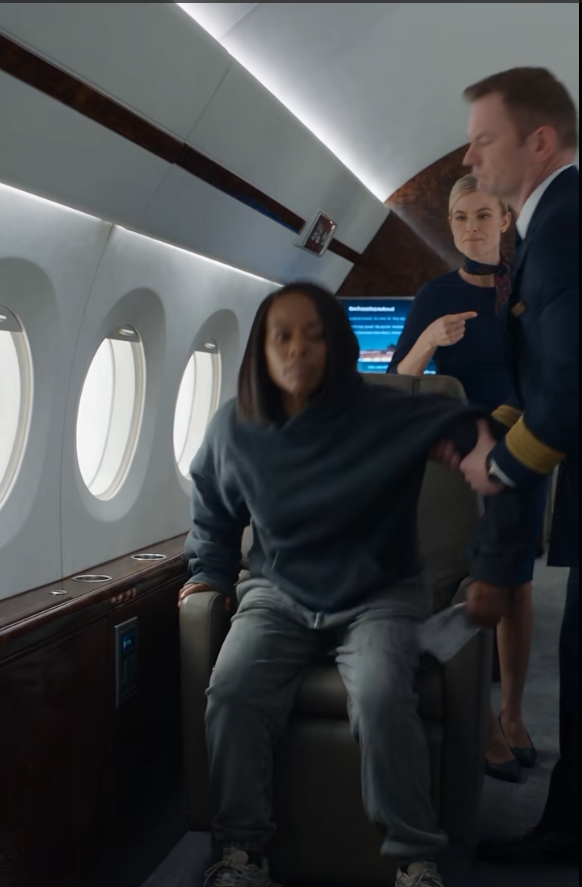
“Second?”
“Cross-station recurrence alerts.”
“Third?”
“Require observable behavior in safety reports. Ban ‘suspicious,’ ‘aggressive,’ ‘doesn’t fit profile’ unless the employee describes what actually happened.”
“Fourth?”
He hesitated.
“Station challenge authority.”
The duty manager’s failure.
He continued.
“If a factual premise is wrong—ticket invalid, identity mismatch, seat duplicate—the station employee must have explicit authority to stop that portion of the escalation without being accused of undermining crew safety.”
I leaned back.
“Can you implement those changes while an independent monitor audits the department?”
“Yes.”
“Can you do it knowing every decision for the next year will be examined?”
His jaw tightened.
“Yes.”
“Then you remain for ninety days under review.”
The board chair looked at me.
“That is a risk.”
“Yes.”
“You could replace him tomorrow.”
“Yes.”
“Why not?”
“Because firing everyone associated with a broken system does not automatically produce people who understand how it broke.”
The labor representative glanced down to hide what might have been a smile.
Then came the harder part.
“The policy changes will not wait ninety days.”
I projected the new framework.
Facts before labels.
Ticket verification before removal in administrative disputes.
Observable behavior before safety characterization.
Mandatory secondary review when police are requested for a nonviolent passenger dispute.
Automatic central review of repeated bias allegations involving the same employee, route, station, or supervisory unit.
Independent passenger-complaint ombudsman.
Quarterly public reporting with privacy safeguards.
No compensation-based closure of conduct investigations.
And one more change.
The board chair read it.
“Executive review simulation?”
“Yes.”
“What does that mean?”
“Every senior executive, including me, spends one shift per quarter observing frontline operations without VIP handling.”
A director laughed.
I didn’t.
He stopped.
“You’re serious.”
“Completely.”
“You think walking around an airport makes executives operational experts?”
“No. I think sitting exclusively in conference rooms makes us dangerously comfortable with abstractions.”
Nobody argued.
We voted.
The reforms passed.
Not unanimously.
That made me trust the vote more.
That evening, my lawyers told me Officer Miller had been placed on administrative leave by the airport authority.
Body-camera footage had confirmed that he never independently examined my boarding pass before using force.
His report stated that the crew had identified me as a suspected fraudulent passenger who refused multiple lawful removal commands.
The airport investigation would determine whether his use of restraint was within policy.
My counsel wanted to file suit immediately.
I asked for the body-camera footage.
They sent it.
I watched.
Miller entered the aircraft already believing the central question was resolved.
Megan said, “She doesn’t belong in this seat and refuses to leave.”
He asked me to stand.
I asked him to verify my reservation.
He interpreted that as argument.
The footage from his chest camera made something painfully clear.
He had not arrived looking for evidence.
He had arrived looking for compliance.
That was not the same thing.
But I also saw moments I had forgotten.
After the first cuff closed, I had said:
“You may bring this entire airline down before sunrise.”
Out of context, it sounded like a threat.
In context, I had meant legal and corporate consequences.
But police officers did not read footnotes in real time.
My statement had escalated the encounter too.
Not caused it.
Not justified it.
But contributed to the temperature.
I called my lawyer.
“We file.”
“Good.”
“Not for maximum damages.”
Silence.
“Vanessa.”
“I want declaratory relief, policy review, records preservation, and reasonable damages tied to the actual injury.”
“You were publicly handcuffed without verification during a five-billion-dollar closing. ‘Actual injury’ is not small.”
“I’m aware.”
“You also have leverage.”
“That is exactly why we don’t use it recklessly.”
She sighed.
“You make litigation less fun.”
“It’s not supposed to be fun.”
“I chose the wrong profession.”
I smiled.
Then my phone showed an incoming message from an unknown number.
I almost ignored it.
It read:
This is Tasha Green. Thank you for reopening my mother’s case. She doesn’t want money. She wants the letter corrected.
I called.
Tasha answered cautiously.
“Dr. Hamilton?”
“Yes.”
“I didn’t expect you to call.”
“What letter?”
There was a pause.
“When my mother complained last year, the airline’s final response said she contributed to the disruption by refusing crew instructions.”
I closed my eyes.
“Was that based on the incident report?”
“Yes.”
“She wants it corrected?”
“She wants somebody to say she wasn’t lying.”
That was all.
Not compensation.
Not a lawsuit.
Not miles.
A corrected record.
I asked, “May I speak with her?”
“She’s here.”
A moment later, an older woman came on the line.
“Hello?”
“Mrs. Green?”
“Yes.”
“My name is Vanessa Hamilton.”
“I know who you are.”
“I’ve read your complaint.”
Silence.
Then: “Did they believe me?”
The question struck harder than anything said in a boardroom.
“I do.”
“That’s not what I asked.”
I looked out the window.
“No,” I said. “The company did not treat your complaint as though it believed you.”
She breathed slowly.
“Thank you.”
“For what?”
“For answering the question I asked.”
I understood then what the company’s apology letters had done wrong.
They apologized for experiences.
Not facts.
We regret that you felt.
We regret the inconvenience.
We regret that your journey did not meet expectations.
Language polished until nobody was responsible for anything.
“Mrs. Green,” I said, “your case is being formally reopened. If the records confirm what the initial review already suggests, the airline will correct the finding in writing.”
“And the miles?”
“What about them?”
“I never used them.”
Despite everything, I laughed.
She did too.
“Keep them,” I said.
“I might.”
That call changed the final piece of the plan.
The next morning, I ordered a review of previous complaints involving disputed removals where the company’s own records later confirmed valid ticketing or identity.
Not to write checks automatically.
To correct records.
Because accountability was not only about what happened next.
Sometimes it meant repairing what the institution had written down about what happened before.
Five days after seat 14A, I held my first company-wide town hall.
The communications team wanted a stage.
I chose an aircraft maintenance hangar.
Not because it looked dramatic.
Because thousands of employees worked in places like it, and the company existed because mechanics, baggage handlers, cleaners, dispatchers, agents, pilots, crew schedulers, engineers, and flight attendants did their jobs long before an executive appeared on television.
Employees filled folding chairs between equipment bays.
Thousands more watched remotely.
I walked to the microphone in a dark suit.
My wrist was still bruised.
The cameras noticed.
I wished they hadn’t.
I began without slides.
“Five days ago, I boarded one of our aircraft as a paying passenger.”
The hangar was quiet.
“I was challenged for occupying a seat I had purchased. My valid documents were confirmed. The confrontation continued anyway. I was removed in handcuffs.”
Nobody needed me to describe the video.
They had all seen it.
“The easiest version of this story is that one employee behaved badly toward the wrong passenger.”
I paused.
“That version is false.”
A few heads lifted.
“She did behave badly. And I was the passenger. But there is no wrong passenger to mistreat.”