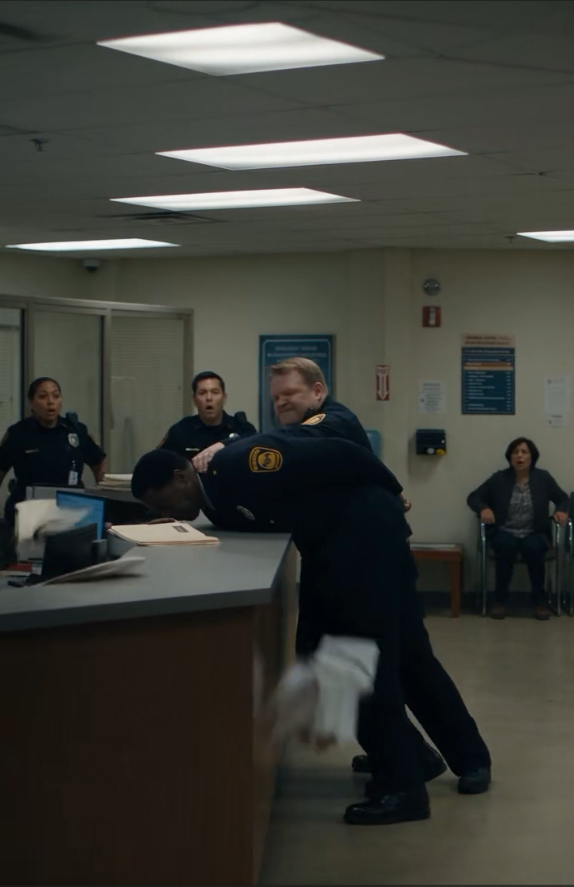
Several people shifted.
“That incident is under investigation. Evidence will decide what happens next.”
I looked around the room.
“What I am going to discuss is why I’m here.”
Nobody needed the history lesson, but I gave them the facts anyway.
Complaint closures.
Evidence discrepancies.
Settlement costs.
Supervisory review patterns.
Cases where video was unavailable despite policy requiring activation.
“Some of you believe the city hired me to improve public confidence.”
Nobody spoke.
“That is part of it. But public confidence is not a public-relations project. It is a consequence of what we do when nobody is watching.”
A captain near the far end of the table folded his hands.
“Chief, are you suggesting the department is broadly corrupt?”
“I’m suggesting I don’t yet know how broad the problem is.”
“That distinction matters.”
“It does.”
I leaned forward.
“And I intend to find out.”
The captain’s face gave me nothing.
Another commander asked, “Will there be outside oversight?”
“Yes.”
That caused the first real reaction.
Small, but visible.
A shoulder stiffened.
Someone exhaled.
“Effective immediately,” I continued, “all complaint closures from the past five years involving allegations of unlawful detention, excessive force, evidence mishandling, or dishonesty will be re-audited. Body-camera retention protocols will be reviewed. Evidence-room access records will be compared against case dispositions.”
“Five years?” someone said.
“Yes.”
“That’s thousands of files.”
“Then we should start.”
A lieutenant cleared his throat.
“Chief, morale is already fragile.”
“So is public trust.”
“I’m just saying that if officers feel like they’re all under suspicion—”
“They are not all under suspicion.”
I let that sit.
“But nobody gets immunity from scrutiny because scrutiny makes them uncomfortable.”
After the meeting, the same captain who had challenged the word corrupt remained behind.
He waited until everyone else left.
“Chief.”
“Yes?”
He closed the door.
“I’ve been here eighteen years.”
I stayed standing.
“That long enough to know where the bodies are buried?”
He did not smile.
“Long enough to know people survive here by being careful.”
“Are you warning me?”
“I’m explaining the culture.”
“Explain it.”
He looked toward the closed door.
“People learn who can hurt them.”
“Caldwell?”
“Caldwell is visible.”
The answer was deliberate.
I waited.
The captain continued.
“Visible people aren’t always the most important people.”
“Who is?”
He shook his head.
“You’ve been here half a day.”
“And somebody put me in handcuffs before breakfast.”
“That might be why you should listen.”
He left without saying anything else.
I stood alone in the conference room.
Visible people aren’t always the most important people.
It could have been wisdom.
It could have been a threat.
At Riverside, I was learning not to assume the difference.
The first useful inconsistency appeared before the end of the day.
The station’s lobby surveillance system showed my arrival clearly.
No aggression.
No suspicious movement.
No failure to comply.
I walked in.
Caldwell noticed me.
He stared at my uniform for approximately three seconds.
Then he approached.
The video had no audio, but my body language was unmistakable. I stopped. Turned. Kept both hands visible.
Caldwell grabbed my right wrist.
I looked down at his hand.
Then back at him.
He spun me toward the desk.
What interested me most was not Caldwell.
It was the other officers.
One looked over before I was touched.
Another stood.
A third shifted behind the desk.
Nobody appeared confused.
Nobody reacted as though an unexpected security threat had developed.
Their movements suggested recognition.
Not recognition of me.
Recognition of a routine.
I watched the footage three times.
On the fourth viewing, I noticed something else.
At 8:49:58, eight seconds before Caldwell touched me, he glanced toward the camera.
Not casually.
Directly.
Then away.
I froze the frame.
The next day, the IT administrator informed me that the lobby camera had experienced two unexplained recording interruptions during the previous year.
Both occurred during citizen complaints involving allegations against Caldwell.
One interruption lasted eleven minutes.
The other lasted seventeen.
Both were attributed to “network instability.”
“Was the equipment faulty?” I asked.
“No.”
“Was the network?”
“Not according to the system diagnostics.”
“Who had administrative access?”
The administrator shifted in his chair.
“Several people.”
“Names.”
He gave me a list.
Caldwell was not on it.
The front-desk officer was.
So was a records supervisor.
And so was the captain who had warned me that visible people were not always the most important.
I kept my face neutral.
“Preserve every login record.”
The administrator nodded.
When he stood to leave, I said, “One more thing.”
He stopped.
“How often has anyone asked you for those logs before?”
He thought about it.
“Never.”
That answer troubled me more than the list.
Part III — What Was Missing
The deeper we went, the cleaner the paperwork became.
That was the first sign.
Truly chaotic departments leave messy records.
Riverside’s questionable files were often immaculate.
Every box checked.
Every supervisor signature present.
Every use-of-force narrative polished enough to survive a casual review.
But when we compared those narratives to dispatch times, medical records, video metadata, evidence-room logs, and civilian statements, the edges began to separate.
One officer wrote that a man had “actively resisted” for nearly four minutes.
Radio traffic suggested the entire encounter lasted less than two.
Another report stated that body-camera video was unavailable because an officer’s device malfunctioned.
Maintenance records showed no malfunction had been reported.
A narcotics evidence package was logged into storage at 11:16 p.m.
The officer named in the entry had already gone home.
None of these discrepancies proved a department-wide conspiracy.
Together, they proved something almost as important.
People had stopped expecting anyone to compare one record against another.
On my third evening as chief, I was alone in the office when the younger front-desk officer from my first morning knocked on the open door.
He did not enter.
“Chief?”
“Yes.”
“Can I talk to you?”
I closed the file I was reading.
“Come in.”
He shut the door behind him but remained standing.
His face looked tired.
I recognized him from the lobby footage. He had been the one who continued typing while Caldwell cuffed me.
“What’s on your mind?”
He looked toward the windows.
“I need to correct my statement.”
I said nothing.
“I wrote that I didn’t see the beginning.”
“Did you?”
“Yes.”
“Why did you write otherwise?”
His answer took several seconds.
“Because Sergeant Caldwell asked me what I saw before internal affairs interviewed me.”
“After I ordered witnesses not to discuss the incident?”
“Yes.”
“What exactly did he say?”
“He said, ‘You were on the phone. You didn’t see the start.’”
“And you understood that as an instruction?”
“Yes.”
“Why?”
The officer rubbed his palms against his uniform pants.
“Because that’s how things work here.”
I leaned back.
“Explain.”
“If a supervisor gives you the safe version, you take it.”
“Safe for whom?”
His eyes lifted.
“That depends.”
I let the silence do the work.
He continued.
“Caldwell has been around forever. He knows who gets good assignments. Overtime. Training. Recommendations. He knows whose mistakes get written up and whose don’t.”
“So you lied.”
His jaw tightened.