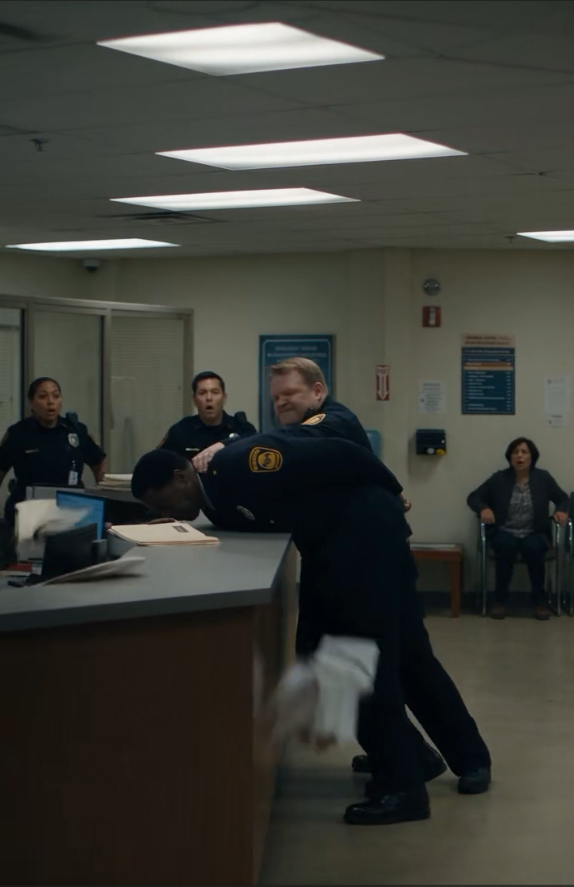
“Yes.”
“Why are you telling me now?”
He looked at my wrists.
The bruising had faded but not disappeared.
“Because I watched you stand there and not make it easy for him.”
“That’s not an answer.”
He nodded slowly.
“No, sir.”
Then he finally gave me one.
“Because I realized if he could do that to the chief in front of everybody, then there isn’t a line.”
That sentence changed the investigation.
Not because it told me Caldwell was abusive.
I already knew that.
It told me fear inside Riverside had rules.
And rules leave patterns.
I asked the officer for names.
He hesitated.
I did not pressure him.
“Start with incidents you personally witnessed.”
He gave me three.
One involved a citizen complaint rewritten by a supervisor.
One involved body-camera footage that officers were told had been “lost.”
One involved a younger patrol officer threatened with a poor evaluation after questioning a search.
“Who made the threat?”
“Caldwell.”
“Who approved the evaluation?”
He paused.
“The captain.”
The same captain.
I wrote nothing for several seconds.
The officer watched me.
“Am I going to get fired for my first statement?”
“You falsified an official statement.”
His face fell.
“Yes, sir.”
“That has consequences.”
He looked toward the door.
I continued.
“But correcting a lie before the investigation proves it matters.”
He looked back at me.
“I can’t promise you an outcome. I can promise the truth will be considered in full.”
He nodded once.
When he reached the door, I said, “Officer.”
He turned.
“The next time somebody tells you the safe version, remember who they’re trying to keep safe.”
After he left, I sat alone for another hour.
The easiest thing would have been to see him as weak.
Maybe he was.
But institutions do not become corrupt only because strong people do bad things.
They become corrupt because ordinary people calculate the price of objecting and decide they cannot afford it.
My job was not merely to punish the people who had crossed the line.
It was to make the line real again.
Caldwell’s administrative interview took place the following morning.
He arrived with a representative and a prepared expression of controlled indignation.
I did not conduct the questioning. Internal affairs did.
I watched through the observation glass.
At first, Caldwell was careful.
He said he had seen an unfamiliar individual in a command-style uniform.
He said the man’s presence raised security concerns.
He said he had attempted to identify him.
The investigator asked, “What did Chief Reed do that you interpreted as threatening?”
Caldwell paused.
“He was evasive.”
“In what way?”
“He didn’t immediately state who he was.”
“He said his identification was inside his jacket.”
“I wasn’t going to let him reach into clothing.”
“Did you ask him to state his name?”
Caldwell looked down at the table.
“I don’t recall.”
The investigator placed a transcript beside him.
“You said, ‘Thought you could just walk in here dressed like a cop.’ Why?”
“I believed he might be impersonating law enforcement.”
“Based on what?”
“The totality of circumstances.”
The phrase was technically legitimate.
It was also useful when someone wanted to sound precise without being specific.
“What circumstances?”
Caldwell shifted.
“His behavior.”
“What behavior?”
Another pause.
“You’d have to be there.”
The investigator did not react.
“I have video.”
Caldwell’s mouth tightened.
Then came the question I had been waiting for.
“Sergeant, why did you tell Officer Daniels that he had not seen the beginning of the encounter?”
Caldwell looked up.
For the first time, his composure slipped.
“I didn’t.”
The investigator placed a recording on the table.
Caldwell stared at it.
“We have Officer Daniels’s supplemental statement.”
His face changed.
Not much.
Enough.
“I may have reminded him he was busy.”
“You violated a direct order not to discuss the event.”
“I was trying to protect the integrity of the investigation.”
Behind the glass, I almost laughed.
The investigator did not.
“By telling a witness what he saw?”
“No. That’s not what happened.”
The interview continued for nearly two hours.
Caldwell denied intimidation.
Denied prior misconduct.
Denied knowledge of camera failures.
Denied ever directing officers to alter reports.
He gave polished answers whenever the facts were general.
When the questions became specific, his memory weakened.
At the end, the investigator asked if he wanted to add anything.
Caldwell leaned back.
Then he looked directly toward the observation window.
He could not see me through the glass.
But he knew I was there.
“This department was fine before Chief Reed arrived.”
The investigator said, “That’s your statement?”
Caldwell kept looking toward the glass.
“No.”
He smiled faintly.
“My statement is that if he tears this place apart trying to prove a point, he better understand what happens when the public realizes how much ugly work it takes to keep a city under control.”
I stared back at him.
There are men who believe rules are restraints placed on lesser people.
Caldwell was one of them.
What I still did not know was how many people had built careers around protecting that belief.
Part IV — The Cost of Looking
The first suspension notice changed the building.
The second changed the city.
By the end of my second week, Caldwell had been formally suspended pending disciplinary proceedings for the lobby incident, witness interference, and potential dishonesty.
Officer Daniels had admitted to filing a false initial statement and was placed on restricted duty while cooperating with the broader review.
Two supervisors were reassigned from complaint review.
The IT audit expanded.
Evidence control was moved to dual authorization.
Then the old complaints began reopening.
Not all of them were valid.
That mattered.
Some involved people who had clearly resisted arrest. Others contained video that supported the officers’ actions. A few accusations collapsed under review.
I made sure those findings were documented as carefully as the bad ones.
If this became a campaign to prove Riverside guilty, it would fail.
Truth does not become stronger when you bend it toward the result you want.
But enough cases remained.
Enough missing minutes.
Enough duplicate language.
Enough supervisor signatures beneath statements that could not be reconciled with the evidence.
The captain who had warned me about visible people came to my office late one afternoon.
This time, he shut the door without asking.
“You’re moving too fast.”
I continued reading.
“Sit down.”
“I’d rather stand.”
“Then stand.”
He planted both hands on the back of a chair.
“You suspended Caldwell.”
“Yes.”
“You reassigned two lieutenants.”
“Yes.”
“You’ve got internal affairs pulling files from cases that are four years old.”
“Yes.”
“People are scared.”
“Good.”
He stared at me.
I looked up.
“People who have done nothing wrong should be inconvenienced. People who have done something wrong should be scared.”
“That sounds clean in a conference room.”
“It sounds clean because it is.”
“No, Chief. It sounds clean because you haven’t been here long enough.”
I closed the file.
“Then tell me what I don’t understand.”
He walked to the window.
“Riverside had a bad stretch. Violent crime up. Staffing down. City hall wanted numbers. The public wanted arrests. The union wanted officers protected. Every time something went wrong, everybody wanted somebody else blamed.”