“That describes half the cities in America.”
“It describes this one.”
He turned.
“Guys started cutting corners.”
“Which corners?”
“You know what I mean.”
“I want you to say it.”
He looked annoyed.
“Reports got cleaned up.”
“Meaning falsified?”
“Language got standardized.”
“Meaning falsified?”
He exhaled.
“Sometimes.”
“What else?”
“Complaints were handled internally because nobody wanted every street arrest turned into a lawsuit.”
“What else?”
“Supervisors protected good cops who made mistakes.”
“What else?”
His eyes hardened.
“You keep asking like there’s some hidden room full of villains.”
“I’m asking because every answer you give makes the next question necessary.”
He leaned toward me.
“You think Caldwell is the disease.”
“I think Caldwell is evidence.”
That stopped him.
I continued.
“You warned me he was only visible.”
The captain’s face closed.
“I was trying to help you.”
“Help me again.”
He looked away.
I waited.
Finally he said, “You don’t understand what happens if you invalidate years of cases.”
“I’m not invalidating anything.”
“Defense attorneys will.”
“If evidence was falsified, they should.”
“You say that like there won’t be consequences.”
“There are already consequences. We’ve just been assigning them to the wrong people.”
His eyes came back to mine.
“You’re going to burn this place down.”
“No.”
I stood.
“I’m going to find out what’s holding it up. If that turns out to be rot, then we rebuild.”
He shook his head.
“You have no idea how many careers that could destroy.”
The words came out before I could soften them.
“If careers depend on lies, they’re already destroyed.”
He left without another word.
Ten minutes later, I opened his personnel file.
Not because of the argument.
Because of the warning.
The captain had served as a lieutenant in internal affairs for three of the five years we were auditing.
His signature appeared on fourteen complaint closures involving officers now under review.
Nine of those files contained nearly identical language.
Insufficient evidence to sustain allegation.
Subject officer acted within training and policy.
No further action recommended.
In six cases, body-camera footage was unavailable.
In four, complainants later received civil settlements from the city.
In three, Caldwell had been the field supervisor.
Visible people are not always the most important people.
The captain had been talking about himself.
The most damaging file arrived from the evidence audit.
A sealed envelope from a four-year-old arrest case had been opened twice after final disposition.
There was no authorized reason.
Access logs showed entry by the evidence custodian.
Then, twelve minutes later, administrative access under the captain’s credential.
The physical evidence inside the envelope was not drugs, money, or a weapon.
It was a flash drive.
The case record said the drive contained video supplied by a civilian witness.
The drive itself was blank.
I asked the auditor to pull the original complaint.
The witness had claimed officers struck a detained man after he was already handcuffed.
The officers denied it.
Body-camera video was listed as unavailable.
The civilian’s video was logged as evidence.
Internal affairs closed the complaint as unsubstantiated.
The captain had signed the finding.
Caldwell had supervised the officers.
“Can deleted data be recovered?” I asked.
The auditor looked at the drive.
“Maybe.”
“Send it out.”
The captain was placed on administrative leave that afternoon.
He came to my office before surrendering his credentials.
“You really think I erased that drive?”
“I think you accessed it after the case was closed.”
“For an audit.”
“There is no audit entry.”
“Then the entry was missed.”
“Why was the evidence custodian there twelve minutes earlier?”
“I don’t know.”
“Why is the drive blank?”
“I don’t know.”
“Why did you close the complaint?”
“Because there wasn’t evidence.”
I looked at him.
“There was evidence.”
He did not answer.
I lowered my voice.
“There was a witness video.”
“You don’t know what was on it.”
“That’s the problem.”
His face changed in a way I had not seen before.
Not anger.
Weariness.
“You want to know what this place was like then?”
“Yes.”
“No, you don’t.”
“Try me.”
He looked toward the door, then back.
“We were losing officers every month. Calls stacked up. People were getting hurt. City hall wanted the numbers down before election season. Every use-of-force case became a headline. Every officer felt like the city hated them until the second somebody needed help.”
He rubbed his forehead.
“Caldwell was rough. Everybody knew it. But he got arrests. His squads got guns off the street.”
“And that excused what?”
“I didn’t say it excused anything.”
“You’re describing the bargain.”
His eyes narrowed.
“What bargain?”
“Results in exchange for silence.”
He said nothing.
I continued.
“You cleaned reports because you thought the department needed protection.”
His jaw moved.
“Sometimes protecting a department means protecting officers from people who don’t understand the job.”
“And who protected the people those officers hurt?”
He looked at me for a long moment.
Then he said, “That’s the kind of question chiefs ask when they still think they can save everybody.”
“No.”
I shook my head.
“It’s the kind of question chiefs ask when they finally understand who has been paying the bill.”
He left his access card on my desk.
When the door closed, I realized my hands were shaking.
Not from fear.
From recognition.
The corruption at Riverside had not begun as a secret criminal enterprise.
That would have been easier.
It had begun as rationalization.
A changed sentence.
A missing reprimand.
A complaint quietly closed because an officer was “one of the good ones.”
A video nobody insisted on finding.
Then another.
Then another.
Eventually, the lie stopped feeling like a lie.
It became procedure.
Part V — The Line
The recovered video arrived on a Thursday morning.
I watched it alone first.
Then again with internal affairs.
Then with the city attorney.
The clip lasted forty-three seconds.
It showed exactly what the civilian witness had alleged.
A handcuffed man stood beside a patrol car.
He was arguing.
Not threatening.
Not fighting.
Caldwell stepped into frame.
The audio was poor, but his voice could be heard.
The man turned his head.
Caldwell struck him.
Once.
Then again.
Another officer moved between them.
The video shook as the witness filming from across the street stepped backward.
Then it ended.
Forty-three seconds.
Four years of buried truth.
The file metadata showed it had been created the night of the incident.
Forensic recovery also found evidence it had been deliberately reformatted after being stored.
The wipe occurred six days before internal affairs closed the complaint.
Administrative logs placed the captain’s credentials in the evidence system during the same period.
It still did not prove he personally erased the drive.
But when confronted with the recovered video, the evidence custodian asked for an attorney.
By noon, the investigation was no longer administrative.
By one, outside criminal investigators were involved.
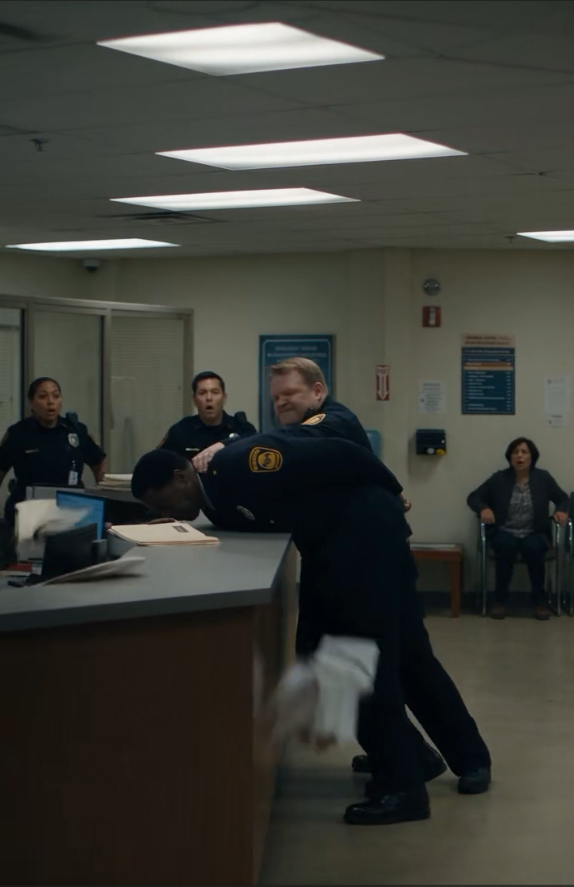
At 2:15, Caldwell entered headquarters through a side door.
He was still suspended.
He had no reason to be there.
The desk officer saw him and reached for the radio.
Caldwell raised both hands.
“I’m here to talk to the chief.”