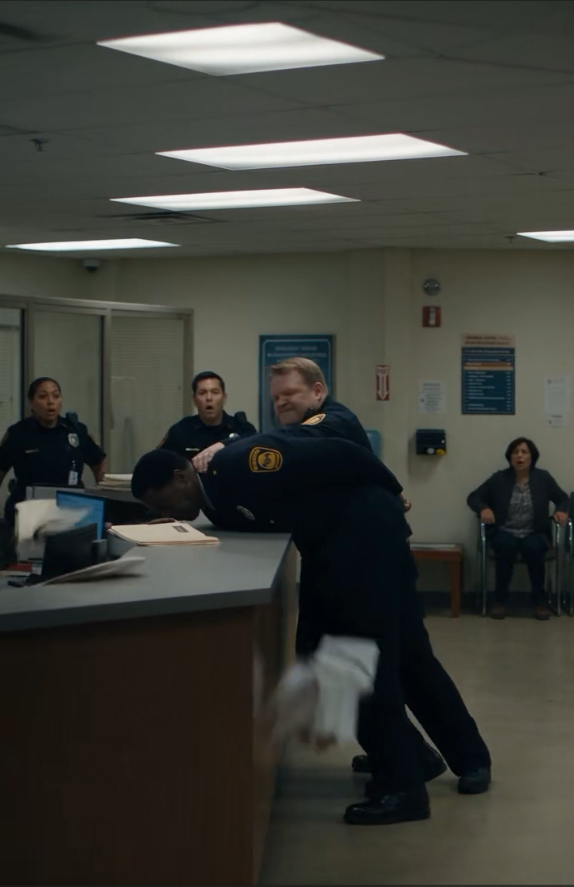
The officer told him to wait.
Caldwell did not.
He walked past the desk.
By the time I heard the commotion in the hallway, he was twenty feet from my office.
Two officers trailed him, uncertain whether to touch him.
I stepped into the doorway.
“Stop.”
He did.
For a second, neither of us spoke.
He looked older than he had two weeks earlier.
No uniform.
No badge.
Gray polo shirt, jeans, jacket.
Without the symbols of authority, he seemed almost ordinary.
That was dangerous in its own way.
“Chief,” he said.
“You’re not authorized to be here.”
“I need five minutes.”
“You can speak to investigators.”
“I’m speaking to you.”
“No.”
He gave a humorless laugh.
“You really enjoy this.”
“What?”
“Watching people squirm.”
The hallway had gone quiet behind him.
I noticed phones in hands.
Officers watching from doorways.
A familiar scene.
Different positions.
I stepped fully into the hall.
“Sergeant Caldwell, leave the building.”
“You think you know what happened.”
“I know what’s on the video.”
His expression changed.
So he knew.
That told me enough.
“Who showed you?” I asked.
He ignored the question.
“You see forty seconds and think you understand four years ago?”
“I understand a handcuffed man was struck.”
“He spit at me.”
“The video does not show that.”
“It happened before.”
“You omitted that claim from your report.”
“Because it didn’t matter.”
“It matters now.”
He took one step closer.
The officers behind him tensed.
I lifted one hand slightly.
Nobody moved.
Caldwell saw it.
Something in his face turned bitter.
“Look at that.”
“What?”
“They listen to you.”
“They’re supposed to listen to the chief.”
“No.”
He shook his head.
“They’re afraid.”
I thought of the lobby.
“No. There’s a difference.”
“Is there?”
“Yes.”
I walked toward him until we were a few feet apart.
“Fear makes people hide mistakes. Leadership makes them report them.”
He smiled.
“You rehearse that?”
“No.”
“Should.”
He looked past me toward the office.
“You know why this department worked?”
“I know why it failed.”
“It worked because men like me did the things men like you write policies about.”
A few officers shifted.
I kept my voice level.
“Men like me?”
He realized too late that he had said it.
The old tone from the lobby was back.
Maybe it had never left.
Caldwell’s mouth tightened.
“You know what I mean.”
“I do.”
“No, you don’t.”
He stepped closer again.
“You walk in here with the polished shoes and the gold badge and the city behind you, and you think twenty years somewhere else tells you what Riverside is.”
“I know what a lie is in every city.”
“You think rules stop violence?”
“No.”
“Policies?”
“No.”
“Complaint forms?”
“No.”
“Then what?”
The hallway was so quiet I could hear a radio squawk from the front desk.
I answered him.
“People who know the rules apply to them too.”
For the first time, he looked uncertain.
Then anger took over.
“You’re going to destroy every cop in this building to prove you’re different.”
“I’m not trying to prove I’m different.”
“What are you trying to prove?”
“Nothing.”
I pointed toward the exit.
“I’m trying to run a police department where the truth survives contact with the police.”
His face went flat.
He looked around the hallway.
At officers he had supervised.
People who had once laughed at his jokes, accepted his instructions, repeated his language in reports.
No one stepped toward him.
That was the moment I understood what he had come for.
Not to confess.
Not to threaten me.
To see whether he still had power.
He didn’t.
Caldwell turned.
Then stopped.
Without facing me, he said, “Ask your captain who taught me how to write the reports.”
The words landed exactly where he intended.
He walked away.
No one spoke until the exterior door closed.
The captain requested another interview that evening.
This time, he brought an attorney.
The first thirty minutes were procedural.
Then investigators showed him the recovered video.
He watched without moving.
When it ended, his attorney whispered something.
The captain shook his head.
“I’ll answer.”
The investigator asked, “Did you know this recording existed when you closed the complaint?”
The captain stared at the blank monitor.
“Yes.”
“Did you view it?”
“Yes.”
“Did you order it destroyed?”
“No.”
“Did you direct anyone to erase it?”
He closed his eyes briefly.
“No.”
“Why was the complaint closed as unsubstantiated?”
His attorney touched his arm.
The captain pulled away.
“Because I changed the finding.”
Nobody spoke.
The investigator leaned forward.
“From what?”
“Sustained.”
My stomach tightened.
“Why?” the investigator asked.
The captain looked toward me.
Not through glass this time.
I was in the room.
“Because the deputy chief at the time told me Caldwell was too valuable to lose.”
The investigator said, “That deputy chief is no longer with the department.”
“No.”
“What exactly were you told?”
The captain swallowed.
“That a sustained excessive-force finding would force disciplinary action. That Caldwell had already had prior issues. That another serious finding could end his career.”
“So you changed it?”
“Yes.”
“Who erased the video?”
“I don’t know.”
“Who knew it existed?”
“Me. Caldwell. The evidence custodian. The deputy chief.”
“Anyone else?”
He looked down.
“Probably.”
The attorney spoke quietly.
The captain nodded.
Then he continued.
“It wasn’t supposed to disappear.”
The investigator asked, “What was supposed to happen?”
“We were going to classify it as inconclusive.”
I stared at him.
The captain rubbed a hand over his face.
“The witness was across the street. The angle was bad. We were going to say it didn’t capture the full context.”
“But it clearly showed the strikes.”
“Yes.”
“Then why classify it as inconclusive?”
He looked at me.
“Because once you decide what the institution needs, you become very creative about what evidence means.”
That was the closest thing to honesty I had heard from him.
It was also devastating.
The investigator continued.
“How many other complaints did you alter?”
The captain’s attorney objected.
The captain answered anyway.
“I don’t know.”
“More than one?”
“Yes.”
“More than five?”
He did not respond.
“More than ten?”
His silence answered.
I thought about every immaculate file.
Every standardized sentence.
Every person who had been told there was insufficient evidence.
The captain looked at me.
“You want a number?”
“Yes.”
“You won’t get one from memory.”
“Then we’ll get it from the files.”
His mouth tightened.
“You think you’re better than me.”
I almost answered too quickly.
Instead I sat back.
“No.”
That surprised him.
I continued.
“I think I’m standing at the point where you once stood.”
His expression changed.
“You were probably tired. Under pressure. Told the department needed protection.”
He stared at me.
“Maybe the first time you changed a finding, you told yourself it was exceptional.”
His attorney shifted, but I kept going.
“Then you did it again. And eventually you stopped asking whether it was right and started asking whether it was survivable.”
The captain’s eyes stayed on mine.
“What would you have done?”
It was not a challenge.