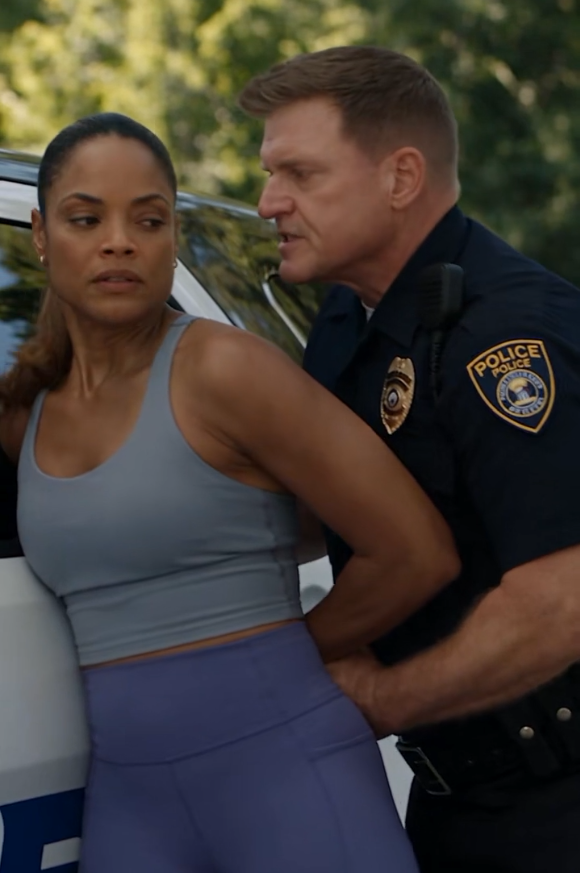
“What?”
“I don’t remember exactly.”
“That’s okay.”
“He said, ‘There’s one.’ Or maybe ‘There’s our one.’ Something like that.”
I did not react.
She searched my face.
“Does that matter?”
“I don’t know.”
That answer was honest.
It also scared me.
I gave her the federal contact number.
“Tell them exactly what you remember. Don’t improve it. Don’t guess. If you’re unsure of wording, say you’re unsure.”
She nodded.
Then stopped.
“You really don’t remember me?”
“I saw you.”
“No. Before today.”
I looked at her.
She said, “You knocked on my door in May.”
For a second I couldn’t place it.
Then I did.
We had canvassed residents near one of the earlier pedestrian stops.
Not as prosecutors announcing themselves.
As federal investigators asking whether people had witnessed police activity on certain dates.
She had spoken to one of our investigators for less than five minutes.
She must have seen me standing near the sidewalk.
“I didn’t talk to you,” I said.
“No.”
Her voice dropped.
“But I saw you.”
I felt the first real cold of the day.
“Did the officers?”
“I don’t know.”
That question stayed with me after she left.
Because coincidence and recognition are very different things.
And only one of them could threaten the integrity of the entire case.
Part III — Reversal
The first hard evidence arrived the next morning.
My deputy called at 6:42.
I answered from bed.
“Tell me.”
“You’re supposed to be detached.”
“You called me before seven.”
“Fair.”
I sat up.
“What did you find?”
“The body-camera files came through.”
“And?”
“The heavier officer’s camera started twenty-three seconds before physical contact.”
I closed my eyes.
“Automatic buffer?”
“Yes. No audio for the buffer, audio after activation.”
“Dash camera?”
“Partial. Cruiser angle is bad.”
“Dispatch?”
“More interesting.”
I got out of bed.
“How interesting?”
“The caller never described a Black female.”
I stopped.
My deputy continued.
“Initial caller said they saw ‘a person’ behind the neighbor’s fence. Dark top. Couldn’t identify sex or race.”
I walked into the kitchen.
“So where did Black female come from?”
“That’s the question.”
“CAD?”
“First written officer update, entered from the younger officer’s mobile terminal eleven minutes after the original call.”
My hand tightened around the phone.
“What does it say?”
“Possible Black female, dark clothing, moving eastbound.”
“That was him.”
“Looks like it.”
“So he created the description he later said I matched.”
“Yes.”
I stared at the kitchen counter.
My badge was no longer there.
I had put it away the night before.
“Video?”
“You need to see it eventually, but not through me if you remain recused.”
“What happens in the buffer?”
“You’re jogging on the sidewalk. Cruiser passes you. Stops ahead. Younger officer gets out first.”
“And the heavier officer?”
“Stays by the vehicle initially.”
“What does the younger one do?”
A pause.
“He watches you approach.”
“Anything else?”
“Then he steps into your path.”
I waited.
“He tells you to stop.”
“And I?”
“You stop.”
The room became very quiet.
My deputy said, “There is no visible flight.”
I leaned against the counter.
The public statement had said I matched a fleeing burglary suspect.
I had not been fleeing.
The original caller had not described a Black woman.
The younger officer had inserted that description himself.
“What about the witness hearing ‘there’s one’?”
“She called us last night.”
“You interviewed her?”
“An investigator did.”
“And?”
“She’s careful. Says she’s about sixty percent sure one officer said, ‘There’s one.’ She cannot identify which officer.”
“That’s not enough for intent.”
“No.”
“But it matters.”
“Yes.”
I poured water into a glass.
My deputy’s voice changed.
“There’s more.”
I stopped.
“Go ahead.”
“The body camera captured conversation after you walked away.”
I did not speak.
She said, “The younger officer asks the heavier one whether they’re in trouble.”
“What does he say?”
“He says, ‘Only if you write it stupid.’”
I set the glass down.
My deputy continued.
“Then younger officer says, ‘She wasn’t the call.’”
I could hear my own refrigerator humming.
“What does the heavier officer say?”
“‘Then make sure the call got us there.’”
For several seconds, neither of us spoke.
That was no longer about a bad stop.
It was about what happened afterward.
Documentation.
Narrative control.
The architecture of the entire case.
My deputy said quietly, “We found the center.”
I knew what she meant.
For months, we had collected examples of reports that appeared to transform weak suspicion into stronger justification.
But we had never been able to prove whether those reports were careless, culturally learned, or intentionally shaped.
Now we had two officers discussing the report before writing it.
And one of them already had a history of similar stops.
Still, I said, “Don’t overstate it.”
She exhaled.
“I knew you’d say that.”
“One recording doesn’t prove department-wide practice.”
“No.”
“It proves this incident needs a separate criminal review.”
“Possibly.”
“And the administrative report?”
“Not filed yet.”
That surprised me.
“When is it due?”
“End of shift yesterday.”
“So it’s late.”
“Yes.”
“Preserve drafts.”
“Already requested.”
I smiled despite myself.
“Good.”
“You trained me well.”
“No. You were irritating before I met you.”
“That’s what I tell people.”
We ended the call.
At nine, my supervisor called.
This time, he wanted me in the office.
Not to work the case.
To decide whether I would remain part of it at all.
The conference room was cold enough to make my shoulder ache.
My supervisor sat at one end.
My deputy sat along the side.
An ethics attorney joined by video from Washington.
The first twenty minutes were procedural.
My status as victim-witness.
Potential impeachment material.
Defense claims of bias.
Screening mechanisms.
Segregation of evidence.
Then the ethics attorney asked me a simple question.
“Can you continue making neutral judgments about this department?”
“Yes.”
“Can you make neutral judgments about the officers involved in your stop?”
I thought about the hand at my wrist.
The knee behind my thigh.
The younger officer telling me to control my attitude.
“Yes,” I said.
She watched me through the screen.
“That was fast.”
“Neutral doesn’t mean unaffected.”
My supervisor said nothing.
I continued.
“I know exactly how I feel about what happened. That is different from deciding what can be proved.”
The ethics attorney nodded slightly.
“Would you seek harsher consequences because it happened to you?”
“No.”
“Would you seek lesser consequences to prove you aren’t biased?”
That question took longer.
My deputy looked at me.
I understood the trap.
Performing restraint can distort judgment just as easily as anger.
“I might,” I said.
The ethics attorney leaned back.
“Explain.”
“I’m aware enough of the appearance problem that I could overcorrect.”
My supervisor finally spoke.
“That’s the answer I was waiting for.”
I looked at him.
He folded his hands.
“You stay on the pattern investigation.”
My deputy’s eyes shifted toward him.
“But,” he continued, “you are screened entirely from the individual investigation of your stop. You do not review the officers’ statements, charging analysis, or disciplinary recommendation.”