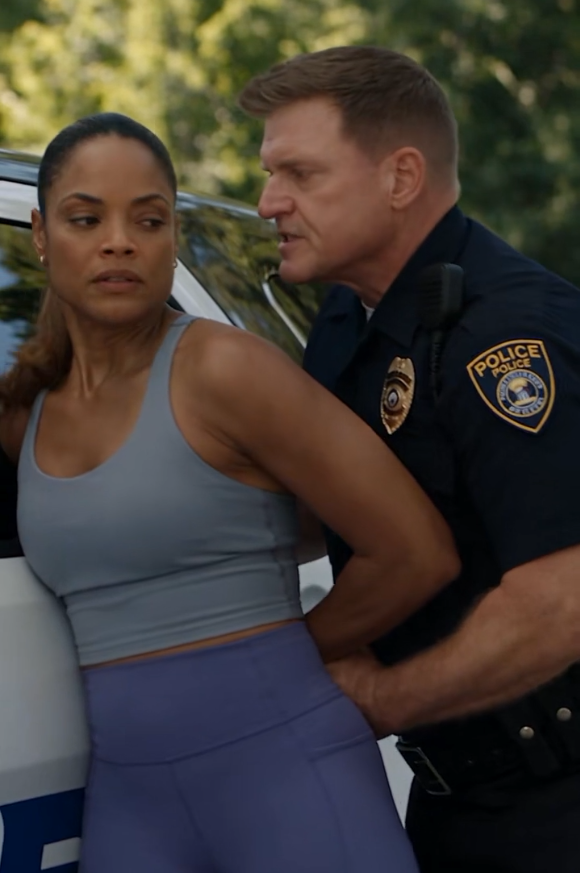
Three federal lawyers.
Two investigators.
Nobody moved.
I said, “If your best response to fifty-seven documented discrepancies is that I personally dislike being held against a police cruiser, then you should reconsider your litigation strategy.”
The city attorney’s face hardened.
He gathered his papers.
The meeting ended twelve minutes later.
My supervisor waited until the room cleared.
Then he closed the door.
“That felt good, didn’t it?”
I looked at him.
“No.”
“Liar.”
“Fine. Slightly.”
“That’s the problem.”
“I know.”
He leaned against the table.
“You were right on substance.”
“That usually helps.”
“You were also too sharp.”
“I know.”
“Do you?”
I packed my notes.
He watched me.
Then he said, “The city is going to try to make you the case.”
“They can try.”
“They may succeed publicly.”
I stopped.
He continued.
“You have no public profile. That helps now. It won’t if they release the stop.”
“Why would they?”
“To say you’re retaliating.”
“They would have to disclose the body camera.”
“Eventually.”
I understood.
A selective leak could show me arguing with officers after detention.
Without the earlier context.
Without dispatch records.
Without the post-stop conversation.
My supervisor said, “Your credibility is now a litigation asset.”
“I hate that phrase.”
“It’s still true.”
“What do you want?”
“Nothing yet.”
“Then why are you warning me?”
“Because you think the hard part is proving the case.”
He picked up his folder.
“It isn’t.”
“What is?”
“Not becoming what they say you are.”
Three days later, a local television station reported that a Justice Department attorney investigating the police department had herself been stopped by city officers.
The story cited unnamed law-enforcement sources.
The report said the attorney became “confrontational” during a lawful detention and later identified herself as a federal official.
It mentioned no injury.
No changed description.
No body-camera evidence.
No dispatch discrepancy.
Within hours, social media did what social media does.
Some people called it proof of systemic bias.
Others called it proof of federal harassment.
People who had never seen the footage knew exactly what had happened.
I said nothing publicly.
That was harder than I expected.
By afternoon, reporters stood outside the federal building.
By evening, someone had posted my home address online.
I stayed elsewhere that night.
The woman with the stroller received messages too after her identity became known through a public-record request.
That angered me more than anything said about me.
She called my deputy, frightened.
Federal investigators arranged witness-protection precautions appropriate to the risk.
Nothing dramatic.
Extra patrol coordination through an uninvolved agency.
Privacy guidance.
A direct contact number.
Still, the fact that she needed any of it made the situation feel contaminated.
My stop had expanded beyond me.
The next morning, my supervisor came into my office and shut the door.
“The younger officer’s union lawyer wants the full body-camera video released.”
I looked up.
“Why?”
“He thinks it helps.”
“How?”
“He says your legal language shows you were controlling the encounter.”
I almost laughed.
“By knowing the law?”
“He says the officers reasonably perceived you as evasive because you lacked identification and challenged their basis.”
“I challenged it after they released me.”
“I know.”
“What does the heavier officer want?”
“His lawyer opposes release.”
Interesting.
“Why?”
My supervisor sat.
“You know why.”
The post-stop conversation.
Only if you write it stupid.
She wasn’t the call.
Then make sure the call got us there.
I turned my chair toward the window.
“If the video comes out, the individual investigation gets compromised.”
“Possibly.”
“If it doesn’t, the department controls the narrative.”
“Yes.”
“Can Justice release it?”
“Not while the criminal review is active.”
“Then we say that.”
“We already did.”
I looked back at him.
“What aren’t you telling me?”
He put a document on my desk.
It was a motion filed in federal court by the city seeking limits on our investigative demands.
The city argued that the department faced an unfair federal process because the lead attorney had become personally involved in an incident with officers.
They wanted me removed.
Not from my stop.
From the entire investigation.
I read the motion twice.
Then I found the paragraph that mattered.
It quoted me.
Not from the roadside.
From an internal Justice presentation four months earlier.
“This department’s problem is not simply misconduct,” I had said. “It is a system that teaches officers how to convert uncertainty into justification after the fact.”
The city called the quote evidence that I had prejudged the department.
I remembered saying it.
I also remembered the slide behind me containing twelve examples.
Still, the wording looked harsher on paper.
My supervisor said, “They got internal material.”
“How?”
“We don’t know.”
“Who attended that presentation?”
“More people than I’d like.”
I read the paragraph again.
The leak changed the case.
Not legally.
Operationally.
Someone with access to federal strategy had provided material to the city or police union.
My deputy entered five minutes later.
She had already heard.
“We need to stop circulating drafts broadly,” she said.
My supervisor nodded.
“Done.”
She looked at me.
“You okay?”
“No reason not to be.”
“That answer means no.”
I handed her the motion.
She scanned it.
Then she said, “They’re afraid.”
My supervisor cut in.
“Don’t turn this into psychology.”
She nodded.
He was right.
Motive could wait.
Evidence could not.
The next month became a controlled narrowing.
Every claim had to survive without me.
Every dataset was rechecked by attorneys who had no involvement in my stop.
Every statistical comparison was independently validated.
Every major witness interview was reviewed for contamination.
We removed three incidents from our findings because my direct involvement created avoidable questions.
That hurt.
It was also right.
Then came the discovery that changed everything again.
The lieutenant who had edited the reports had been teaching an unofficial report-writing session during evening roll call.
Not a formal class.
No training code.
No syllabus.
Just fifteen minutes at a time.
Supervisors helping officers “tighten articulation.”
One officer had recorded part of a session on his phone because he was new and wanted to remember the guidance.
He gave it to us after receiving a federal subpoena.
The lieutenant’s voice was clear.
“If you know why you stopped somebody, put the facts in that support why. Don’t leave the report weak because dispatch was vague.”
A younger voice asked, “What if dispatch didn’t give the detail?”
The lieutenant answered:
“Dispatch gets you there. Your observations justify what you do.”
Legally, that statement could be correct.
An officer can develop independent reasonable suspicion.
Then came the next sentence.
“Just don’t write it like you decided after.”
The recording ended.
My deputy played it twice.
Neither of us spoke.
She finally said, “That’s the case.”
I shook my head.
“It’s evidence.”
“It’s more than evidence.”
“No. Don’t fall in love with it.”
She frowned.
“Why are you fighting this?”
“Because ambiguity matters.”
“What ambiguity?”
“He could mean officers should document contemporaneous observations clearly.”
“He says, ‘Don’t write it like you decided after.’”
“I heard him.”
“You think that’s innocent?”
“I think a defense lawyer gets to argue it is.”