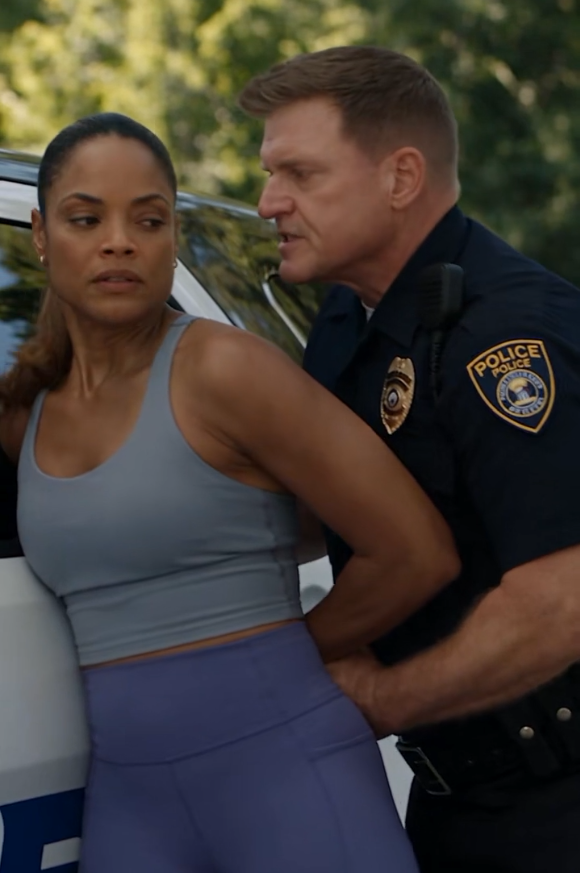
She leaned back.
“You’ve become very generous.”
“No. Careful.”
She looked at me for a long moment.
Then said quietly, “Because of your stop.”
I knew what she meant.
Before August, I had trusted myself to draw hard conclusions from patterns.
Now every conclusion felt suspect because I knew someone would ask whether I wanted it to be true.
I hated that my own self-scrutiny was becoming another form of distortion.
She said, “You told me once that bias isn’t fixed by pretending you don’t have a perspective.”
“I did.”
“You said it’s fixed by building a process stronger than your perspective.”
I remembered.
She continued.
“So trust the process.”
I looked at the transcript again.
“Then we keep it.”
“Good.”
“And we keep the ambiguity in the memo.”
She smiled.
“Of course we do.”
That evening, for the first time since the stop, I ran again.
No phone.
No badge.
Same navy leggings.
Different gray top.
I considered carrying identification.
Then didn’t.
Not as a statement.
Because I had never needed to justify existing in my own neighborhood before.
I refused to build that lesson into my routine.
At the intersection where the cruiser had stopped me, I slowed.
The asphalt looked ordinary.
Cars moved.
A dog barked behind a fence.
Nothing marked the place.
That helped.
I kept running.
Part V — The Hearing
The city challenged our findings before negotiations over a federal consent decree could begin.
Not a public trial.
A federal evidentiary hearing tied to the city’s motion to restrict the investigation and exclude materials related to my stop.
The city’s theory was straightforward.
My personal experience had infected the federal investigation.
Our theory was simpler.
The evidence existed independently of me.
The judge scheduled two days.
It lasted four.
I sat behind the government table but did not question witnesses involving my incident.
The city called experts on police procedure.
We called records specialists, civilians, former officers, and data analysts.
The lieutenant testified on the third day.
He was calm.
Professional.
He wore a dark suit that fit badly across his shoulders and answered questions as if each one were a report field.
He denied instructing officers to fabricate information.
I believed that answer might even be true.
People rarely describe their own systems using the language outsiders eventually apply to them.
He said his job was to improve officer articulation.
He said young officers often failed to include what they saw, heard, and inferred.
He said supervisors helped them write legally complete reports.
Then the federal attorney questioning him displayed one of the edited reports.
Original:
Observed male walking east near reported area.
Final:
Observed Black male matching caller’s description walking rapidly east from reported area.
The attorney asked, “Did the caller describe race?”
“No.”
“Did the caller describe sex?”
“I don’t recall.”
The dispatch record appeared.
The caller had not.
“Did the officer radio that he independently observed anything tying this individual to the reported activity?”
“Not necessarily everything goes over radio.”
“Did body camera show the individual walking rapidly?”
“I would need to review it.”
Video played.
The man walked at a normal pace carrying a grocery bag.
The courtroom stayed quiet.
The attorney asked, “What fact supported the word ‘rapidly’?”
The lieutenant said, “Officer perception.”
“Where is that in the draft?”
“It isn’t.”
“Who added it?”
“I may have suggested clarification.”
“Based on what?”
“The officer’s recollection.”
“Where is that recollection documented?”
“I don’t know.”
That happened repeatedly.
Not dramatic admissions.
Not confessions.
Gaps.
Small, accumulating gaps.
By the end of the afternoon, the department’s defense had changed.
It was no longer that reports were always accurate.
It was that inaccuracies were administrative rather than constitutional.
That distinction mattered.
On the fourth morning, the city called the younger officer from my stop.
I had known it was possible.
Still, seeing him walk into court tightened something behind my ribs.
He looked different in a suit.
Younger, somehow.
His lawyer had fought to keep the pending individual review from becoming part of the broader hearing.
The judge allowed limited testimony because the city itself had made my bias an issue.
My supervisor leaned toward me.
“You can leave.”
“No.”
“You don’t need to prove anything.”
“I’m not.”
The younger officer took the oath.
City counsel began gently.
He asked about the burglary call.
The patrol response.
The initial uncertainty.
The city attorney asked whether the officer recognized me before the stop.
“No.”
“Had you ever met her?”
“No.”
“Did you know she was leading the federal investigation?”
“No.”
That matched my understanding.
Then came the key question.
“Did you stop her because she was a federal attorney?”
“No.”
Of course not.
City counsel turned slightly toward the judge.
“That matters, Your Honor. This was not retaliation.”
Our attorney rose.
“We have never alleged the initial stop was retaliation.”
The judge nodded.
“Proceed.”
City counsel asked whether the officer believed I matched information available to him at the time.
“Yes.”
“What information?”
“Possible burglary suspect. Dark clothes. Female. Moving from the area.”
There it was.
The federal attorney stood for cross-examination.
“Who told you the suspect was female?”
The younger officer hesitated.
“Dispatch.”
“Which transmission?”
“I don’t remember.”
A transcript appeared on the screen.
“Is there any dispatch transmission describing a female before the stop?”
He looked.
“No.”
“Any describing race?”
“No.”
“Who entered ‘possible Black female’ into the mobile system?”
Another pause.
“I did.”
“Before or after you saw the federal attorney jogging?”
He looked toward his lawyer.
The judge said, “Answer.”
“After.”
“Where did you get the description?”
“I believed it fit what we were looking for.”
Our attorney let the sentence sit.
Then:
“You believed the person you saw fit the description, so you entered a description of the person you saw?”
The officer shifted.
“I was updating possible suspect information.”
“Based on what source?”
“My observations.”
“Of a woman jogging on a sidewalk?”
“Yes.”
“Had you seen her behind the residence?”
“No.”
“Had anyone told you she had been behind the residence?”
“No.”
“Was she carrying property?”
“No.”
“Looking into yards?”
“No.”
“Running away from your cruiser?”
“She was jogging.”
“So before you stopped her, what connected her to the burglary call other than geographic proximity and clothing color?”
The officer did not answer immediately.
Finally:
“She was in the area.”
The federal attorney nodded.
“After dispatch informed you the caller now believed the person behind the house was male and wearing a hooded top, did you continue detaining her?”
“Briefly.”
“Why?”
“Scene safety.”
“She was unarmed?”
“We didn’t know that.”
“Hands visible?”
“Yes.”
“Compliant?”
“Mostly.”
I felt my deputy shift beside me.
Our attorney said, “Define mostly.”
“She questioned why she was being detained.”
“Did she physically resist?”
The officer looked uncomfortable.
“No.”
“Did she attempt to flee?”
“No.”
“Strike you?”
“No.”
“Threaten you?”
“No.”
“Refuse an order to stop?”
“No.”
The attorney changed direction.
“After releasing her, did you ask your partner whether you were in trouble?”
The officer’s lawyer objected.
The judge overruled.
“Yes.”
“Why?”
“Because she said she was a federal attorney.”
“Your partner responded, ‘Only if you write it stupid.’ Correct?”