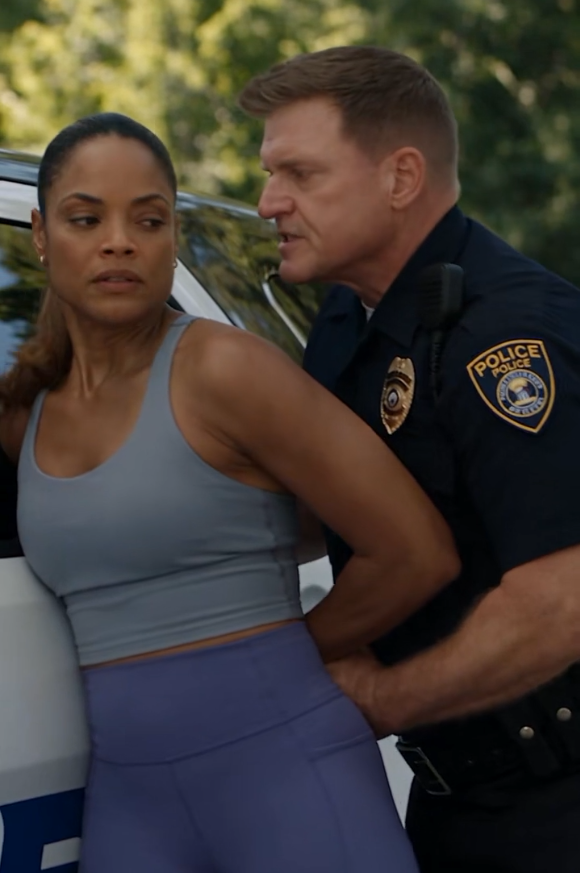
The officer swallowed.
“Yes.”
“What did you understand that to mean?”
“That the report needed to be accurate.”
Our attorney nodded.
“Then you said, ‘She wasn’t the call.’”
The courtroom changed.
Not with noise.
With attention.
The officer stared at the table.
“Yes.”
“What did that mean?”
“That she probably wasn’t the person the caller saw.”
“You knew that when you released her?”
“Yes.”
“Your partner said, ‘Then make sure the call got us there.’”
“Yes.”
“What did that mean?”
“I don’t know.”
“You didn’t ask?”
“No.”
“Did you file your report by the end of shift?”
“No.”
“Why not?”
“I wanted supervisor guidance.”
“From whom?”
The officer named the lieutenant.
The same lieutenant.
Our attorney displayed the report history.
Draft saved at 11:18 a.m.
Edited at 3:42 p.m.
Final filed at 4:07 p.m.
The first draft described me as “female jogger contacted near burglary area.”
The final version described me as “individual matching initial suspect characteristics observed leaving the vicinity.”
The federal attorney asked, “Who changed that sentence?”
The officer said, “I did.”
“After speaking with the lieutenant?”
“Yes.”
“What did he tell you?”
The officer’s lawyer objected again.
Overruled.
The officer rubbed his palms against his trousers.
“He told me the report needed to explain why the stop happened.”
“That isn’t what I asked. What did he tell you?”
Silence.
The officer looked toward the lieutenant.
The lieutenant did not move.
The younger officer said, “He said if the stop was lawful, the report should read lawful.”
The words landed harder than shouting would have.
Our attorney said, “And if the facts did not read that way?”
The city objected.
Sustained.
The question disappeared.
The answer did not.
When court recessed, I stayed seated.
People moved around me.
Folders closed.
Chairs scraped.
My deputy touched my elbow.
“You okay?”
“Yes.”
“You don’t look okay.”
“I’m thinking.”
“About?”
I watched the younger officer leave through a side door.
“He believed him.”
“Who?”
“The lieutenant.”
She followed my gaze.
“You think that helps him?”
“No.”
“But?”
“It explains him.”
My deputy sat again.
I said, “He didn’t sound like someone describing a conspiracy.”
“No.”
“He sounded like someone describing training.”
That was the terrible simplicity of it.
The final day centered on remedy.
The city was now willing to negotiate changes.
Body-camera enforcement.
Stronger complaint review.
Dispatch-audit procedures.
Limits on report edits.
Supervisor documentation.
Data collection for pedestrian stops.
Independent monitoring.
But they refused one provision.
Our team wanted any material post-event changes to an officer’s narrative preserved and visibly attributed.
The city argued that reports needed normal supervisory editing without turning every correction into impeachment material.
The point sounded technical.
It wasn’t.
It was the spine of the entire case.
If supervisors could continue silently rewriting the factual basis for stops, nothing else mattered.
Negotiations went late into the evening.
At 8:30, my supervisor pulled me aside.
“The city will accept everything except edit attribution.”
“Then we don’t have a deal.”
“They’ll preserve version history internally.”
“Not enough.”
“Monitor gets access.”
“Officers and courts need to know when material facts were added after supervisor review.”
He watched me.
“You understand what happens if we walk?”
“Yes.”
“Months more litigation.”
“Yes.”
“Possible appeal.”
“Yes.”
“Reforms delayed.”
“Yes.”
“People stay under the current system longer.”
I said nothing.
That was the harder choice.
Take ninety percent now.
Or fight for the mechanism that addressed the exact practice our evidence revealed.
My supervisor said, “Tell me why this provision is worth the delay.”
I knew the wrong answer instantly.
Because of what happened to me.
So I gave him the right one.
“Because every reform they’ve agreed to depends on the integrity of the record.”
He waited.
“If a stop is reviewed by internal affairs, they read the report. If a civilian files a complaint, investigators compare it to the report. If a prosecutor evaluates a case, they read the report. If a supervisor reviews legality, they read the report. If a monitor audits behavior, the report is part of the record.”
He nodded.
I continued.
“If material facts can be added later without visible attribution, then the document we use to evaluate every other reform can still be shaped after the event.”
“And if the city walks?”
“Then we litigate.”
“Easy to say.”
“No.”
I looked through the glass wall toward the conference room.
“It’s not easy at all.”
He knew what I meant.
Every additional month had a cost.
Not abstract.
Real people would be stopped during those months.
Complaints would still be handled under the old system.
Young officers would still learn from the same supervisors.
Compromise was not cowardice.
Sometimes compromise was the only way reform happened.
But some compromises removed the thing being reformed.
My supervisor asked, “Would you make the same decision if you had never been stopped?”
I thought about it.
Then answered.
“Yes.”
“How do you know?”
“Because we requested version histories before August.”
He smiled faintly.
There was the proof I needed.
The principle predated me.
“Then go tell them.”
We returned to the room.
The city attorney looked exhausted.
“So?”
I sat.
“No agreement without attribution of material factual edits.”
He leaned back.
“You’re willing to blow up a department-wide reform package over footnotes in report software?”
“No.”
“What would you call it?”
“Authorship.”
He stared at me.
I continued.
“If a supervisor changes grammar, nobody cares. If a supervisor adds facts that strengthen legal justification, the record must show who added them and when.”
“This creates endless litigation.”
“It creates accountability.”
“It creates hesitation.”
“When changing facts?”
“When improving reports.”
“Then label the improvement.”
His mouth tightened.
“You really can’t separate this from what happened to you.”
I felt every person at the table go still.
Months earlier, that accusation would have made me defensive.
Now I understood it differently.
He was asking the wrong question.
Nobody is separate from experience.
The issue is whether the evidence survives the person presenting it.
So I said:
“You don’t have to trust me.”
He frowned.
I slid the proposed provision toward him.
“Build the system so nobody has to.”
For the first time that night, he had no immediate answer.
The agreement was signed at 1:17 in the morning.
Material factual edits would be preserved.
Supervisor changes would be attributed.
Original narratives would remain accessible.
Officers would certify whether post-review additions came from independent recollection, newly received evidence, or supervisory instruction.
The monitor would audit the practice quarterly.
It was not dramatic.
It would never make a good television image.
But I knew exactly how much could hide inside a sentence.
And now the sentence would have a history.
Part VI — Aftermath
The federal findings became public six weeks later.
They did not call the department irredeemable.
They did not describe every officer as corrupt.
They did not claim every stop was unlawful.
That mattered.
The report was more powerful because it was precise.
It documented a pattern of stops inadequately tied to reported conduct, inconsistent documentation of suspicion, weak civilian-complaint review, and supervisory practices that sometimes strengthened legal justifications after the fact without clear attribution.
The department entered the consent decree.