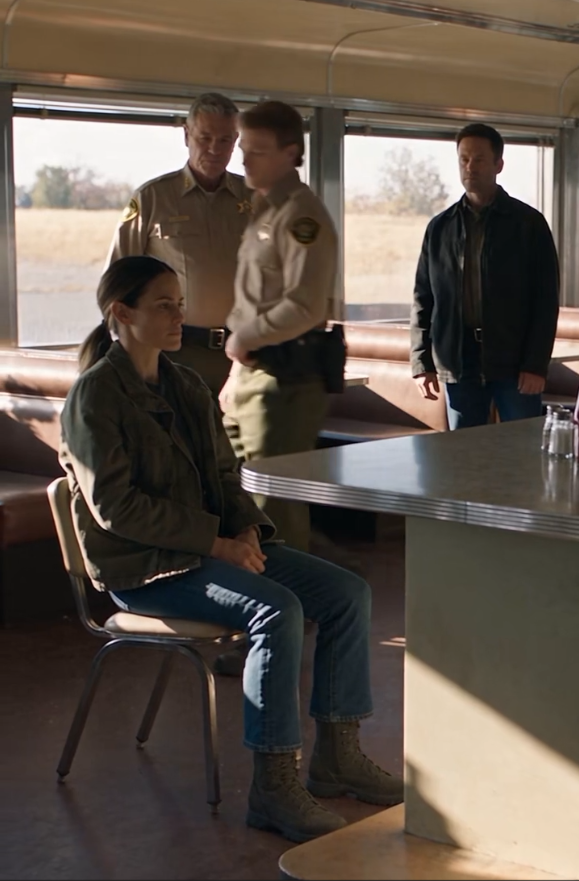
And switched the camera off.
A tiny red light disappeared.
There.
That mattered.
He sat again.
“Now,” he said, “we can speak freely.”
I almost smiled.
Instead I looked at the blank camera.
Miller misunderstood.
“You nervous now?”
“No.”
“Should be.”
He pushed the forfeiture form toward me again.
“Sign.”
I didn't touch it.
Granger tapped the table.
“You know, Sheriff, maybe she's waiting for somebody.”
Miller looked at me.
“Are you?”
Silence.
Granger stood.
“I'll find out.”
He left.
Miller stayed.
For the next twenty minutes, he tried different versions of the same tactic.
Threat.
Friendliness.
Impatience.
False sympathy.
He told me the prosecutor was hard on traffickers.
He told me juries didn't trust outsiders.
He told me my Bronco would probably sit in impound until weeds grew through the floorboards.
I watched him talk.
At 6:11, the door opened.
The young deputy entered.
“Sheriff?”
Miller turned.
“What?”
“Dispatch says State Highway called asking about an arrest on Highway 19.”
Miller's face remained neutral.
“Why?”
“Not sure. They got a vehicle inquiry.”
“What vehicle?”
The deputy looked at me.
“Bronco.”
Granger appeared behind him.
“I've got it,” he said.
He pulled the deputy into the hallway.
The door remained open just enough for voices to carry.
“Who called?” Granger asked.
“Trooper desk.”
“And who called them?”
“Didn't say.”
“Tell dispatch the vehicle is part of an active federal narcotics investigation. No information released.”
“Yes, sir.”
“Who logged the impound?”
“Me.”
“You enter the VIN?”
“Yes.”
Granger swore quietly.
“Delete it.”
A pause.
“What?”
“Take it out of the system.”
“Why?”
“Because I said so.”
The young deputy didn't answer immediately.
Miller rose and closed the door.
Our eyes met before it shut.
His face had changed.
Only slightly.
“Somebody tracking your truck?” he asked.
I said nothing.
“You got some kind of stolen-vehicle alert?”
Silence.
He sat down.
“Who are you?”
I had already answered that.
He knew it.
He stared at me for another ten seconds, then walked out.
This time he left me alone.
I shifted my wrists.
The cuffs had numbed two fingers.
Outside the room, the sheriff's office became busier.
Phones rang.
Boots crossed the hallway.
A printer started.
Stopped.
Started again.
At 6:24, I heard Granger arguing with someone.
At 6:31, the young deputy opened the interview-room door carrying a paper cup of water.
He placed it on the table.
“Can you drink with those on?”
“Yes.”
He hesitated.
Then he unlocked one cuff from the table ring and reattached it with more slack.
“Thank you.”
He looked surprised that I'd spoken.
“Sheriff says no talking.”
“Then don't.”
He turned to leave.
“Deputy.”
He stopped.
I nodded toward the ceiling camera.
“When did that stop recording?”
He looked at it.
“Sheriff shut it off.”
“Before or after I asked for counsel?”
He didn't answer.
He knew.
“Don't change the answer later,” I said.
His face tightened.
“I didn't say anything.”
“You don't need to.”
He walked out.
The door closed softly.
At 6:47, Granger came back carrying my field jacket.
He dropped it on the table.
My military identification card lay on top.
The room became very quiet.
He picked it up between two fingers.
“Lieutenant Commander.”
I said nothing.
His eyes moved across the card again.
Then back to me.
“Navy.”
Silence.
“What exactly do you do for the Navy?”
I looked at the card.
Granger's confidence was no longer theatrical.
He was calculating.
Miller entered behind him.
“What'd you find?”
Granger handed him the identification.
Miller read it.
His forehead creased.
“So she's an officer.”
Granger didn't respond.
Miller looked at me.
“Lieutenant Commander what?”
No answer.
He looked at Granger.
“What does that mean?”
“It means lieutenant commander.”
“I'm asking what she does.”
“I don't know.”
Miller tossed the card onto the table.
“Then it doesn't matter.”
Granger gave him a look.
That was the first time I saw genuine disagreement between them.
“Boyd.”
“What?”
“We need to check this.”
“With who?”
Granger glanced toward the door.
“Outside.”
They left.
I sat alone with my military ID on the table.
They had made another mistake.
They had put proof of their discovery in front of me before deciding what to do with it.
At 6:56, I heard Miller say from the hallway, “Call who?”
Granger answered too softly to make out.
Miller again, louder.
“No. Absolutely not.”
Then Granger.
“Then get her out.”
My eyes moved to the clock.
Four minutes until my check-in window opened.
Nineteen minutes until the system flagged me overdue.
They didn't understand the timetable.
But Granger understood something else.
He came through the door at 7:01.
No jacket now.
Sleeves rolled.
“Stand up.”
I remained seated.
“Why?”
“We're moving you.”
“To a cell?”
He didn't answer.
Miller appeared.
“We've decided not to charge you tonight.”
That was fast.
I looked between them.
“What changed?”
“Evidence review.”
“Which evidence?”
Miller's face colored.
“You want out or not?”
There it was.
An exit.
A rational person would have taken it.
I could walk out.
Recover my Bronco later.
Contact counsel.
Call command.
Let federal agencies handle the rest.
It would be clean.
Safe.
Easy.
And the moment I left, the evidence would begin disappearing.
The bag.
The fake photographs.
The forfeiture form.
The camera log.
The impound entry Granger had ordered deleted.
Whatever original recording existed of my arrest.
Whatever other vehicles behind that fence belonged to people who had been pressured into signing.
I looked at Miller.
“Am I under arrest?”
He hesitated.
“No.”
“Then return my property.”
“We'll release what isn't evidence.”
“My vehicle.”
“Still part of the investigation.”
“My phone.”
“Evidence.”
“My firearm.”
“Evidence.”
“My military identification?”
Miller's mouth flattened.
“That you'll get.”
“So I'm free to leave without my vehicle, phone, weapon, or most of my property.”
“You should take the offer.”
I looked at Granger.
He was watching me too carefully.
“Book me,” I said.
Miller blinked.
“What?”
“If you believe I committed a crime, book me.”
“We're releasing you.”
“Then release my property.”
“No.”
“Then book me.”
Granger stepped closer.
“You don't want that.”
I met his eyes.
“Actually, I think you don't want that.”
For the first time all evening, Thomas Granger had no immediate answer.
Part III — The Reversal
At 7:19, somewhere far outside Okehaven, I became officially overdue.
I didn't hear alarms.
No dramatic phone rang at that exact moment.
Nobody burst through the door.
Real systems rarely behave like movies.
A missed administrative check-in creates a notification.
Someone verifies.
Someone calls.
Someone checks the last known travel plan.
Someone runs the vehicle.
Then small inconsistencies begin appearing.
The problem for Miller and Granger was that they had spent years surviving because nobody with enough authority had ever looked at all their inconsistencies at once.
At 7:26, dispatch called the booking desk.
I heard the young deputy answer.
“Okehaven Sheriff's Office.”
Pause.
“Yes, ma'am.”
Longer pause.
He glanced toward the interview room.
“Yes, ma'am. One moment.”
He covered the receiver.
“Sheriff!”
Miller emerged from his office.
“What?”
“Call for you.”
“Who?”
The deputy looked at me again.
“Department of the Navy.”
Miller stopped.
Granger appeared from the hallway.
Nobody spoke for a moment.
Then Granger crossed the room and took the phone.
“Agent Thomas Granger, DEA.”
He listened.