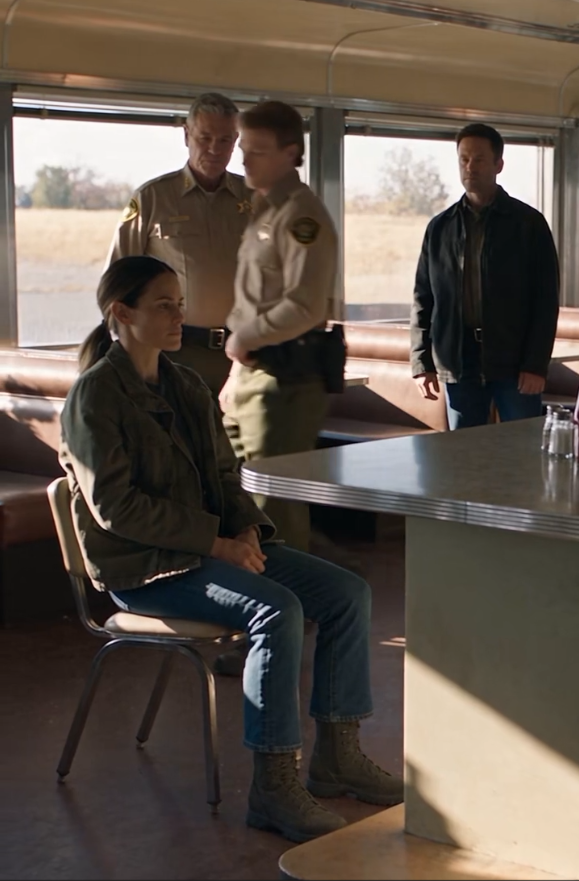
His posture changed.
“She's here.”
Miller turned toward him sharply.
Another pause.
“No, she hasn't been injured.”
Pause.
“Routine narcotics detention.”
Granger listened.
“No.”
His eyes moved toward the Pelican case sitting on a desk in the evidence-processing area.
“No, nothing like that.”
The voice on the other end continued.
Granger's expression became completely still.
He looked at the case again.
“Yes.”
Pause.
“I understand.”
He hung up.
Miller approached.
“What?”
Granger didn't answer.
“What?”
Granger lowered his voice.
“That case contains controlled federal equipment.”
Miller stared at him.
“So?”
“So we opened the exterior seal.”
“You said you didn't open the case.”
“The seal, Boyd.”
Miller's eyes narrowed.
“You told them?”
“They already knew.”
“How?”
“I don't know.”
That was only partly true.
I knew.
The Pelican case held a secure communications module assigned to me for post-operation contact. The case itself wasn't transmitting some magical distress signal, but its tamper seal carried an individually logged serial number. My leave paperwork identified the equipment in my custody.
Once Granger admitted they had taken possession of it while simultaneously claiming there had been no federal-equipment issue, the situation became more complicated than a small-town drug arrest.
Miller walked into the interview room.
“You set this up?”
I almost admired the question.
It implied a level of planning that would have required me to know he intended to plant narcotics in my truck before I entered Higgins Diner.
“No.”
“You drove in here looking for trouble?”
“No.”
“Then why does the Navy know where you are?”
“They knew where I was going.”
Miller stared.
“You said you didn't need a phone call.”
“I never said that.”
He thought back.
He was right.
I hadn't.
He'd assumed.
Granger entered.
“We need to process the release.”
Miller turned.
“She won't leave.”
“Then make her.”
I looked at Granger.
“You plan to physically remove me from a sheriff's office after telling the Navy I'm detained?”
He stopped.
Miller rubbed a hand over his face.
“Jesus Christ.”
Granger pointed at me.
“She's playing us.”
“No,” I said. “You're doing fine by yourselves.”
Miller slammed his palm against the doorframe.
“Enough.”
He looked at Granger.
“Fix it.”
Granger pulled him into the hallway.
This time they moved far enough away that I couldn't hear.
The young deputy stood at the booking counter.
His shoulders were rigid.
I watched him glance toward the evidence-processing desk.
Then toward the hallway.
Then at me.
He walked closer.
“You really Navy?”
“Yes.”
“What do you do?”
“I can't discuss it.”
His eyes dropped toward my wrists.
“What they said about the drugs…”
I waited.
He swallowed.
“I wasn't on the search.”
That was important.
“Who was?”
“Sheriff. Agent Granger. Deputy Hollis.”
The third deputy.
The one who had barely spoken in the diner.
“Did you see the drugs before they searched my Bronco?”
The deputy's eyes flicked toward the hallway.
“I shouldn't be talking to you.”
“Then stop.”
He didn't move.
I let the silence work.
Finally he said, “I saw Agent Granger carrying a blue duffel when they left the station.”
“When?”
“Before the call.”
“What call?”
“The anonymous tip.”
There it was.
Not proof.
But a crack.
“Does your station record dispatch traffic?”
“Yes.”
“Automatically?”
“Yes.”
“Can Sheriff Miller delete it?”
The young deputy looked uncomfortable.
“I don't know.”
That meant probably.
“Can you?”
“No.”
“Where is it stored?”
He stepped back.
“I said too much.”
“Then don't say anything else.”
He turned.
“Deputy.”
He stopped.
“You have a decision coming.”
His back stiffened.
“I don't need a speech.”
“I wasn't going to give one.”
He looked over his shoulder.
“Then what?”
“Just decide before someone else decides for you.”
He walked away.
At 7:48, the first outside law-enforcement vehicle arrived.
Not military.
Texas Department of Public Safety.
One state trooper.
Miller met him outside.
Granger stayed inside with me.
From the window in the booking area, I could see them speaking near the entrance.
The trooper gestured toward the impound lot.
Miller answered.
The trooper looked toward my Bronco.
Granger noticed me watching.
“You enjoying this?”
“No.”
“You think one phone call makes you untouchable?”
“No.”
He sat across from me again.
“You people always think your credentials are armor.”
“You people?”
“Special mission. Federal. Intelligence. Whatever the hell you are.”
He had guessed enough.
I said nothing.
He leaned closer.
“I've worked cases with operators before. You're not royalty.”
“I know.”
“You bleed like everybody else.”
“Yes.”
That answer seemed to bother him.
He wanted resistance.
I gave him agreement.
Granger pushed back from the table.
“You know what your problem is?”
I looked at him.
“You think because you've been somewhere dangerous, you understand men like us.”
“Men like you?”
“People who actually live with consequences.”
I almost laughed.
Instead I said, “Your evidence bag was used before.”
He froze.
Only for a fraction of a second.
But I saw it.
“The packet you showed me in the diner,” I continued. “There was residue from an old evidence seal.”
His eyes changed.
I had found the nerve.
“You don't know what you saw.”
“Maybe.”
“You didn't.”
“Then you shouldn't be worried.”
He stood.
“I am not worried.”
“You're standing.”
He stared at me.
Then he walked out.
That confirmed more than an admission would have.
The narcotics hadn't simply been purchased on the street for planting.
They had likely come from evidence.
Maybe from a prior seizure.
Maybe from DEA custody.
That explained Granger's role.
Miller could seize cars all day, but access to controlled substances created a problem.
A dirty federal agent solved it.
If I was right, the corruption scheme went beyond civil forfeiture abuse.
They were recycling evidence to manufacture new arrests.
Which meant every planted case created the materials for the next one.
A closed loop.
Efficient.
Until someone looked closely at the packaging.
At 8:03, the state trooper left.
Miller came inside furious.
“Who entered the Bronco into the state system?”
The young deputy looked up.
“I did.”
“I told you to remove it.”
“Agent Granger told me.”
“Same thing.”
“I couldn't.”
Miller stopped.
“What do you mean you couldn't?”
“Once DPS queried it, the record locked.”
Granger swore.
Miller pointed toward the computer.
“Show me.”
They moved to the desk.
I couldn't see the screen.
I didn't need to.
The infrastructure was doing what institutions sometimes did well when enough systems overlapped.
Creating records.
Records were harder to intimidate than people.
Granger turned from the computer.
“We move the vehicle.”
Miller stared at him.
“Where?”
“My storage site.”
“Now?”
“Yes.”
The young deputy looked between them.
Miller noticed.
“Go check cells.”
“We don't have anyone in cells.”
“Then check them anyway.”
The deputy left.
Granger lowered his voice.
“We get the Bronco off county property, separate the bag, wipe the booking footage, and cut her loose.”
Miller hissed, “You think that's going to fix this?”
“It buys time.”
“You said this was routine.”
“It was.”
“Until you picked a damn Navy officer.”
“You picked the vehicle.”
Miller's face changed.
That mattered.
Granger realized it too late.
From my chair, I said nothing.
Miller turned toward me.
“You hear that?”
I looked at him.
Granger stepped between us.
“She hears nothing.”
I didn't need them to say more.