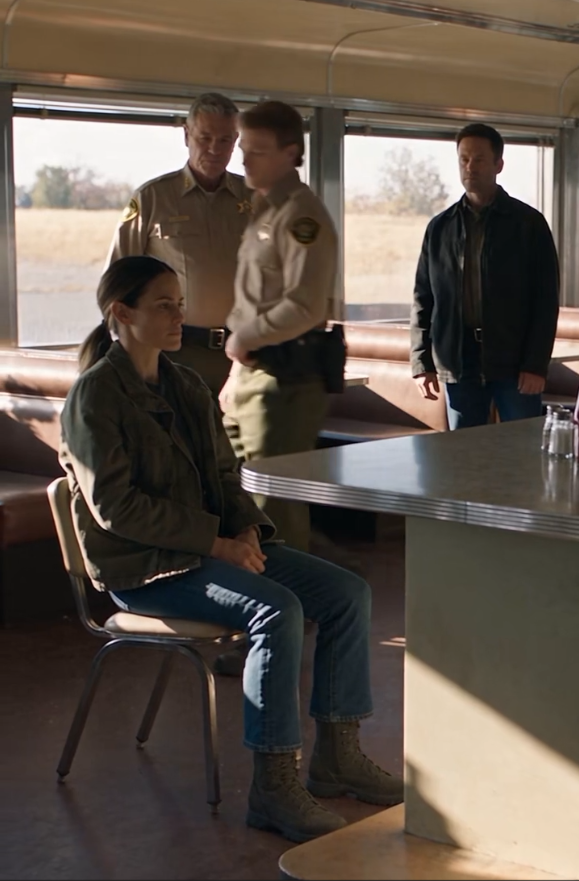
The sheriff selected targets.
Granger supplied drugs and federal cover.
The deputies performed stops and seizures.
The machine was visible now.
The only question was how much evidence remained.
At 8:12, the young deputy returned carrying a small black external hard drive.
Granger stared at it.
“What is that?”
“Backup.”
“For what?”
“Booking camera.”
Miller stood.
“I thought you shut it off.”
“I did,” Miller said.
The deputy shook his head.
“The wall switch kills the monitor feed. The recorder stays on.”
Nobody moved.
For the first time that evening, I saw genuine fear on Boyd Miller's face.
Not theatrical anger.
Not frustration.
Fear.
He turned toward the young deputy.
“You sure?”
“Yes, sir.”
Miller looked at the camera above the interview room.
Then at me.
I remembered the red light disappearing.
A monitor indicator.
Not necessarily the recorder.
The deputy had known the system better than his sheriff.
Granger held out his hand.
“Give me the drive.”
The deputy didn't.
“Now.”
The young man looked at Miller.
Miller said, “Do it.”
He still didn't move.
Granger stepped forward.
“Deputy.”
The young deputy tightened his grip on the drive.
“What are you going to do with it?”
Granger's voice became soft.
“You don't ask me that.”
“I am now.”
There it was.
The decision.
Not mine.
His.
Miller moved toward him.
“Hand it over.”
The deputy backed up.
“You told me we had probable cause.”
“We did.”
“You told me the tip came in before Agent Granger got here.”
“It did.”
“I was working dispatch.”
Miller stopped.
The young deputy's breathing had quickened.
“There wasn't a call.”
Granger's face went flat.
The deputy looked at me.
Then back at his sheriff.
“There wasn't any anonymous tip.”
Part IV — Reckoning
The room stayed still for three seconds.
Then everybody moved.
Miller lunged for the hard drive.
The deputy stepped backward.
Granger reached toward his jacket.
I rose as far as the cuff attached to the table allowed.
“Don't,” I said.
One word.
Granger looked at me.
So did the deputy.
“Keep your hands visible,” I told him.
Granger laughed once.
“You giving commands now?”
“Yes.”
His hand stopped near his jacket.
Not because he respected me.
Because the young deputy had moved his own hand near his holster.
The situation had changed from corruption to instability.
Those were different problems.
Miller saw it too.
“Everybody calm down.”
The deputy looked almost offended.
“You just tried to take the recording.”
“Because it's county property.”
“Then why delete it?”
“I didn't say delete.”
Granger said, “Kid, you're confused.”
“Don't call me kid.”
“Fine. Deputy. You are confused.”
“I saw the bag.”
Granger's eyes narrowed.
“What bag?”
“The blue duffel.”
Miller stepped forward.
“Listen to me.”
The deputy shook his head.
“No.”
That simple refusal hit Miller harder than shouting would have.
The sheriff's authority depended on the assumption that his orders ended arguments.
Now they didn't.
A phone rang.
Nobody answered.
It rang again.
Dispatch shouted from the front room.
“Sheriff! Federal call!”
Miller closed his eyes briefly.
Granger looked toward the rear exit.
I saw it.
So did the deputy.
“Don't,” I said again.
Granger glared at me.
“You really like that word.”
“It keeps coming up.”
The phone continued ringing.
Miller finally walked out.
The deputy still held the hard drive.
Granger looked at him.
“You know what happens if you hand that over?”
The deputy said nothing.
“Every arrest you've ever made gets questioned.”
“I've been here eight months.”
“You lose your career.”
“Maybe.”
“You think she cares?” Granger pointed at me. “She'll be gone tomorrow. Back to whatever classified hole she crawled out of. You're the one who lives here.”
That was the first smart thing Granger had said to him.
Because it was true.
The deputy had to live with whatever happened next.
I couldn't promise him protection.
I couldn't promise him a career.
I couldn't even promise that federal investigators would believe he had only recently understood what was happening.
So I didn't.
He looked at me.
“What happens if I give them this?”
“I don't know.”
He seemed startled.
“You don't know?”
“No.”
“Aren't you supposed to tell me everything'll be fine?”
“No.”
“What am I supposed to do?”
I looked at the drive.
“Tell the truth.”
Granger scoffed.
“That simple?”
“No,” I said. “Just necessary.”
Miller returned.
His face had gone pale.
“They're coming.”
Granger stared.
“Who?”
“Federal investigators.”
“Which agency?”
“Several.”
“How long?”
Miller looked at the clock.
“Maybe thirty minutes.”
Granger's jaw tightened.
“Then we have thirty minutes.”
“For what?”
“To fix this.”
Miller stared at him as if seeing him clearly for the first time.
“There is no fixing this.”
“Don't get weak now.”
“We've got Navy calling, DPS records, camera footage—”
“Camera footage we can remove.”
The young deputy raised the hard drive slightly.
Granger looked at him.
Miller did too.
Then Miller made his final mistake.
“Give it to him.”
The deputy's face emptied.
Not fear.
Not anger.
Something quieter.
Disappointment.
He had still been hoping, somewhere deep down, that the sheriff might choose differently.
Now he knew.
“No.”
Miller's voice hardened.
“That's a direct order.”
“No, sir.”
“Then you're suspended.”
The deputy removed his badge.
For one second I thought he was surrendering it.
Instead he placed it on the booking counter.
“Fine.”
Granger moved.
Fast.
He grabbed for the hard drive.
The deputy twisted away.
The drive hit the floor.
Granger shoved him against the counter.
The young deputy reached for Granger's wrist.
Miller yelled.
I pulled against the table restraint.
The metal ring held.
Granger struck the deputy once across the face.
Not a wild punch.
A short, controlled blow.
The deputy stumbled.
Granger reached toward the floor for the drive.
“Reese!”
The deputy's voice.
I looked down.
His key ring had skidded beneath the table.
Close.
Not close enough.
I dropped to one knee, stretched my cuffed arm, and hooked the ring with two fingers.
Granger saw me.
He kicked the hard drive toward the hallway and reached inside his jacket.
This time he wasn't bluffing.
The deputy saw it too.
“Federal agent! Don't!”
Granger drew his pistol.
The room compressed.
People imagine moments like that feel fast.
They don't.
Training does something strange to time.
The more familiar the problem, the less space panic occupies.
I got the key into the cuff.
Turned.
The bracelet opened.
Granger's pistol cleared his jacket.
I moved before the muzzle stabilized.
Two steps.
Left hand to his weapon wrist.
Right forearm across his elbow.
Turn.
Drive.
His balance broke.
The pistol pointed toward the floor.
He tried to recover.
I rotated his wrist until his fingers opened.
The weapon dropped.
I kicked it away.
Granger came at me with his free hand.
I redirected him past my shoulder and put him chest-first against the booking counter.
No flourish.
No dramatic exchange.
Three seconds of work.
I pinned his wrist between his shoulder blades.
He cursed.
“Don't move.”
Miller stood six feet away.
His hand hovered near his holster.
I looked at him.
“Sheriff.”
He froze.
The young deputy recovered Granger's pistol.
Then his own.
He stepped back and aimed neither directly at me.
Good judgment.
Miller slowly raised both hands away from his weapon.