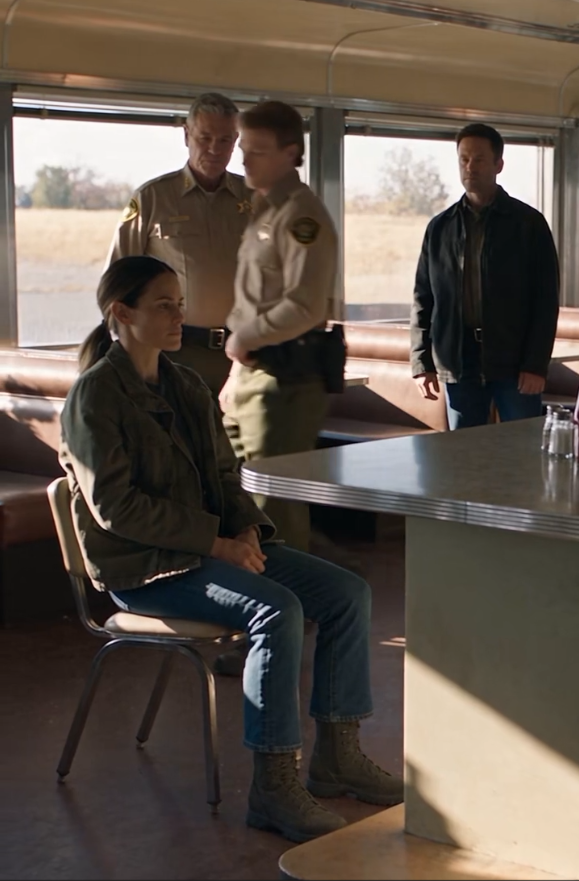
“Everybody calm down.”
The sentence almost made me laugh.
Outside, tires crunched over gravel.
More than one vehicle.
Too soon for the federal team Miller expected in thirty minutes.
Headlights swept across the front windows.
The state trooper had returned.
Behind him were two unmarked SUVs.
Granger stopped struggling.
The young deputy breathed out.
Miller looked toward the entrance.
I released Granger only when the deputy had him covered.
Then I stepped back.
My wrists were red.
My fingers tingled.
The booking room looked ordinary.
Cheap tile.
Fluorescent lights.
Coffee machine.
A plastic chair knocked onto its side.
Nothing about it looked like the center of a conspiracy.
That was usually the way.
The front door opened.
Two federal investigators entered with the state trooper.
Behind them came a Navy commander I recognized immediately.
Commander Daniel Mercer.
My operations officer.
He stopped when he saw me.
Then his gaze moved to Granger.
Then to the pistol on the floor.
Then to the cuffs hanging from one of my wrists.
Mercer had a talent for saying a great deal with very little.
“Alice.”
“Sir.”
“You missed check-in.”
“I noticed.”
His expression didn't change.
“You look terrible.”
“Thank you.”
One of the federal investigators stepped forward.
“Lieutenant Commander Reese?”
“Yes.”
“Are you injured?”
“No.”
Granger straightened his shirt.
“This is a misunderstanding.”
The investigator looked at him.
“Agent Granger?”
“Yes.”
“Step away from the counter.”
“I am a federal agent.”
“We're aware.”
“I need to speak with my field office.”
“You'll have that opportunity.”
Granger glanced at Miller.
The sheriff said nothing.
The second investigator noticed the hard drive on the floor.
“What is that?”
The young deputy bent and picked it up.
“Booking video backup.”
Miller opened his mouth.
The deputy continued before he could speak.
“It contains the interview after she requested counsel. Sheriff Miller believed the camera was off.”
The investigator looked at Miller.
Miller's face went gray.
Granger interrupted.
“That officer is disgruntled. He was just suspended.”
The young deputy placed the drive on the counter.
“I was suspended about three minutes ago.”
The investigator looked at the badge beside it.
Then at Granger.
“Who searched the Bronco?”
Granger crossed his arms.
“I did.”
“Who found the narcotics?”
“I did.”
“Where are they now?”
“Evidence.”
“Show us.”
Nobody moved.
The investigator looked at Miller.
“Sheriff?”
Miller stared at Granger.
Then something finally broke.
Not conscience.
Self-preservation.
He pointed toward the evidence room.
“Back there.”
Granger turned.
“Boyd.”
Miller wouldn't look at him.
The investigator said, “Nobody touches anything.”
They secured the room.
Then they secured us.
Technically, I was still a detainee until the situation was sorted out.
I understood.
Mercer did too.
He gave me a look that said don't make this harder.
I sat.
The young deputy sat across the room with an ice pack against his cheek.
Miller sat near the booking counter.
Granger remained standing until someone told him to sit.
For the next forty minutes, investigators photographed everything.
The Pelican case.
My property bag.
The forfeiture paperwork.
The interview room.
The camera system.
The blue duffel.
The packets.
Then one investigator picked up the bag Granger had shown me inside the diner.
He turned it beneath the light.
His thumb stopped over the adhesive residue.
“What's this?”
Granger didn't answer.
The investigator looked closer.
There were three visible characters beneath the torn tape.
A case code.
He photographed it.
Then he called someone.
Ten minutes later, his expression changed.
He walked back into the booking room.
“Agent Granger.”
Granger looked up.
The investigator held the bag.
“This packaging belongs to DEA evidence file 24-7716.”
Silence.
Granger's face became unreadable.
The investigator continued.
“That file was a narcotics seizure processed eleven months ago.”
Miller stared at him.
“What?”
Granger said nothing.
The investigator looked at the sheriff.
“The evidence was logged for destruction six weeks ago.”
Miller stood.
“You told me you got it from—”
Granger turned sharply.
“Sit down.”
Miller actually did.
Habit.
Even now.
The investigator's gaze moved between them.
“How did narcotics scheduled for destruction in a federal case end up inside Lieutenant Commander Reese's vehicle?”
Nobody answered.
He waited.
Silence had changed sides.
Part V — The Final Confrontation
By 10:14 p.m., the sheriff's office parking lot was full.
State investigators.
Federal investigators.
A DEA internal-affairs team driving in from a regional office.
Navy personnel.
The county prosecutor, who looked like he wished he had chosen a different career.
I had finally been uncuffed.
My phone was returned temporarily so I could contact counsel.
Mercer sat beside me in an unused office.
He closed the door.
“You couldn't take a quiet vacation.”
“I tried.”
“You always say that.”
I flexed my hands.
Sensation had returned to my fingers.
Mercer looked at the marks around my wrists.
“You sure you're okay?”
“Yes.”
“You're terrible at that answer.”
“Still accurate.”
He leaned back.
“What happened?”
I gave him the short version.
Diner.
Plant.
Arrest.
Forfeiture form.
Military ID.
Attempted release.
Booking footage.
Granger's evidence packaging.
Mercer listened without interrupting.
When I finished, he looked through the small office window toward Miller and Granger.
“You could've walked out.”
“Yes.”
“Why didn't you?”
“Because they wanted me to.”
He nodded.
That was enough explanation for him.
A knock sounded.
One of the federal investigators stepped inside.
“Commander. Lieutenant Commander.”
He looked exhausted already.
“Preliminary search of the station turned up twenty-three closed forfeiture files with almost identical paperwork.”
“How many out-of-state drivers?” I asked.
“Twenty-one.”
“Vehicles?”
“Nineteen seized.”
“Charges?”
“Most reduced after property transfer.”
“And the others?”
“Two prison sentences. Four probation agreements. Some cases were dismissed.”
He paused.
“We also found destruction records tied to Granger.”
Mercer looked at him.
“How bad?”
The investigator exhaled.
“Potentially very bad.”
He closed the door behind him.
“Granger was assigned as a liaison on several regional narcotics cases. He had access to evidence awaiting certified destruction. Quantities don't match final disposal records.”
“The planted drugs came from those seizures,” I said.
“We believe so.”
The investigator continued.
“Miller appears to have identified targets through traffic stops, diners, gas stations, motels. Out-of-state vehicles. Drivers alone. People unlikely to return for lengthy court proceedings.”
“Civil forfeiture.”
“Yes.”
“Granger supplied narcotics.”
“That's the working theory.”
Mercer crossed his arms.
“How long?”
“At least three years.”
I thought of the cars behind the fence.
Eleven I'd counted.
There would be more elsewhere.
“What about Deputy Hollis?”
“Being interviewed.”
“The young deputy?”
“Cooperating.”
I nodded.
The investigator hesitated.
“There's one issue.”
There always was.
“What?”
“Granger claims you asNextlted him.”
Mercer gave me a tired look.
I ignored it.
“There are cameras.”
“Yes.”
“The booking recording should show him drawing.”
“It does.”
“Then what's the issue?”
“He's also claiming the entire arrest was legitimate and any irregularities were Miller's responsibility.”
I looked through the window.
Granger sat alone at a desk with two investigators nearby.
His posture had changed.
No swagger.
No toothpick.
But he was thinking.
Trying to separate himself from the sheriff.
“He'll blame the local department,” I said.
“That appears to be the strategy.”
“Then show Miller.”
The investigator paused.
“Show him what?”
“The federal evidence code.”
Mercer understood first.
“You want them turning on each other.”
“No.”
I looked at the investigator.