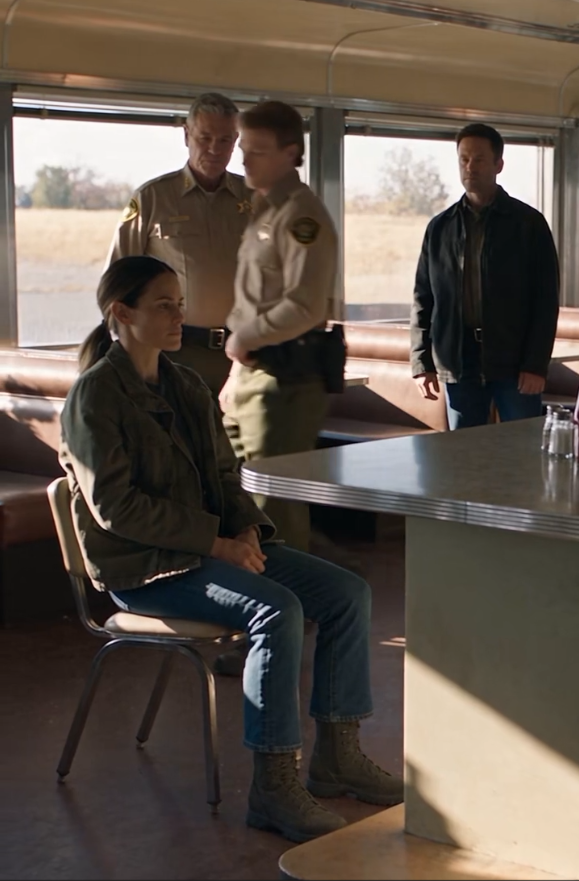
“I want Miller to understand Granger can prove the drugs came from federal evidence, which means Granger can claim Miller stole them after transfer unless the chain proves otherwise.”
The investigator considered it.
“You think Miller has records.”
“I think men like Miller keep records when they don't trust men like Granger.”
“That's speculative.”
“Yes.”
Mercer smiled faintly.
“But?”
“But Miller selected the targets. Granger controlled the narcotics. Neither could trust the other completely. If money was divided, there will be accounting.”
The investigator left without promising anything.
Twenty minutes later, Sheriff Miller asked for a lawyer.
Then he asked to speak with investigators before the lawyer arrived.
That contradiction told me I was right.
At 10:52, they found the ledger.
Not on paper.
On Miller's personal laptop.
A password-protected spreadsheet hidden beneath tax records.
Vehicle descriptions.
Plate states.
Estimated resale values.
Cash seized.
Property transferred.
Case numbers.
Initials.
B.M.
T.G.
H.
Numbers beside each.
Shares.
There were forty-seven entries.
Not twenty-three.
Forty-seven.
The investigator came back carrying a printed copy.
He placed it on the desk in front of me.
I looked at the first page.
Dates stretched back thirty-four months.
One column contained notes.
Solo driver.
Transient.
No local.
Cash.
Military?
I stopped.
One entry from eight months earlier had that last note.
Military?
Outcome: declined.
They had considered a service member before.
Apparently decided against it.
Today they hadn't checked first.
Mercer read over my shoulder.
“What's this?”
“I don't know.”
The investigator said, “There's more.”
He turned to the final page.
Today's date was already entered.
My Bronco.
Colorado.
Female solo.
Vehicle value estimate.
Cash unknown.
Beside the initials column:
B.M. / T.G.
And in the notes field:
DINER. EASY.
I stared at that word.
Easy.
Not dangerous.
Not suspicious.
Not armed.
Not criminal.
Easy.
They had reduced me to an asset before they ever walked through the diner door.
The investigator said, “Miller claims Granger chose you.”
I looked at the sheet.
“He did.”
“But earlier we heard Granger say Miller picked the vehicle.”
“They both did.”
The investigator waited.
I tapped the note.
“Miller identified the Bronco. Granger approved the target.”
“How can you know that?”
“Because Miller's system needs federal protection. Granger's system needs local authority. Neither acts alone.”
Mercer looked at me.
“Forty-seven.”
I nodded.
That was no longer a bad sheriff and a corrupt federal agent improvising crimes.
It was an institution.
Small.
Crude.
But systematic.
The final confrontation came just before midnight.
Not in a gunfight.
Not in the parking lot.
Not with sirens.
It happened in the same interview room where Miller had switched off the camera and told me nobody would believe an outsider.
The federal team asked me to sit in on one portion of his statement because Miller had requested it.
I almost declined.
Then I went in.
He looked smaller without his badge.
His uniform shirt was open at the collar.
His belt and weapon were gone.
A lawyer sat beside him now.
Two investigators sat opposite.
I took the chair against the wall.
Miller looked at me.
For several seconds, he said nothing.
Then, “You happy?”
His lawyer turned toward him.
“Sheriff—”
“Former sheriff,” one investigator corrected.
Miller laughed bitterly.
“Already?”
Nobody answered.
He looked at me again.
“You could've left.”
“Yes.”
“I gave you the door.”
“You gave me an escape route for you.”
His jaw tightened.
“You think you're better than everybody in this town.”
“No.”
“Come in here with your secret-squirrel military job and your Colorado plates and look down on us.”
“I stopped for pie.”
That silenced him.
Not because it was clever.
Because it was true.
I hadn't come to expose him.
I hadn't known his name.
He had chosen me because my Bronco looked profitable.
Miller stared at the table.
“Granger said nobody would ever look twice.”
His lawyer closed his eyes.
The investigator leaned forward.
“Look twice at what?”
Miller realized he'd started.
There was no clean way to stop.
He looked at his attorney.
The attorney spoke quietly.
“If you're going to cooperate, cooperate fully.”
Miller rubbed both hands over his face.
Then he began.
The first seizure had been accidental.
At least according to him.
A traffic stop.
Small amount of legitimate narcotics.
Driver had twelve thousand dollars in cash from selling a trailer.
County seized the truck and money.
Driver hired a lawyer.
Charges were reduced.
County kept part of the assets.
Miller noticed how much easier that money was than requesting budget increases.
Then came another.
And another.
Eventually legitimate seizures weren't enough.
Granger supplied evidence from federal destruction lots.
Miller supplied targets.
Some drivers fought.
Those cases were dismissed quietly.
Most didn't.
Most signed.
Most went home.
“Why the diner?” the investigator asked.
“Easy to see who was passing through.”
“And Higgins?”
Miller glanced toward me.
“Waitress would call sometimes.”
My head lifted.
That was new.
“She participated?”
Miller shook his head.
“No. Not like that.”
“How?”
“She'd call if somebody left drunk. That's all. Traffic safety. We watched anyway.”
The waitress hadn't betrayed me.
Good.
The investigator returned to the ledger.
“What does H stand for?”
Miller hesitated.
His lawyer spoke softly.
“Answer.”
“Hollis.”
The third deputy.
“What was his role?”
“Searches. Impound.”
“Did the young deputy participate?”
“No.”
“Why not?”
“He was new.”
Miller looked toward me.
“Didn't trust him yet.”
The young deputy's nervousness made sense now.
He hadn't been nervous because he knew.
He'd been nervous because pieces had never quite fit.
Granger had assumed silence meant obedience.
Miller had assumed youth meant control.
They had mistaken uncertainty for loyalty.
The investigator continued.
“Who planted the narcotics in Reese's vehicle?”
Miller closed his eyes.
“Granger.”
“Did you see him do it?”
“Yes.”
“Did Deputy Hollis?”
“Yes.”
“Did you authorize it?”
Miller looked directly at me.
For the first time all night, there was no performance in his face.
“Yes.”
My anger arrived quietly.
Not when they cuffed me.
Not when they threatened me.
Not when Granger drew his weapon.
Now.
Because the answer was so ordinary.
Yes.
No ideology.
No desperation.
No elaborate justification.
They had ruined lives because it worked.
The investigator placed another document on the table.
“Two defendants from your earlier cases are still incarcerated.”
Miller looked down.
“One.”
“Two.”
“One had unrelated—”
“Two people are incarcerated on cases involving evidence linked to Granger's destruction files.”
Miller's face changed.
He hadn't known.
Or had convinced himself he didn't.
The investigator said, “One has been inside twenty-two months.”
Miller stared at the document.
His lawyer whispered something.
I didn't hear.
I didn't need to.
That was the real weight of what he'd built.
Not my wrists.
Not my Bronco.
Twenty-two months stolen from a human life.
Miller looked at me.
“I never meant—”
I stood.
“No.”
The room stopped.
His lawyer looked up.
I continued.
“Don't tell me what you meant.”
Miller swallowed.
I kept my voice quiet.
“You chose people because you thought they couldn't fight back. Whether you meant the rest stopped mattering the first time you learned an innocent person was paying for your system and you kept using it.”
He looked away.
I moved toward the door.
Behind me, he said, “What happens to me now?”